Dance Moves: Names, Types, Steps and Definitions
Dance moves are the building blocks of dance. They include steps, gestures, turns, jumps, isolations, rhythms, and full-body actions that dancers use to respond to music, communicate ideas, and create a particular style. Some movements are simple enough for complete beginners, while others require years of training, coordination, strength, balance, and musical awareness.
A dance move can be as simple as a Step Touch or as recognizable as the Moonwalk, Running Man, Grapevine, or Body Roll. Every form of dance develops its own movement vocabulary, from hip-hop and jazz to ballet, ballroom, salsa, and contemporary dance.
This guide explains what dance moves are, the names and definitions of common movements, different types of dance steps, beginner-friendly moves, movement techniques, and practical ways to learn choreography more effectively.
Table of Contents:
- What Are Dance Moves?
- Dance Movement Names and Definitions
- Basic Dance Moves for Beginners
- Different Types of Dance Moves
- Dance Steps vs. Dance Moves: What’s the Difference?
- Techniques of Dance: How to Improve Your Movement
- Popular Dance Moves Across Styles
- How to Learn Dance Moves Faster
- FAQ About Dance Moves
What Are Dance Moves?
Dance moves are intentional body actions used in choreography, social dancing, improvisation, or performance. A movement may involve only one part of the body—such as an arm gesture or shoulder isolation—or combine the feet, hips, torso, head, and arms into a coordinated action.
Some movements follow a recognizable pattern. A Grapevine, for example, uses a repeated sequence of sideways and crossing steps. Others describe a quality or technique rather than a fixed sequence: a wave travels through connected joints, while a freeze emphasizes a sudden stop or held position.
The term dance movement can have a broader meaning than the name of one step. It may describe how a dancer travels through space, transfers weight, changes levels, responds to rhythm, or uses energy and dynamics. In other words, movement in dance includes both the vocabulary a dancer learns and the way that vocabulary is performed.
Dance movements help dancers:
- Follow and interpret musical rhythm.
- Build choreography and movement phrases.
- Travel through space and change direction.
- Express emotion, character, or intention.
- Develop coordination, balance, and body control.
- Communicate with partners or other performers.
- Develop an individual movement style.
Understanding a few basic dance moves also makes classes easier to follow because teachers frequently build longer combinations from smaller steps and actions that appear repeatedly across different styles.
Dance Movement Names and Definitions
Learning the names of dance moves helps beginners recognize instructions and understand how different movements work. However, terminology is not completely universal: the same name can describe slightly different actions in different dance traditions, and some terms refer to an entire technique or style rather than one isolated step.
Step Touch
A Step Touch is one of the simplest beginner dance steps. The dancer steps to one side and brings the opposite foot in to touch beside the supporting foot, usually without transferring full weight onto the touching foot. It is common in warm-ups, fitness dance, pop choreography, and beginner routines.
Grapevine
The Grapevine is a traveling pattern that moves sideways. A common version uses a side step, a crossing step behind, another side step, and a final touch or closing step. Variations can cross in front instead and appear in jazz, line dancing, fitness routines, and social dance.
Box Step
A Box Step creates a box-like pathway on the floor through forward, side, backward, and closing actions. Variations appear in ballroom dances such as waltz and rumba. It is useful for learning weight transfer, direction, and timing.
Ball Change
A Ball Change is a quick transfer of weight, usually from the ball of one foot onto the other foot. It is widely used in jazz, tap, musical theater, and commercial choreography and often connects one movement to the next.
Kick Ball Change
A Kick Ball Change combines a small kick with two quick weight transfers. After kicking, the dancer steps onto the ball of that foot and then shifts weight to the opposite foot. The movement is common in jazz and commercial dance combinations.
Body Roll
A Body Roll is a fluid sequential movement through the torso. Depending on the technique, the motion may travel from the chest through the ribs and hips or move in the opposite direction. Body rolls appear in commercial dance, hip-hop-influenced choreography, jazz funk, Latin dance, and other styles.
Body Wave
A Body Wave creates the visual effect of a wave traveling through connected parts of the body. The head, chest, ribs, hips, and knees may participate in sequence. The term overlaps with Body Roll in some teaching environments, so the distinction can depend on the style and instructor.
Moonwalk
The Moonwalk is a backward gliding movement that creates the illusion that the dancer is trying to walk forward while sliding in the opposite direction. Michael Jackson made it internationally famous, although gliding techniques existed in dance before his performances popularized the name.
Running Man
The Running Man creates the appearance of running while remaining largely in place. It combines alternating knee lifts with backward sliding or stepping actions and became especially recognizable through late twentieth-century hip-hop and club dance culture.
Two Step
The term Two Step has different meanings across dance traditions. In basic social or club dancing, it often refers informally to an easy side-to-side groove in which the dancer shifts weight from one foot to the other. This should not be confused with specific named dances that also use “two-step” in their titles.
Chassé
A Chassé is a traveling action in which one foot appears to “chase” the other. Variations are used in ballet, jazz, ballroom, and stage dance, although technique and timing differ between styles.
Pirouette
A Pirouette is a turn performed on one supporting leg and is most strongly associated with ballet technique. Successful pirouettes depend on alignment, balance, core control, preparation, and spotting.
Jazz Square
A Jazz Square is a four-step pattern commonly used in jazz dance and musical theater. A typical version crosses one foot over the other, steps backward, moves to the side, and then steps forward to complete the square-like pathway.
Shuffle
Shuffle can describe different foot actions depending on the dance style. In tap, a shuffle is a specific brushing action of the foot. In shuffle dance, the term refers more broadly to a style with its own sliding, running, and heel-toe vocabulary. The techniques should not be treated as identical simply because they share the same name.
Heel-Toe
Heel-Toe footwork alternates or pivots through the heels and toes to create rhythmic directional changes or sliding effects. Variations appear in hip-hop, shuffle dance, country dance, and other social or street styles.
Charleston
The Charleston is both a historical dance and a recognizable movement vocabulary associated with the 1920s. Its characteristic actions include swinging or kicking legs, twisting feet, and energetic rhythmic changes. Charleston vocabulary remains influential in swing and vintage jazz dancing.
Twist
The Twist uses rotational movement through the feet, knees, and hips while the dancer generally remains in place. It became internationally popular as a social dance in the early 1960s and has since become a familiar movement in party and popular dance.
Floss
The Floss is a repeating movement in which the arms swing around the hips while the pelvis shifts in the opposite direction. Its widespread popularity came through internet culture, gaming, and youth dance trends.
Dougie
The Dougie is a groove-based hip-hop dance associated with relaxed body movement, shifting weight, shoulder action, and personal styling. Rather than one rigid sequence, dancers commonly personalize the groove.
Robot
The Robot is a movement concept that imitates mechanical motion through controlled isolations, fixed angles, sharp stops, and deliberately non-human movement qualities. The illusion depends more on control and timing than on speed.
Popping
Popping is a funk dance style and technique rather than one single dance move. One of its defining techniques is the rapid contraction and relaxation of muscles to create a visible “hit” or pop. Popping also includes a much broader vocabulary of movement concepts and illusions.
Locking
Locking is also a funk dance style with its own movement vocabulary, not simply one isolated move. It is characterized by energetic movement interrupted by distinctive held positions or “locks,” often combined with expressive gestures, rhythm, and interaction with the audience.
Wave
A Wave creates the illusion that energy travels smoothly through a sequence of joints. An arm wave may pass from the fingers through the wrist, elbow, shoulder, and across the upper body, while larger variations can travel through the entire body.
Head Roll
A Head Roll is a controlled circular or semicircular action involving the head and upper body. The movement should be performed within a comfortable range rather than forcing the neck into an extreme position.
Shoulder Shimmy
A Shoulder Shimmy alternates the shoulders rapidly to create a shaking or vibrating effect through the upper body. Variations appear in jazz, Latin dance, belly dance, and social dance traditions.
Pas de Bourrée
Pas de Bourrée refers to a family of three-step patterns found in ballet and adapted into jazz and other dance forms. The exact foot positions and technique vary by style, but the pattern is often used to travel or transition between movements.
Fan Kick
A Fan Kick is a large circular leg action in which the working leg sweeps through an arc. It appears frequently in jazz, musical theater, dance teams, and performance choreography and requires flexibility as well as control through the supporting side of the body.
Lunge
A Lunge shifts weight deeply into one bent leg while the other leg extends. Dancers use lunges to change level, create strong lines, redirect movement, or prepare for another action.
Spin
A Spin is a rotation of the body around an axis. Spins can be performed on one foot, both feet, another body part, or the floor depending on the dance tradition. Technique varies considerably between ballet, ballroom, street, and social dance.
Freeze
A Freeze is a deliberately held position that interrupts motion. Freezes are especially important in breaking, where dancers may support the body in difficult or visually striking positions, but the general idea of stopping movement for emphasis also appears in other styles.
Basic Dance Moves for Beginners
Beginners do not need complicated choreography to start dancing. The most useful basic dance moves are movements that teach rhythm, weight transfer, coordination, direction, and confidence before adding greater speed or technical difficulty.
Step Touch, a basic side-to-side Two Step, Grapevine, Box Step, Body Roll, Jazz Square, simple turns, Heel-Toe variations, and easy arm patterns are useful starting points. They expose beginners to different movement ideas without requiring advanced flexibility or athletic ability.
A beginner should focus first on three foundations:
- Hear the rhythm. Many pop, jazz, hip-hop, and commercial dance combinations are commonly taught in eight-counts. Counting can help organize choreography, but not every dance form or musical tradition uses the same phrasing.
- Transfer weight clearly. Most steps require the dancer to know which foot supports the body. Unclear weight transfer can make the next movement difficult or cause loss of balance.
- Stay controlled without becoming rigid. Relaxing unnecessary tension makes it easier to coordinate the upper and lower body while still maintaining posture and balance.
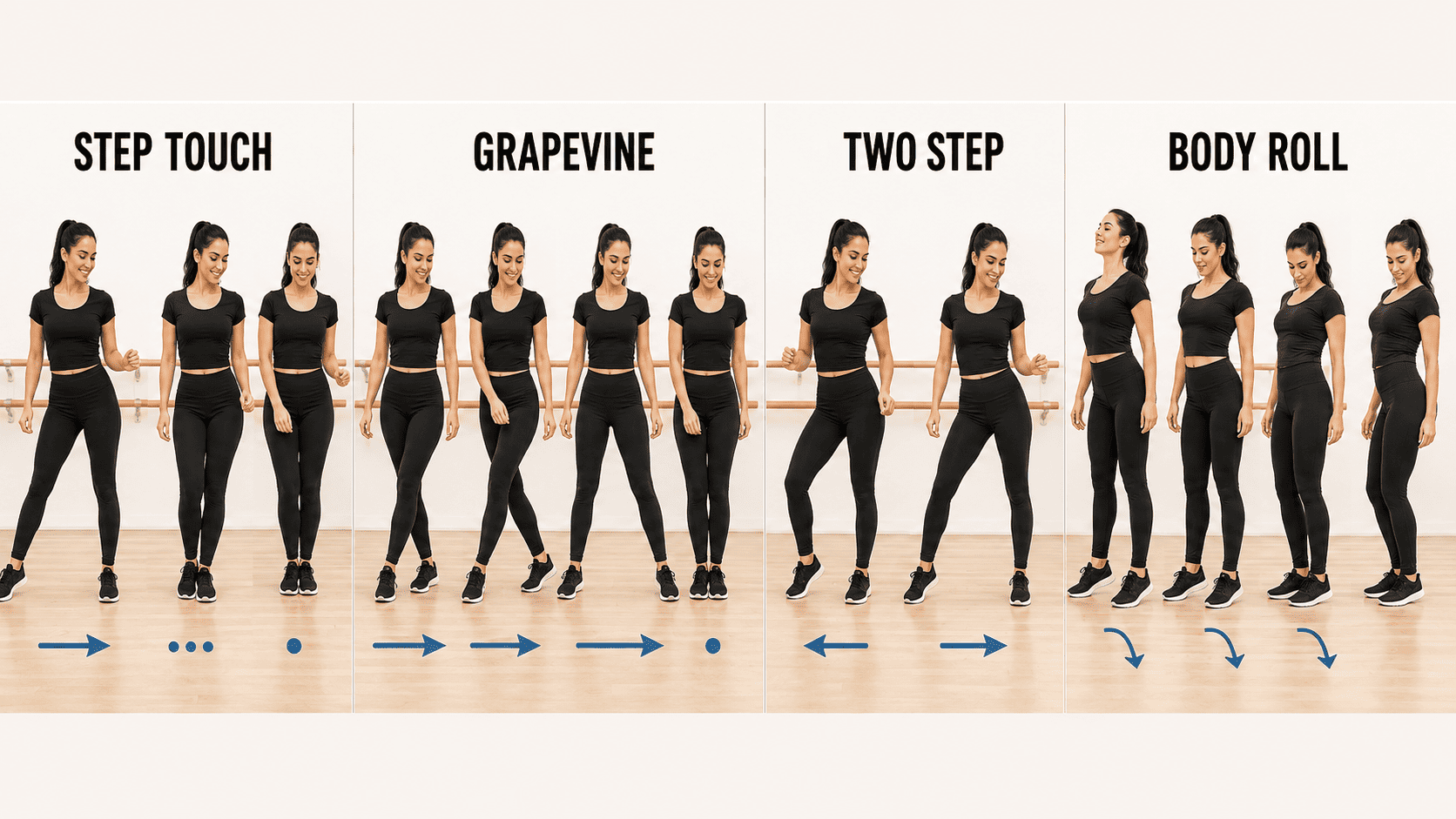
A simple beginner combination could use a Step Touch right and left, a Grapevine in each direction, a side-to-side Two Step, and a Body Roll. The purpose is not to memorize as many moves as possible, but to practice connecting familiar actions while staying on rhythm.
Different Types of Dance Moves
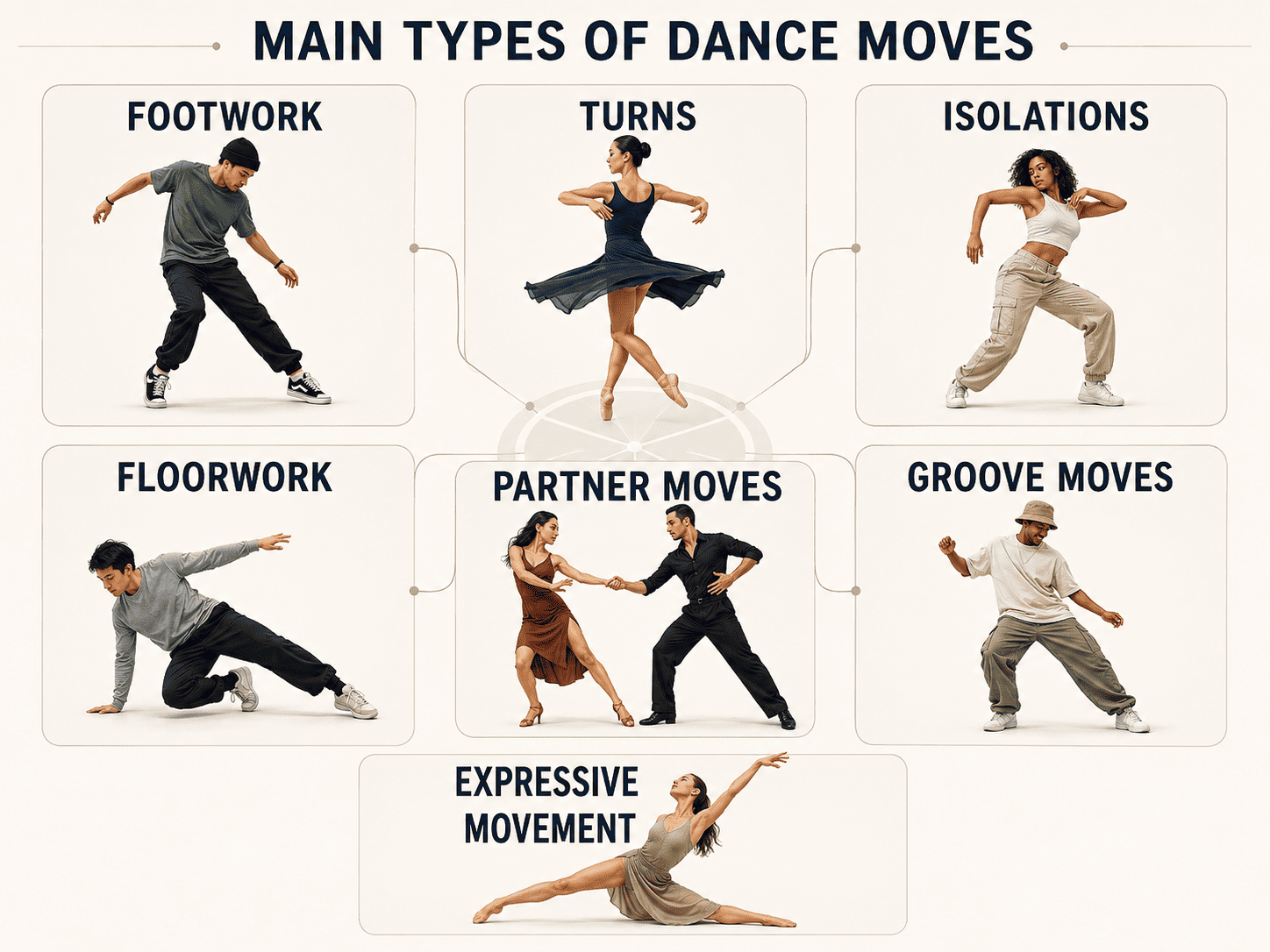
There is no single universal system for classifying every dance movement. A useful approach is to group movements by their main function: how the feet create rhythm, whether the body travels or rotates, which body parts are isolated, how the dancer interacts with the floor or another person, and what quality of energy the movement creates.
Footwork Moves
Footwork emphasizes patterns created primarily through steps and weight changes. Examples include Grapevine, Ball Change, Pas de Bourrée, Heel-Toe variations, Running Man, and different shuffle actions. Footwork can create rhythm, travel, direction changes, or intricate patterns underneath relatively simple upper-body movement.
Turns and Spins
Turns rotate the body around an axis. Pirouettes, chainé turns, inside and outside partner turns, pivots, and spins belong to this broad category. Depending on the style, successful turning may require spotting, core stability, controlled weight placement, or connection with a partner.
Body Isolation Moves
Isolations create the impression that one area of the body moves independently from the rest. Shoulder, rib cage, chest, head, and hip isolations appear in many forms of jazz, hip-hop, Latin, commercial, and contemporary dance.
Floor Moves
Floorwork uses contact with the ground as an active part of the movement rather than treating the floor only as a surface for the feet. Rolls, slides, downrock, floor transitions, knee work, and some freezes fall into this category. Breaking and contemporary dance use floorwork in particularly different ways.
Partner Dance Moves
Partner movements depend on physical or visual communication between two dancers. Turns, cross-body leads, promenades, rotations, dips, and many ballroom figures require timing, spatial awareness, and some form of lead-follow or coordinated movement relationship.
Groove Moves
Groove-based movement emphasizes pulse, bounce, weight, timing, and personal style. A side-to-side Two Step, Dougie, body groove, or simple hip-hop bounce can look uncomplicated technically but depends heavily on rhythmic quality and relaxed control.
Expressive Dance Movements
Expressive movements are shaped primarily by intention, dynamics, and emotional quality rather than by one fixed step pattern. Reaches, contractions, suspensions, falls, rises, gestures, and sustained transitions are common in contemporary, modern, and lyrical choreography.
Dance Steps vs. Dance Moves: What’s the Difference?
Dance steps and dance moves are closely related terms, and there is no universal distinction that applies to every dance tradition. Teachers, dancers, and choreographers may use step, move, movement, figure, or pattern differently depending on the style.
In everyday beginner instruction, a dance step often refers primarily to foot placement and weight transfer. Step Touch, Grapevine, Ball Change, and Box Step are good examples because their identities are strongly connected to what the feet are doing.
A dance move is often used more broadly for a recognizable action involving part or all of the body. Body Roll, Robot, Wave, Freeze, and Moonwalk are commonly described as moves even though their defining characteristics extend beyond ordinary foot placement.
This distinction is practical rather than absolute. A movement called a “step” in one genre may be called a “move,” “figure,” or “pattern” somewhere else. The important point for beginners is to understand both the footwork and the complete body action rather than become overly concerned with terminology.
Different types of dance steps also depend on genre. Ballroom, jazz, hip-hop, ballet, and social dances all organize movement differently. For more background on partner-dance vocabulary and development, see our guide to the history of ballroom dancing.
Techniques of Dance: How to Improve Your Movement
Learning the names of dance moves is only one part of dancing well. Technique determines how efficiently, safely, rhythmically, and clearly a movement is performed. Although technique varies greatly between genres, several abilities support dancers across many styles.
Posture
Posture organizes the body for movement. Rather than forcing one rigid position, dancers learn the alignment appropriate to their style while avoiding unnecessary tension. Core support, head placement, and relaxed shoulders can make movement more controlled and efficient.
Balance
Balance allows dancers to control weight over a supporting base. It becomes especially important during turns, kicks, lunges, directional changes, and single-leg movements. Slow weight-transfer exercises can reveal balance problems that are hidden when choreography is performed quickly.
Coordination
Coordination is the ability to organize several actions at once. A choreography may require the legs to follow one rhythm while the arms perform another pattern and the head changes focus. Breaking complex combinations into smaller layers makes coordination easier to develop.
Musicality
Musicality connects movement to sound. It includes recognizing rhythm, phrasing, accents, pauses, dynamics, instrumentation, and changes in energy. Two dancers can perform identical steps yet create very different results depending on how they interpret the music.
Isolation
Isolation develops control over individual body areas. Practicing the shoulders, rib cage, hips, or head separately can improve body awareness and make more complex movements cleaner.
Dynamics
Dynamics describe the quality with which movement is performed. An action can be sharp or sustained, heavy or light, sudden or gradual, restrained or expansive. Changing dynamics gives choreography contrast and prevents technically correct movements from looking mechanically identical.
Improvement therefore depends on movement quality as much as vocabulary. A simple Step Touch performed with clear rhythm, weight transfer, posture, and intention can look more convincing than a technically difficult action performed without control.
Popular Dance Moves Across Styles
Some dance moves become widely recognizable because they appear in concerts, films, clubs, social dances, music videos, competitions, or online trends. They may originate in a particular tradition and later be adapted into different performance contexts.
The Moonwalk became one of the most recognizable movement illusions in popular entertainment after Michael Jackson's performances brought the backward glide to an enormous international audience.
The Running Man became closely associated with hip-hop and club culture and remains common in retro choreography, fitness routines, and social dancing.
The Grapevine has remained useful because the pattern can travel easily and adapt to jazz, line dance, fitness, and recreational choreography.
The Body Roll appears across commercial dance, jazz funk, Latin-inspired choreography, and other styles because it creates continuous motion through the torso.
The Floss illustrates how digital culture can rapidly popularize a recognizable movement among audiences who may not otherwise participate in formal dance training.
The Robot remains visually memorable because it transforms controlled isolations and stops into the illusion of mechanical movement.
The Charleston demonstrates a different kind of longevity: movement vocabulary associated with a historical social dance continues to appear in swing dancing and vintage-inspired choreography a century later.
The basic Two Step remains practical in informal social dancing because its simple weight shifts can adapt easily to different tempos and musical settings.
Together, these examples show that movement vocabulary can survive, change meaning, and move between social, stage, street, and popular culture.
How to Learn Dance Moves Faster
The fastest way to learn dance moves is not simply to repeat them at full speed. Effective practice separates the movement into manageable parts and gradually adds timing, coordination, dynamics, and transitions.
Start slowly. Learn where the feet and body need to go before trying to match the original tempo. Speed can hide mistakes that become difficult to correct later.
Break complex movements into sections. Learn the footwork first if necessary, then add arms, torso, direction, and styling. Once each layer feels comfortable, reconnect them.
Use counts when they suit the choreography. Many popular and commercial combinations are taught in eight-counts, but dancers should also learn to listen to the actual phrasing and rhythm of the music instead of depending permanently on numbers.
Practice short combinations. Connecting three or four familiar movements develops memory and transitions more effectively than trying to memorize a long list of unrelated actions.
Train both sides. Practicing a step or turn in both directions develops coordination and prevents the body from becoming completely dependent on one dominant side.
Use video or a mirror selectively. Recording yourself can reveal differences between what a movement feels like and what it actually looks like. Pay attention to timing, posture, weight placement, and transitions rather than judging only the final pose.
Focus on transitions. Knowing individual dance moves is not the same as being able to dance continuously. Practice how one action ends and the next begins so that a sequence feels connected rather than assembled from separate pieces.
Take classes when possible. A qualified teacher can identify issues with timing, alignment, balance, or technique that are difficult to diagnose from a video alone.
Consistent practice builds movement memory gradually. The goal is not only to reproduce a shape but to understand the timing, weight transfer, coordination, and quality that make the movement work.
More articles about Dance Facts
Explore more guides and related content about Dance Facts.
FAQ About Dance Moves
What are dance moves?
Dance moves are intentional movements used in choreography, social dance, freestyle, or performance. They can include steps, turns, gestures, jumps, isolations, slides, waves, floorwork, and full-body actions.
What is dance movement?
Dance movement describes how the body moves through time and space. It can refer to a specific action or more broadly to footwork, gestures, body actions, rhythm, dynamics, direction, and movement quality.
What is movement in dance?
Movement in dance is purposeful physical action used to interpret rhythm, communicate an idea, express emotion, or create a particular visual or stylistic effect.
What are some common dance movement names?
Common movement names include Step Touch, Grapevine, Box Step, Ball Change, Body Roll, Moonwalk, Running Man, Chassé, Jazz Square, Pirouette, Heel-Toe, Wave, and basic Two Step variations.
What are different types of dance moves?
Useful categories include footwork, turns and spins, isolations, floorwork, partner movements, groove-based movements, and expressive or dynamic actions. These categories can overlap because one movement may serve more than one function.
What are different types of dance steps?
Dance steps can include stationary and traveling steps, weight-transfer patterns, turning steps, syncopated footwork, partner figures, jumps, and rhythm-based steps. The terminology and technique depend on the dance style.
What are the easiest dance moves for beginners?
Beginner-friendly choices include Step Touch, a basic side-to-side Two Step, Grapevine, Box Step, Body Roll, Jazz Square, simple turns, and uncomplicated arm patterns.
What are techniques of dance?
Dance technique can involve posture, alignment, balance, coordination, timing, musicality, body control, isolation, flexibility, strength, and dynamics. The technical priorities vary significantly between dance genres.
What are dance methods?
“Dance methods” is not one standardized technical category. In general use, the phrase can describe approaches to learning or training, such as slow practice, repetition, counting, movement analysis, technique exercises, choreography practice, and musical training.
Are dance steps and dance moves the same?
The terms overlap and are sometimes used interchangeably. In everyday teaching, a step often emphasizes footwork and weight transfer, while a move may describe a broader full-body action. Different dance traditions use their own terminology.
How can I remember dance moves?
Practice slowly, divide choreography into short sections, connect movements in small combinations, use counts when appropriate, repeat transitions, and review video of your practice. Naming movements can also help some dancers remember sequences.
How many types of dance moves are there?
There is no fixed number because each dance form has its own vocabulary and new movement variations continually develop. Broad categories include footwork, turns, isolations, floorwork, partner movements, grooves, jumps, gestures, and expressive movements.

Discover more about the world of dance: