Contra Dance: Definition, History & How It Works
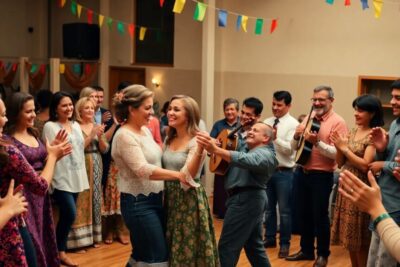
Contra dance is a social folk dance in which lines of couples move through repeated patterns guided by a caller and music. Also called contra dancing and sometimes written contradance, it is known for flowing movement, partner and neighbor interaction, repeated figures, and a strong community focus.
At a typical event, dancers form longways sets, learn a sequence during a short walk-through, and then repeat the choreography to lively music. As the dance continues, couples progress through the set and meet new neighbors, creating one of the form's most distinctive social features.
This guide explains what contra dance is, where the tradition came from, how its formations and progression work, which figures and music are common, what happens at an event, and what beginners should know before joining their first dance.
Table of Contents:
- What Is Contra Dance?
- Origin and Meaning of the Term “Contra Dance”
- Contra Dance Origin: Where Did Contra Dancing Come From?
- Contra Dance History
- How Contra Dance Works
- Contra Dance Formations
- Progression in Contra Dance
- Contra Dance Choreography and Common Figures
- Contra Dance Music
- What Happens at a Contra Dance Event?
- Contra Dance vs Square Dance
- Techno Contra and Modern Contra Style
- Benefits of Contra Dancing
- How to Start Contra Dancing as a Beginner
- Conclusion: Why Contra Dance Still Matters
What Is Contra Dance?
Contra dance is a partner-based folk dance usually performed in long lines of couples. Small groups within the set follow a repeating sequence of figures such as swings, allemandes, circles, stars, chains, and do-si-dos while a caller teaches and prompts the choreography.
Unlike a performance-centered dance form, contra is primarily participatory. Dancers learn each sequence at the event rather than arriving with a routine memorized in advance, which allows beginners and experienced participants to share the same floor.
The choreography is repeated several times, but the social experience changes because couples progress through the longways set and encounter different neighbors. This combination of repetition, progression, music, and interaction is central to the form.
Origin and Meaning of the Term “Contra Dance”
The exact origin of the term contra dance is debated. One explanation connects it with the French term contredanse, which was historically related to English country dancing. Another interpretation links the word contra to dancers positioned opposite one another in facing formations.
What is well established is that English country dances circulated widely in Europe and became fashionable in France, where related forms were known as contredanses. Dance forms, terminology, music, and figures then continued to circulate and change across Europe and the Atlantic world.
Because of this complicated history, it is safer not to describe the modern American name as the result of one simple linguistic path. Today, contra dance is the standard spelling in the United States, although contradance also appears.
The Spanish and Caribbean term contradanza belongs to related historical developments but should not be treated as another name for modern American contra dancing. Caribbean contradanza developed into its own musical and dance traditions.
Contra Dance Origin: Where Did Contra Dancing Come From?
The roots of modern contra dancing lie in older European social-dance traditions, particularly English country dances and related forms that circulated in France and elsewhere. Long formations, facing couples, repeated figures, musical phrasing, and progression all appeared in traditions that contributed to later North American dancing.
When these social dances crossed the Atlantic, dancers and communities adapted them to local music, customs, and social settings. Over time, distinctive American traditions developed, with New England becoming especially important to the continuity of the form.
Contra therefore does not have one inventor or a single moment of creation. It emerged gradually through cultural exchange, regional adaptation, and generations of dancers, musicians, callers, and choreographers.
Contra Dance History
The history of contra dance in North America stretches from colonial and early American social dancing through nineteenth-century regional traditions, twentieth-century revivals, and today's active dance communities.
In colonial and early American society, country-dance forms appeared at social gatherings and celebrations. Dancers did not necessarily depend on the modern calling system familiar today. Instructions could come from dance leaders, experienced participants, printed dance collections, or figures already known within the community.
During the nineteenth century, contra dances existed alongside quadrilles, cotillions, reels, and forms that contributed to the development of American square dancing. Regional continuity was particularly important in New England, where older country- and contra-dance traditions remained active even as social fashions changed elsewhere.
The twentieth century brought periods of preservation and renewal. Ralph Page became an important figure in maintaining and documenting New England traditions, while later callers and choreographers such as Dudley Laufman and Ted Sannella helped introduce contra to new dancers and communities during and after the folk revival.
By the late twentieth century, contra communities had spread far beyond New England. Contemporary dancers continue to use traditional figures while introducing new choreography, musical approaches, role terminology, festivals, dance weekends, and experimental events.
How Contra Dance Works
Before the music starts, the caller normally teaches the choreography during a walk-through. Dancers practice the figures and learn how the sequence fits together before performing it at full tempo.
When the music begins, the caller prompts the figures at the appropriate moments. The sequence repeats several times, and the caller may gradually reduce the prompts once the dancers are moving confidently.
The result is structured without feeling rigid: the choreography remains predictable while partners, neighbors, musical energy, and the experience of moving through the set continually change. Unlike line dancing, where dancers generally perform the same choreography independently within rows, contra is built around direct interaction between partners and neighboring couples.
Contra Dance Formations
Contra is most strongly associated with longways sets, but several arrangements can be used within that general structure. Understanding these formations helps explain how couples interact and progress through the dance.
Longways Sets
In a longways set, couples form two extended lines running up and down the hall. Small groups within the line—often two couples at a time—perform the choreography together while other groups perform the same sequence simultaneously along the set.
Proper Formation
In a traditional proper formation, the two dance roles remain on consistent sides of the longways set. Historically this was commonly described as men standing in one line and women in the other, although contemporary communities may use gender-neutral role terminology.
Improper Formation
In a traditional duple improper setup, one couple crosses relative to the proper arrangement, creating alternating dance roles along each side of the set. This formation supports many of the progressions used in modern contra choreography.
Beginners do not need to memorize these technical arrangements before attending an event. The caller normally explains where everyone should stand during the walk-through.
Becket Formation
In Becket formation, partners begin side by side on the same side of the set, facing another couple across from them. The formation takes its name from Becket Reel, a dance choreographed by Herbie Gaudreau that helped establish this arrangement in modern contra.
Becket formations allow different progression patterns and are widely used in contemporary choreography.
Partners and Neighbors
Dancers normally choose a partner for each individual dance, while neighbors are the other dancers they encounter within the set. As the choreography progresses, those neighbors change repeatedly.
Progression in Contra Dance
Progression is the process that carries couples through the longways set. At the end of each repetition, dancers arrive in a new position where they meet another neighboring couple and begin the choreography again.
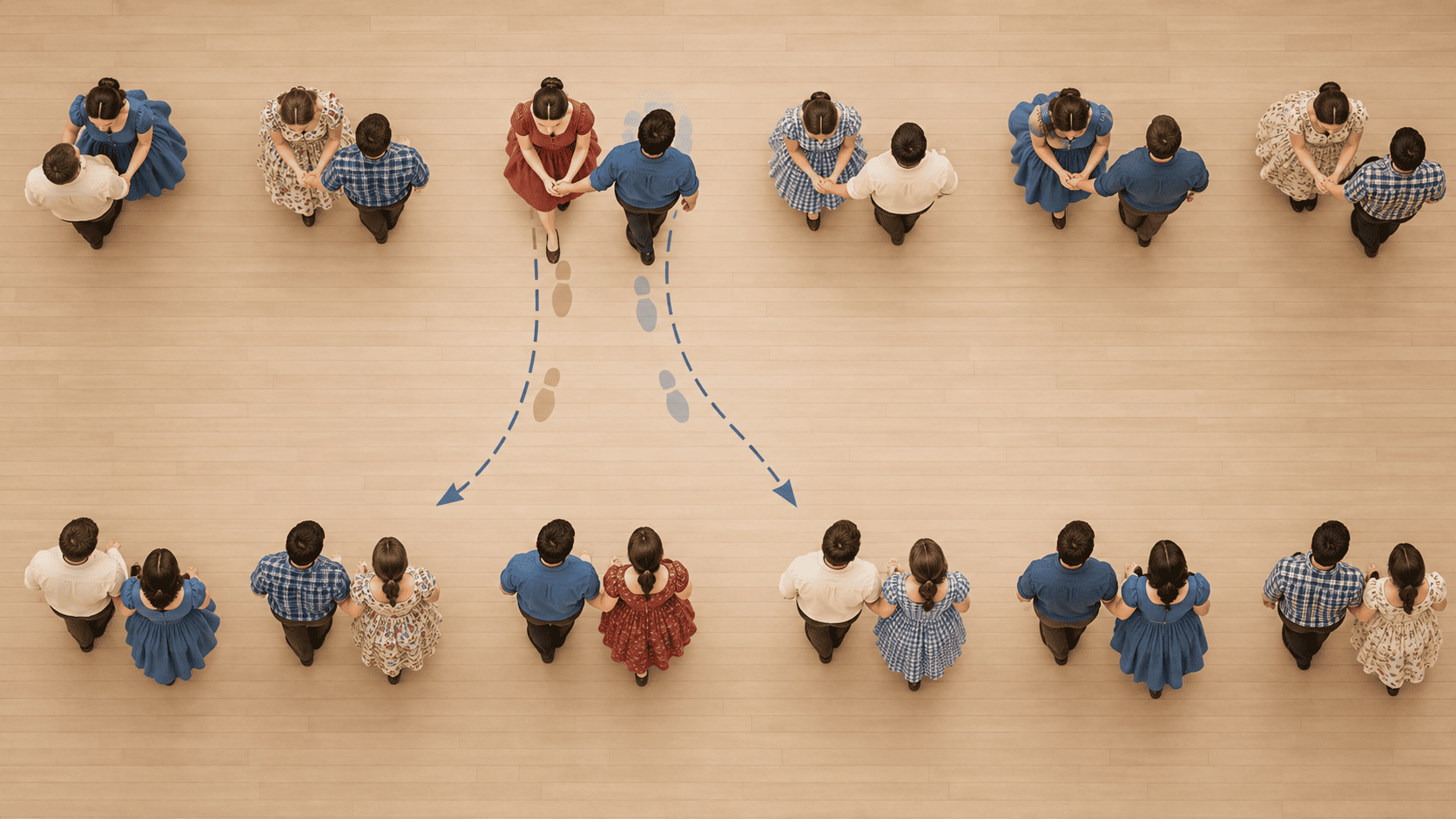
The sequence may remain identical, but the people dancing together change. This allows participants to interact with many dancers during one piece of music and gives the floor its characteristic sense of continuous movement.
Progression can feel confusing during a first event because newcomers must recognize where the next repetition begins. The caller, experienced dancers nearby, and the geometry of the set usually help guide everyone into the correct position.
Contra Dance Choreography and Common Figures
Contra choreography is built from movement units called figures. Choreographers arrange them into repeated sequences designed to match the phrasing of the music and the progression of dancers through the set.
Common figures include:
- Do-si-do: Two dancers move around one another, commonly passing right shoulders and returning toward their starting positions.
- Allemande: Two dancers turn together using one hand, with the direction determined by the call.
- Swing: Two dancers rotate together in a partner hold, often ending oriented for the next figure.
- Balance: A short rhythmic weight shift or movement in and out, often used before a swing or another figure.
- Star: Several dancers connect in the center and rotate together.
- Chain: A crossing and turning figure in which dancers exchange places across the set. A traditional ladies' chain is one familiar example.
- Promenade: Partners travel together in a shared direction.
- Circle left or right: A small group joins hands and travels around a circle.
Beginner choreography may rely on a small vocabulary and clear transitions, while more advanced dances can introduce unusual progressions, faster timing, or figures that require greater spatial awareness.
The choreography is normally taught shortly before it is danced rather than learned as a performance routine far in advance. Repetition allows the figures to settle into the phrasing and energy of the music.
Contra Dance Music
Music is central to the flow of contra dancing. Traditional events commonly use fiddle tunes, reels, jigs, and other folk melodies with a strong beat and regular phrasing suited to repeated choreography.
Common instruments include fiddle, guitar, piano, mandolin, flute, banjo, bass, and accordion. Instrumentation varies by region and band, but the music needs to provide a clear rhythmic and phrase structure for the dancers.
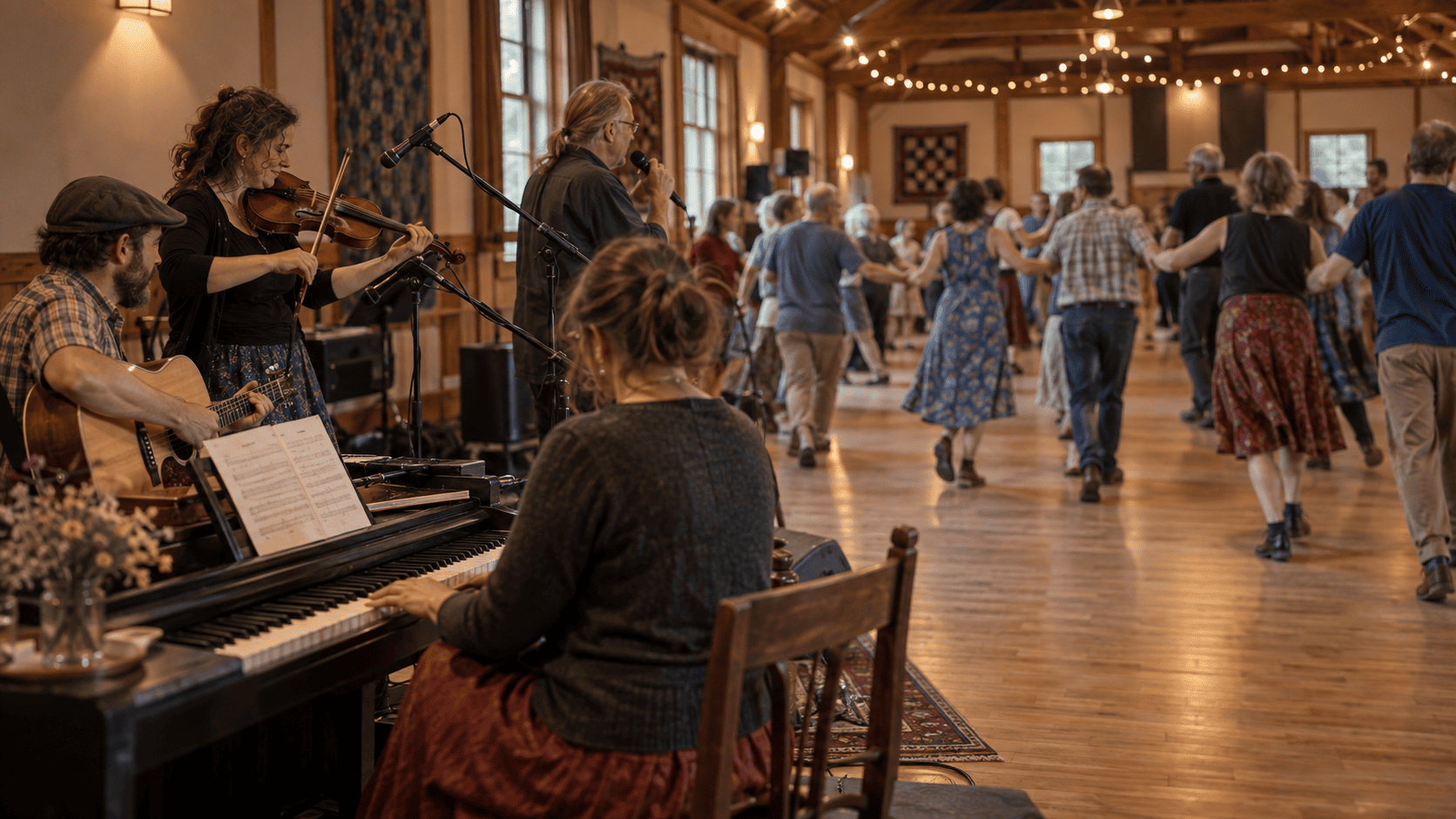
The repertoire can draw from New England, Irish, Scottish, Appalachian, old-time, French Canadian, and other folk traditions. Contemporary bands may also combine traditional dance phrasing with bluegrass, swing, electronic, or other musical influences.
Musicians and caller work closely together. Tempo, phrasing, and energy affect how comfortably the figures flow, making the band an active part of the dance rather than simply background entertainment.
What Happens at a Contra Dance Event?
Many events begin with a short beginner orientation covering basic figures, how to form a set, how to listen to the caller, and how to move comfortably with other dancers.
The main program then consists of a series of separate dances. Participants choose partners, form sets, listen to a walk-through, and dance the repeated sequence while the musicians play.
Live music is common and remains an important part of contra culture, although some events use recorded music or electronic formats. Participants often choose new partners between dances rather than staying with the same person for the entire evening.
The atmosphere is generally informal and participatory. Many communities actively welcome newcomers, and experienced dancers often help beginners find their place when needed.
Contra Dance vs Square Dance
Contra dance and square dance are closely related social folk-dance traditions. Historically, they have often shared events, figures, callers, musicians, and local dance communities, so the boundary between them has not always been absolute.
In their typical modern forms, however, their structures are easy to distinguish. Square dancing commonly organizes four couples into a square, while contra generally uses longways sets in which couples progress through the line.
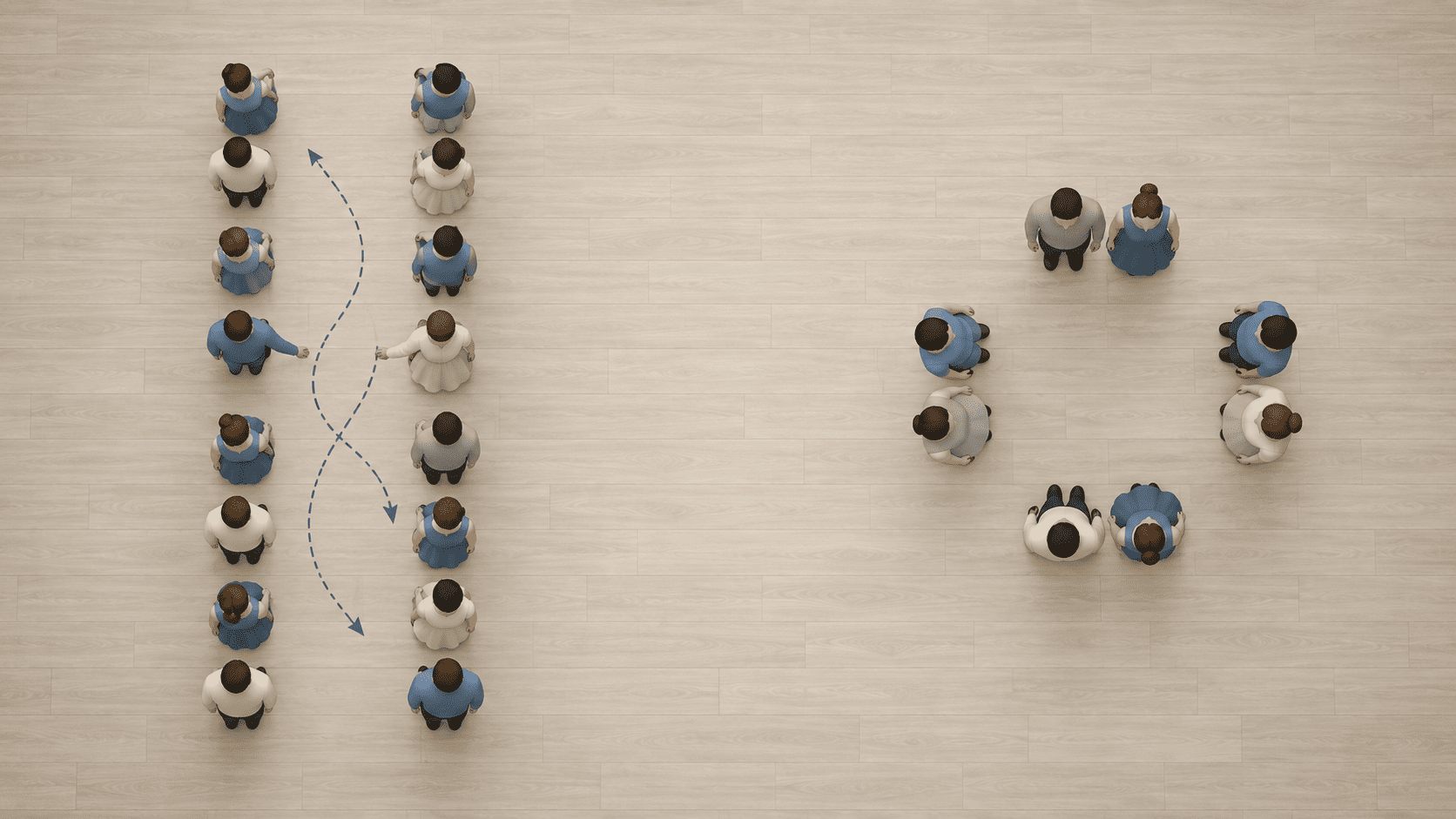
Modern western square dance also uses an extensive standardized vocabulary of calls that participants learn progressively. Contra usually relies on a shorter choreography taught in full during a walk-through before each individual dance.
Both traditions depend on music, callers, repeated figures, and cooperation. The clearest practical difference is the combination of longways formation and progression that characterizes most modern contra dancing.
Techno Contra and Modern Contra Style
Techno contra adapts contra formations and figures to electronic or heavily amplified music, often accompanied by lighting and a dance-party atmosphere. The sound changes, but the structure may still include a caller, longways sets, progression, swings, circles, allemandes, and chains.
Contemporary contra communities also experiment with choreography, music, and calling practices. Some callers and events use gender-neutral role terms such as larks and robins, while others use positional calling or different terminology. No single role-naming system is universal across all contra communities.
These developments show that the tradition continues to change rather than functioning only as historical preservation. New approaches coexist with acoustic music, long-established figures, and more traditional calling practices.
Benefits of Contra Dancing
Contra dancing provides sustained physical activity while challenging timing, coordination, directional awareness, balance, attention, and memory. Its progressive structure also creates frequent social interaction with partners and neighbors, making the experience both physically active and strongly community-oriented.
How to Start Contra Dancing as a Beginner
Look for a local contra group, folk-dance organization, community dance, college group, or regional dance calendar. Beginner orientations held before the main program are particularly useful for learning common figures and understanding how a set works.
Wear comfortable clothing and shoes that allow easy walking and turning. Footwear should provide enough control to move confidently without gripping the floor excessively, but should not be so slippery that balance becomes difficult. Bringing water is also useful because a full evening may involve sustained activity.
You generally do not need to arrive with a partner. At many social events, dancers choose a different partner for each dance, and newcomers can simply let others know that it is their first time.
Listen to the caller and avoid worrying about occasional mistakes. If you lose the sequence, stay calm, watch nearby dancers, and allow the structure of the set to help you reconnect with the choreography.
Contra is largely learned through participation. After several dances, common figures begin to feel familiar and progression through the set becomes much easier to recognize.
Conclusion: Why Contra Dance Still Matters
Contra dance is a living social tradition shaped by transatlantic country-dance culture, American regional development, New England continuity, twentieth-century revival, and modern creativity. Its combination of caller-led choreography, longways formations, progression, music, and constant interaction allows beginners and experienced dancers to share the same floor while keeping a historic form active and adaptable.
Square Dance: Meaning & History
Ice Dance: Meaning, History, Rules, Moves and Olympic Facts
Salsa Music: Origins, Rhythm, Instruments & History
Ghost Dance: Meaning, History, and Native Legacy
Argentine Tango: Meaning, History, Music, Milonga and Dance Style

Bandoneon: Meaning, History, Tango Instrument, Range and Players
Discover more about the world of dance: