Argentine Tango: Meaning, History, Music, Milonga and Dance Style
Argentine tango is one of the most expressive and intimate partner dances in the world. Known for its close embrace, improvised movement, deep musicality, and emotional connection, Argentine tango is more than a dance style; it is a social tradition, a cultural language, and one of the most iconic artistic expressions of Argentina and Uruguay.
Unlike stage dances built mainly around choreography, Argentine tango is created in the moment. Two dancers listen to the music, connect through the embrace, and move together through subtle signals, pauses, walking steps, pivots, and turns. This makes every dance unique.
This guide explains what Argentine tango is, its meaning, brief history, music, abrazo, milonga culture, social codes, difference from ballroom tango, global revival, and key facts. For a broader overview of tango as a general dance form, visit this guide to Tango Dance.
Table of Contents:
- What Is Argentine Tango?
- Argentine Tango Meaning and Philosophy
- Argentine Tango Origin and Brief History
- The Abrazo: The Heart of Argentine Tango
- Argentine Tango Music and the Bandoneon
- Argentine Tango vs Ballroom Tango
- What Is a Milonga? Social Tango, Codes and Etiquette
- Argentine Tango Outside Argentina
- How to Learn Argentine Tango
- What to Wear for Argentine Tango
- Facts About Argentine Tango
- Conclusion: Why Argentine Tango Still Matters
What Is Argentine Tango?
Argentine tango is a social partner dance that developed in the Río de la Plata region, especially Buenos Aires and Montevideo. It is often described as the tango dance of Argentina, although Uruguay also played an important role in its development.
At its core, Argentine tango is based on walking, embrace, connection, improvisation, and musical interpretation. One partner usually leads and the other follows, but both dancers actively participate in the movement. The leader proposes direction and timing, while the follower interprets and responds with balance, sensitivity, and presence.
The Argentine tango dance is different from many performance-based dances because it does not require fixed choreography. In a social setting, dancers improvise according to the music, the available space, and the feeling of the moment. This is why Argentine tango often feels like a conversation rather than a routine.
As an Argentine dance, tango carries deep cultural meaning. It reflects urban life, migration, nostalgia, elegance, desire, and connection. Today, people dance Argentinian tango in milongas, festivals, studios, cultural centers, and social dance communities around the world.
Argentine Tango Meaning and Philosophy
The meaning of Argentine tango is strongly connected to human connection. The dance is not only about steps or dramatic poses. It is about listening, responding, waiting, and sharing a moment with another person.
Argentine tango is often called a “dance of connection” because partners communicate through the body rather than words. A small shift in weight, a change in breath, a pause, or a slight rotation can guide the next movement. This subtle communication gives tango its emotional depth.
The philosophy of Argentine tango values presence over speed and feeling over display. A simple walk can be more meaningful than a complicated step if it is danced with musicality, balance, and intention. This is one reason experienced dancers often say that tango is easy to begin but takes a lifetime to understand.
Tango in Argentina is also tied to memory and identity. It carries the emotional tone of the city, the stories of immigrants, the sound of old orchestras, and the atmosphere of social dance halls where people gather to dance, listen, and connect.
Argentine Tango Origin and Brief History
The Argentine tango origin is usually traced to the late 19th century in the Río de la Plata region, especially Buenos Aires in Argentina and Montevideo in Uruguay. These port cities brought together European immigrants, Afro-descendant communities, local criollo culture, and working-class social life.
The history of Argentine tango began in popular neighborhoods, patios, bars, dance halls, and urban gathering spaces. Early tango was shaped by different musical and dance influences, including milonga, habanera, candombe, European melodies, and African rhythmic traditions.
At first, tango was often associated with marginal spaces and was sometimes criticized as scandalous because of its close embrace. Later, it gained popularity in Europe, especially in France. Once tango became fashionable in Paris, it was more widely accepted by upper classes in Argentina.
In the 20th century, Argentine tango grew through orchestras, singers, dance halls, films, stage shows, and international festivals. Its Golden Age in the 1930s and 1940s helped define many of the sounds and social traditions still associated with tango today.
This section gives only a brief historical overview so this article stays focused on Argentine tango as a dance style. For a deeper timeline, origin story, etymology, and global expansion, read the full guide to Tango History.
The Abrazo: The Heart of Argentine Tango
The abrazo, or embrace, is one of the most important elements of Argentine tango. It is the physical and emotional connection that allows two dancers to move as one. Through the abrazo, dancers share balance, direction, intention, and musical feeling.
In Argentine tango, the embrace can be close, open, or flexible. In close embrace, the dancers maintain a more intimate chest connection, often used in traditional social tango. In open embrace, there is more space between partners, allowing for larger movements and more visible footwork. Many dancers use a flexible embrace that changes depending on the music and movement.
The embrace is not meant to be rigid. It should feel alive, responsive, and comfortable. A good abrazo allows the leader to communicate clearly and the follower to respond freely. It also helps both dancers stay connected to the rhythm and mood of the music.
This focus on embrace is one of the main reasons Argentine tango feels different from ballroom tango and other partner dances. The dance begins not with the feet, but with the connection between two people.
Argentine Tango Music and the Bandoneon
Argentine tango music is the emotional engine of the dance. It guides the rhythm, pauses, intensity, and mood of each movement. Dancers listen not only to the beat, but also to the melody, phrasing, instruments, and emotional color of the song.
Traditional tango music often includes the bandoneon, violin, piano, double bass, and sometimes vocals. The bandoneon is especially important because its expressive sound became closely associated with the feeling of tango.
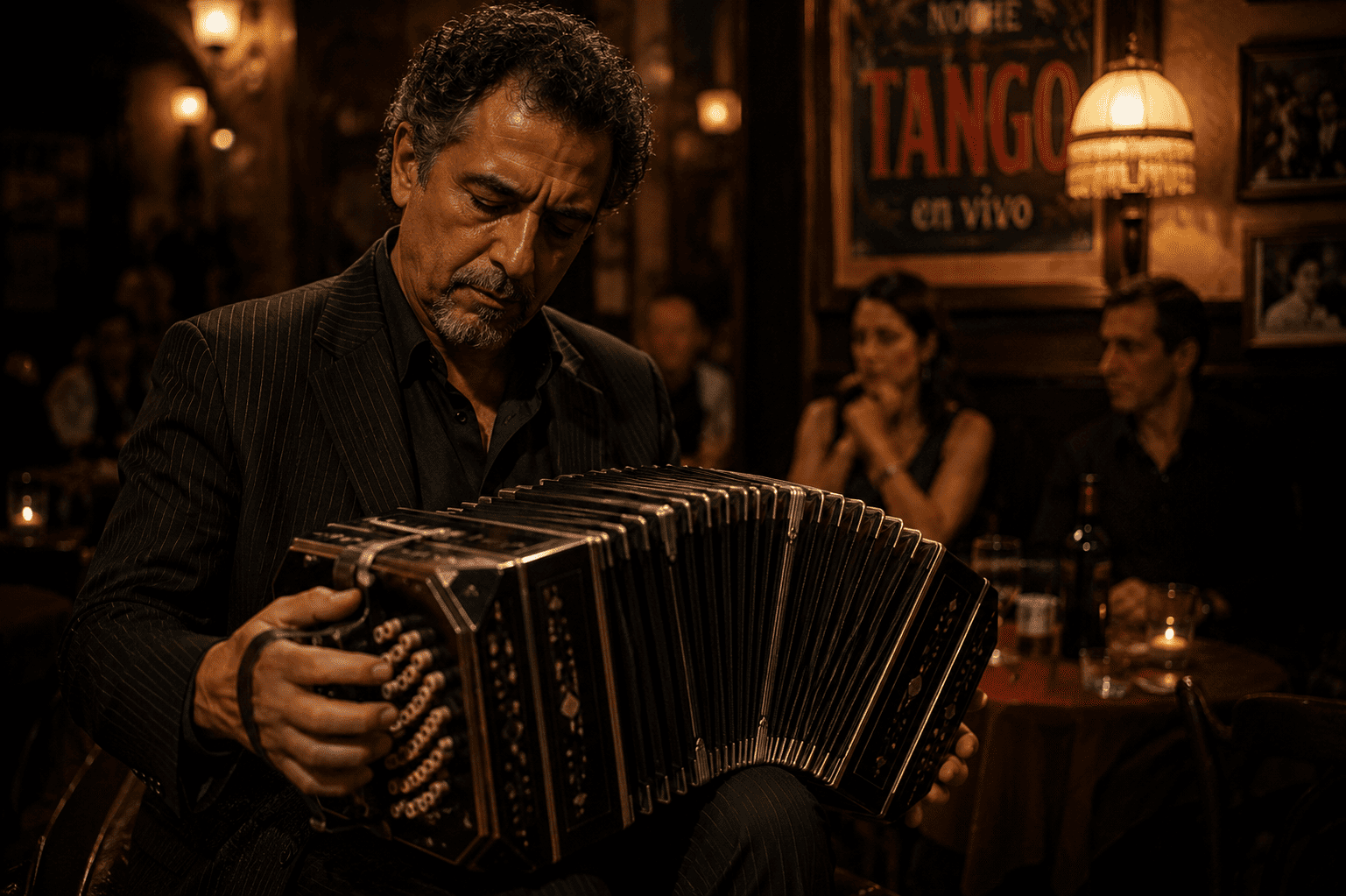
Important tango music figures include Carlos Gardel, whose voice helped bring tango songs to international audiences, and Astor Piazzolla, who expanded tango through Tango Nuevo by blending traditional tango with classical and jazz influences.
This article only summarizes the role of music in Argentine tango. For a deeper guide to tango songs, orchestras, composers, the Golden Age, Tango Nuevo, and Neotango, visit Tango Music.
Argentine Tango vs Ballroom Tango
Argentine tango and ballroom tango share the word “tango,” but they are different dance forms. Argentine tango is usually social, improvised, and based on partner connection. Ballroom tango is more standardized, choreographed, and often used in competitions.
| Aspect | Argentine Tango | Ballroom Tango |
|---|---|---|
| Purpose | Social dance, improvisation, connection | Performance, competition, technique |
| Embrace | Close, open, or flexible abrazo | Structured ballroom frame |
| Movement | Grounded, subtle, improvised | Sharp, dramatic, choreographed |
| Music | Traditional tango orchestras and social dance music | Ballroom tango tracks with a stronger competitive rhythm |
| Floor use | Designed for shared social dance floors | Often designed for performance or competition space |
| Feeling | Intimate, musical, conversational | Theatrical, precise, visual |
The biggest difference is the purpose of the dance. Argentine tango invites dancers to create movement in the moment. Ballroom tango emphasizes a polished visual result. Both require skill, but Argentine tango is more focused on social connection, musicality, and improvisation.
A milonga is a social tango event where people gather to dance Argentine tango. It can take place in a dance hall, studio, café, cultural center, club, or community space. For many dancers, the milonga is where Argentine tango truly comes alive.
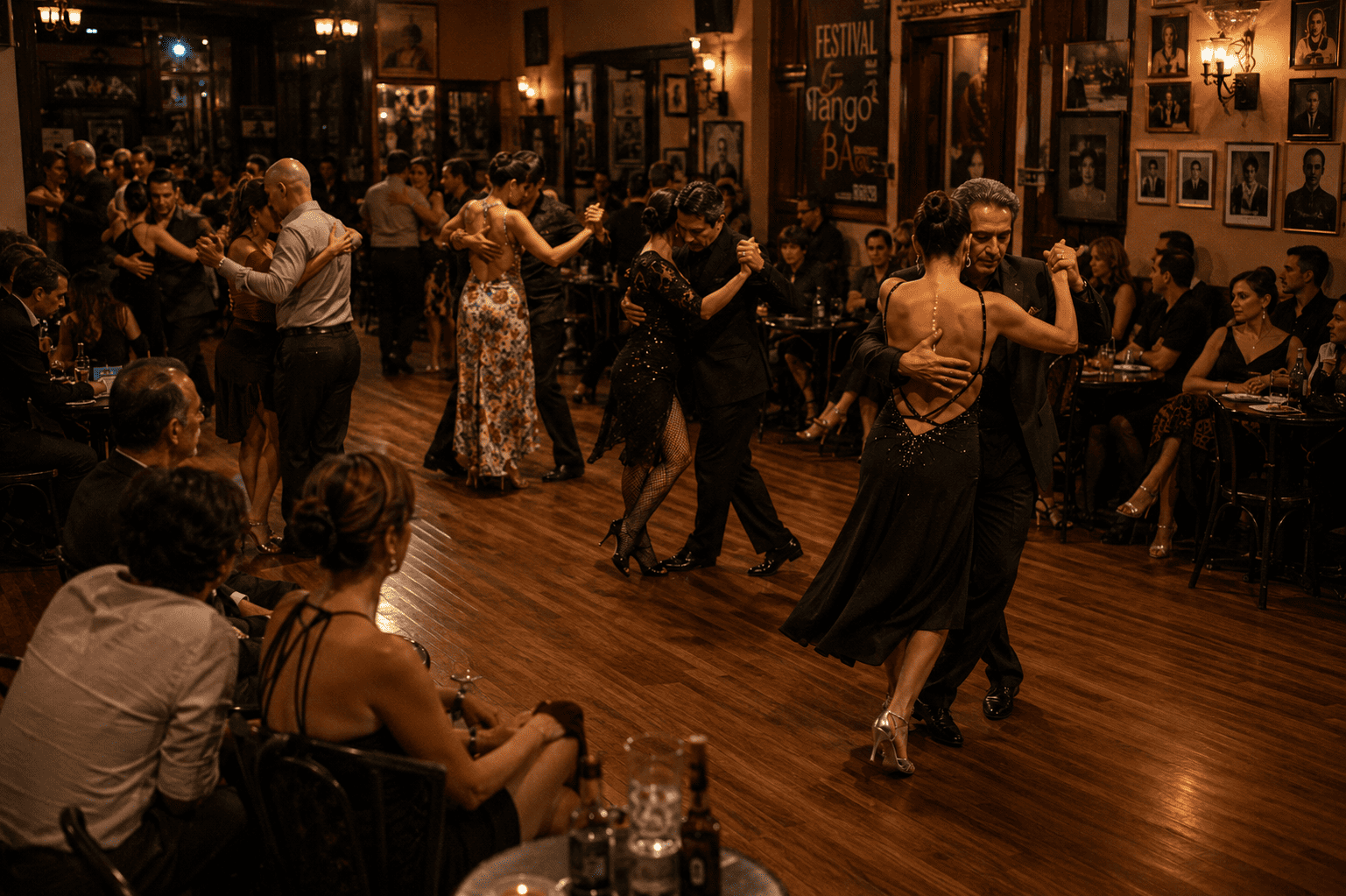
At a milonga, dancers usually follow social customs known as códigos. These customs help create respect, order, and comfort on the dance floor. They are part of the culture of Argentine tango and are especially important in traditional tango communities.
Cabeceo
The cabeceo is a traditional way to invite someone to dance using eye contact and a small nod. This avoids public rejection and allows both people to accept or decline discreetly.
Tandas and Cortinas
Music at a milonga is usually organized into tandas, or sets of three or four songs. Between tandas, a short non-tango song called a cortina plays, signaling dancers to leave the floor and choose new partners.
Floorcraft
Floorcraft is the ability to move safely and respectfully around the dance floor. In traditional milongas, dancers move counterclockwise in a shared line of dance. Good floorcraft helps everyone enjoy the social space.
These traditions make Argentine tango more than a set of steps. They create a social world with its own etiquette, rhythm, and sense of community.
Argentine Tango Outside Argentina
Argentine tango did not remain only in Argentina. In the early 20th century, it traveled to Europe and became a fashionable dance, especially in France. Paris played a major role in changing tango’s reputation. Once French society embraced it, tango gained new prestige in Argentina and beyond.
In the United Kingdom, tango entered social dance culture and influenced ballroom traditions. In the United States, Argentine tango developed through immigrant communities, dance schools, stage performances, festivals, and social clubs. Today, cities such as New York, San Francisco, Chicago, Los Angeles, and Miami have active tango communities.
The tango revival of the late 20th century helped Argentine tango grow again outside Argentina. Stage shows, international teachers, festivals, and workshops introduced new generations to the dance. Today, Argentine tango is practiced across Europe, North America, Asia, Australia, and Latin America.
This global growth shows how Argentine tango can travel while keeping its core identity: embrace, improvisation, music, and emotional connection.
How to Learn Argentine Tango
Learning Argentine tango usually begins with walking, posture, balance, embrace, and musical listening. Beginners often expect dramatic movements right away, but tango starts with the ability to move clearly and comfortably with another person.
A beginner class may teach basic walking, weight changes, simple turns, leading and following, and how to listen to tango music. Many group classes rotate partners so students can learn to connect with different people.
Private lessons can help dancers improve faster because the teacher can correct posture, embrace, timing, and technique in detail. Online lessons can also be useful, especially for practicing solo balance, pivots, musicality, and tango vocabulary.
The best way to understand Argentine tango is to combine classes with social dancing. Attending a milonga, even as an observer at first, helps beginners understand the music, etiquette, floorcraft, and community side of tango.
Patience is essential. Argentine tango is not about memorizing many steps quickly. It is about developing sensitivity, connection, rhythm, and confidence over time.
What to Wear for Argentine Tango
Argentine tango clothing should balance elegance and comfort. Because the dance includes walking, pivots, close embrace, and leg movement, dancers need clothes that allow freedom without interfering with connection.
Women often wear dresses, skirts, fitted tops, or flexible pants that allow easy movement. Slits, stretch fabrics, and asymmetrical cuts are common because they help with steps such as ochos, turns, and ganchos. Men often wear dress shirts, trousers, vests, or elegant casual clothing that allows movement.
Shoes are especially important. Tango shoes usually have smooth leather or suede soles to allow controlled pivots. Women’s shoes often include secure straps and heels, while men’s shoes usually have supportive soles and a slight heel.
This is only a brief overview. For a complete guide to tango dresses, shoes, fabrics, accessories, and dress code, visit Tango Dresses.
Facts About Argentine Tango
These facts help explain why Argentine tango remains one of the world’s most respected social dances:
- Argentine tango developed in the Río de la Plata region. Buenos Aires and Montevideo were both central to its origin.
- Argentine tango is improvised. Social dancers usually create the dance in the moment rather than following a fixed routine.
- The abrazo is central. The embrace allows dancers to communicate through subtle body movement.
- Milongas are tango social events. They are where dancers gather to dance, listen, socialize, and practice tango culture.
- Argentine tango is different from ballroom tango. It is more social, grounded, and improvisational.
- Music shapes the dance. Dancers respond to rhythm, melody, pauses, and emotion in the music.
- Paris helped popularize tango internationally. French acceptance changed tango’s status in the early 20th century.
- Anyone can learn Argentine tango. It requires patience, practice, listening, and willingness to connect.
These facts also show why Argentine tango is more than a dance from Argentina. It is a social art form shaped by history, music, migration, community, and personal expression.
More articles about Dance List
Explore more guides and related content about Dance List.
See more about Dance ListConclusion: Why Argentine Tango Still Matters
Argentine tango still matters because it offers something rare: a dance built on listening, connection, improvisation, and shared presence. It began in the social world of Buenos Aires and Montevideo, but it grew into a global tradition practiced by people of many cultures and backgrounds.
The power of Argentine tango comes from its simplicity and depth. A walk, a pause, an embrace, or a small change in weight can carry emotion when danced with musicality and intention. This is why tango continues to attract beginners, experienced dancers, musicians, travelers, and cultural enthusiasts around the world.
Whether experienced in a traditional milonga, a dance class, a festival, or a performance, Argentine tango remains a living conversation between music, movement, history, and human connection.
Contra Dance: Definition, History & How It Works
Square Dance: Meaning & History
Ice Dance: Meaning, History, Rules, Moves and Olympic Facts
Salsa Music: Origins, Rhythm, Instruments & History
Ghost Dance: Meaning, History, and Native Legacy

Bandoneon: Meaning, History, Tango Instrument, Range and Players
Discover more about the world of dance: