Lion Dance: Meaning, History, Types, Symbolism and Facts
The lion dance is one of the most recognizable traditional performances in Chinese culture. With its powerful drums, colorful costumes, expressive movements, and festive energy, the lion dance is performed to bring good luck, chase away evil spirits, and celebrate important moments in community life.
Although many people first see lion dancing during Lunar New Year, the tradition has a much deeper meaning. It is connected to Chinese history, martial arts, symbolism, religious customs, festivals, business blessings, family celebrations, and cultural identity. Today, lion dance is performed not only in China, but also in Vietnam, Malaysia, Singapore, Indonesia, Japan, Korea, the United States, Canada, Australia, and many other parts of the world.
This guide explains the meaning of lion dance, its origin and history, the main types of lion dance, what the lion symbolizes, the meaning of lion dance colors, the role of costumes and music, and why this tradition continues to be important today.
Table of Contents:
- What Is Lion Dance?
- Lion Dance Meaning and Symbolism
- Lion Dance Origin and History
- History of Lion Dance Timeline
- Types of Lion Dance
- Northern Lion Dance and Southern Lion Dance
- Lion Dance Costumes and Colors Meaning
- Music, Stances, Movements, and Performance
- When and Where Lion Dances Are Performed
- Evolution, High Pole Lion Dance, and Competitions
- Lion Dance Cultural Significance
- Lion Dance Around the World
- Lion Dance in Popular Culture
- Lion Dance Facts
- Conclusion: Why Lion Dance Still Matters
What Is Lion Dance?
Lion dance is a traditional performance art in which dancers wear a lion costume and imitate the movements, emotions, and personality of a lion. The performance usually combines dance, music, martial arts, acrobatics, and storytelling.
A typical lion dance is performed by two dancers inside one lion costume. The front dancer controls the head, eyes, mouth, and facial expressions, while the back dancer controls the body and tail. Together, they create the illusion of a living creature that can jump, bow, sleep, wake up, play, search, eat, and interact with the audience.
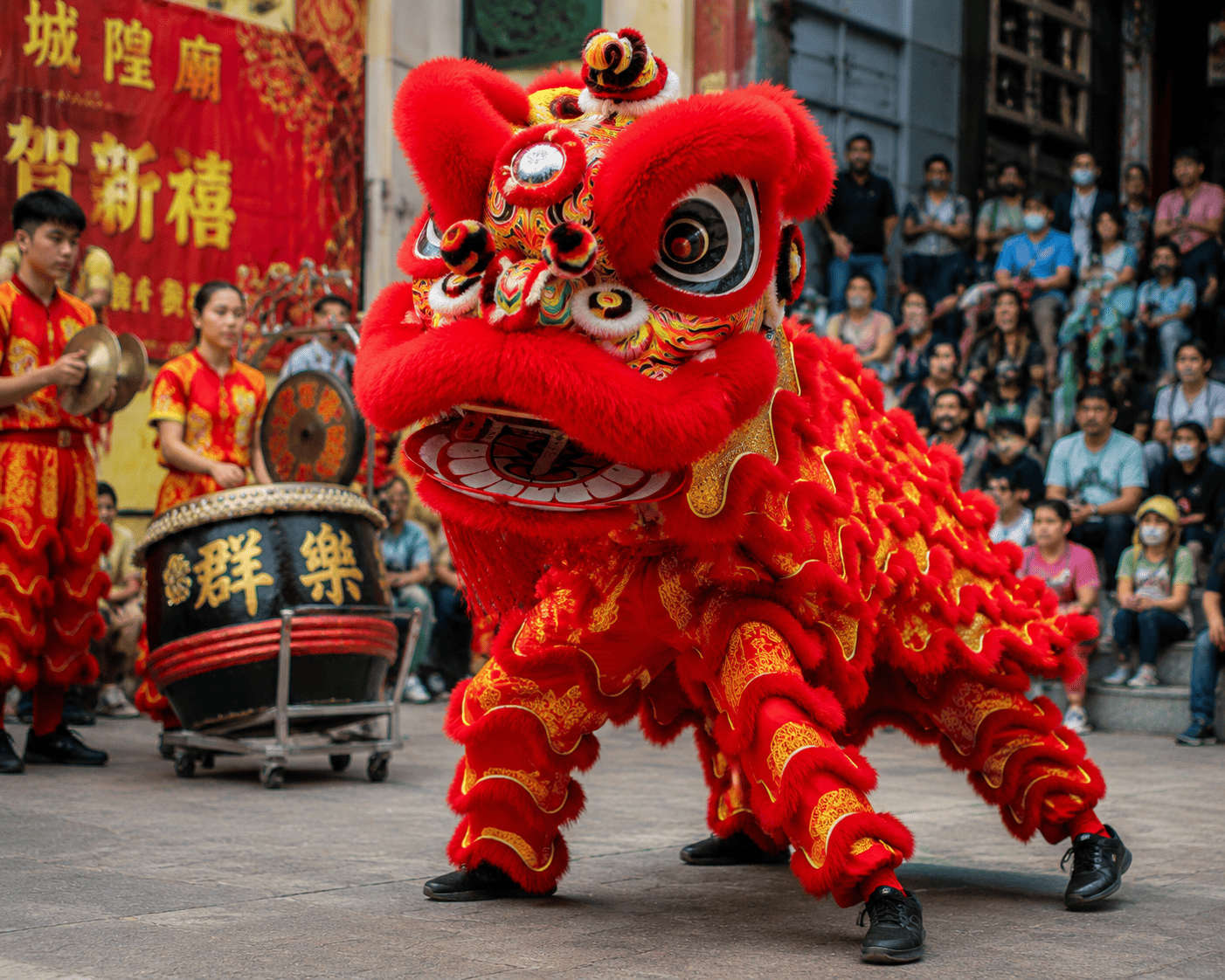
The lion is usually accompanied by a loud musical ensemble made up of drums, cymbals, and a gong. These instruments guide the rhythm of the performance and help create excitement. The sound is also symbolic: traditionally, loud noise is believed to scare away bad luck and negative energy.
In simple terms, if someone asks what is lion dance, the answer is this: lion dance is a traditional cultural performance that uses a lion costume, rhythmic music, martial movements, and symbolic actions to bring good luck, protection, prosperity, and celebration.
Lion Dance Meaning and Symbolism
The lion dance meaning is strongly connected to luck, protection, courage, wisdom, and prosperity. In Chinese culture, the lion is seen as a powerful guardian creature. Even though lions are not native to most parts of China, the image of the lion became associated with strength, dignity, and the ability to drive away harmful forces.
So, what does lion dance symbolize? Lion dance symbolizes good fortune, protection from evil spirits, success, happiness, and renewal. That is why it is often performed during Lunar New Year, weddings, business openings, temple festivals, and major community celebrations.
During Lunar New Year, the lion dance represents a fresh start. The lion is believed to clear away bad luck from the previous year and welcome blessings for the new one. At business openings, the lion dance is performed to invite prosperity, attract customers, and bless the space. At weddings, it can symbolize joy, harmony, and a fortunate beginning for the couple.
The lion dance symbolism is also expressed through movement. A lion may bow to show respect, leap to show power, blink its eyes to appear alive, or “eat” lettuce during a prosperity ritual. Each action has meaning. The dance is not random entertainment; it is a symbolic performance designed to bless people, places, and events.
Lion Dance Origin and History
The lion dance origin is usually traced to ancient China, where lion-like performances became part of court entertainment, religious ceremonies, and festival traditions. The exact beginning of lion dance is difficult to define because the tradition developed over many centuries through folklore, ritual, theater, and martial arts.
One important point about lion dance origins is that the lion itself was not originally a common animal in China. The image of the lion likely entered Chinese culture through trade, diplomacy, and cultural exchange with regions such as Central Asia, India, and Persia. Over time, the lion became a symbol of protection and power in Chinese imagination.
The history of lion dance became more visible during imperial China, especially as performances were used in festivals, temples, and official celebrations. By the Tang Dynasty, lion dances were already associated with court entertainment and ceremonial events. Later, regional communities developed their own versions, movements, costumes, and musical patterns.
As the tradition evolved, lion dance became closely connected to martial arts schools. Many troupes trained with strong stances, jumps, coordination drills, and partner work. This connection between lion dancing and martial arts helped shape the powerful movements seen in many performances today.
Over time, the lion dance spread beyond China through migration and diaspora communities. Chinese immigrants brought the tradition to Southeast Asia, North America, Europe, and Australia, where it became a way to preserve heritage, celebrate identity, and introduce Chinese culture to wider audiences.
History of Lion Dance Timeline
The lion dance history can be understood as a long timeline of cultural exchange, ritual development, regional variation, and global expansion. The tradition did not appear in one single moment. It grew through centuries of performance, belief, and community practice.
Ancient Roots: The Lion as a Guardian Symbol
The earliest roots of lion dancing are connected to the arrival of lion imagery in Chinese culture. Lions became associated with strength, protection, and royal power. Stone guardian lions eventually appeared in front of temples, palaces, and important buildings, reflecting the lion’s role as a protective figure.
Imperial China: Court and Festival Performances
During imperial periods, lion-like performances became part of official entertainment and public celebration. These performances helped transform the lion from a symbol into a moving, dramatic character. The dance became part of festive life, religious events, and seasonal ceremonies.
Regional Development: Northern and Southern Styles
As different regions developed their own customs, the lion dance separated into recognizable styles. The Northern Lion Dance became more playful, acrobatic, and courtly, while the Southern Lion Dance became more expressive, martial, and symbolic. This regional split remains one of the most important parts of history of lion dancing.
Migration and Diaspora: Lion Dance Around the World
With Chinese migration, lion dance traveled to Southeast Asia, the Americas, Europe, and beyond. In diaspora communities, lion dancing became a way to maintain cultural roots, teach younger generations, and celebrate identity in multicultural societies.
Modern Era: Competitions, High Poles, and Global Stages
Today, lion dancing history continues through modern competitions, high-pole performances, international festivals, and creative stage productions. The tradition still carries its ancient symbolism, but it now also includes athletic innovation, global teamwork, and contemporary performance design.
Types of Lion Dance
There is more than one type of lion dance. The two main types of lion dance in Chinese tradition are the Northern Lion Dance and the Southern Lion Dance. Both represent the lion as a powerful and lucky creature, but they differ in costume, movement, rhythm, and performance style.
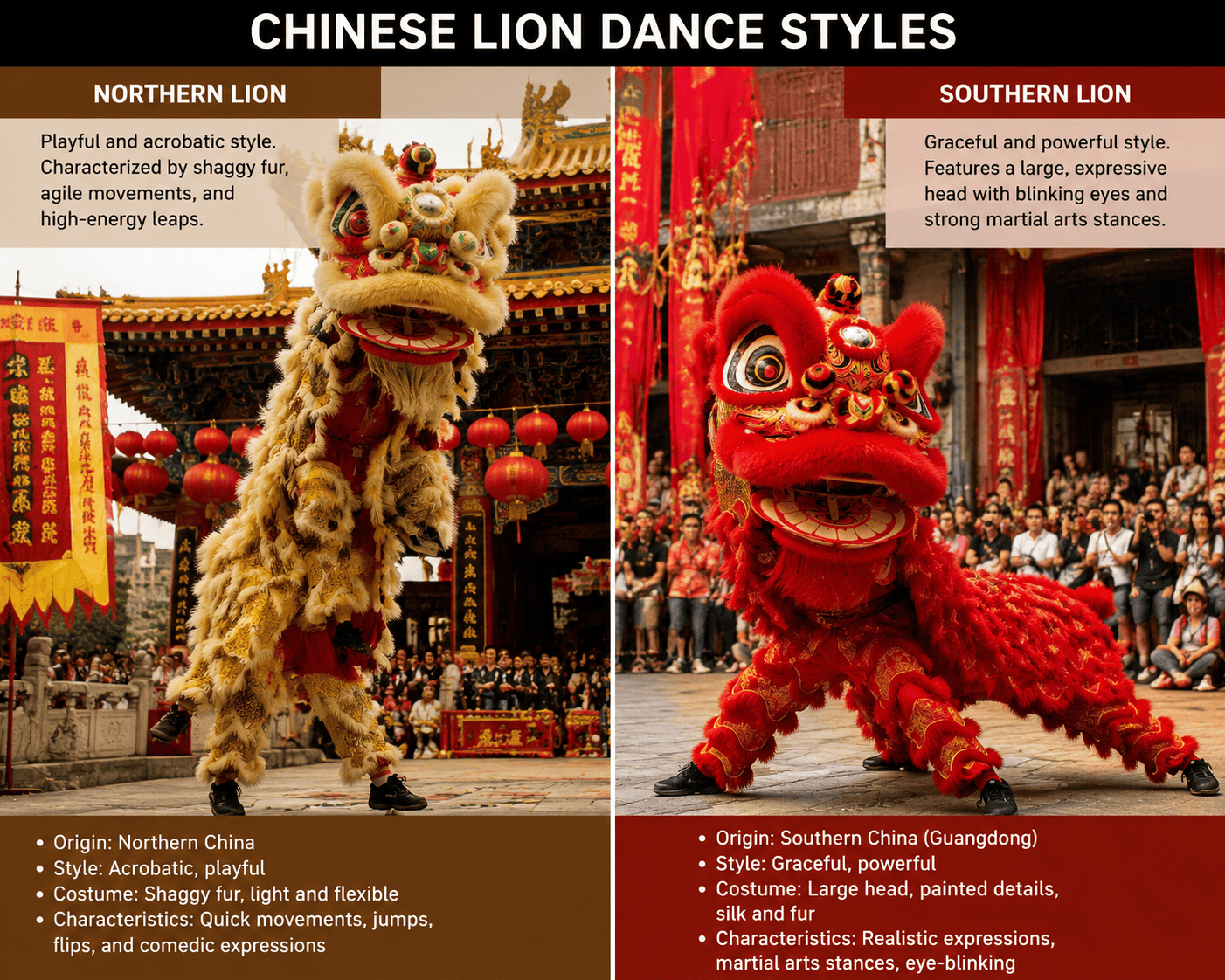
The Northern style is often more playful, acrobatic, and theatrical. The Southern style is usually more expressive, symbolic, and martial. In addition to these two major Chinese styles, many countries and communities have developed their own regional versions of lion dancing.
Understanding the different types is important because “lion dance” is not one fixed performance. It is a living tradition with many forms, each shaped by local culture, history, training, and purpose.
Northern Lion Dance and Southern Lion Dance
Northern Lion Dance
The Northern Lion Dance is known for its acrobatic and playful style. The costume often has a shaggy, dog-like appearance, sometimes compared to a Pekingese dog. Northern lions are commonly performed in pairs, often representing male and female lions.
The movements in Northern Lion Dance are energetic and athletic. Performers may roll, jump, balance, climb, and interact with a guiding character. The style often feels theatrical and entertaining, with the lion behaving like a curious animal that plays with the audience or follows a performer.
Southern Lion Dance
The Southern Lion Dance is the style most commonly seen in many overseas Chinese communities. It is especially associated with Guangdong and Cantonese traditions. The Southern lion has a large expressive head, blinking eyes, a moving mouth, dramatic fur, and strong emotional character.
Southern Lion Dance is deeply connected to martial arts. Performers use strong stances, low movements, sharp turns, and powerful coordination. The lion may appear curious, fierce, cautious, playful, or triumphant depending on the story of the routine.
Fut San, Hok San, and Green Lion
Within Southern Lion Dance, there are important sub-styles. Fut San, also written as Fo Shan, is known for strong martial movements and traditional power. Hok San, also written as He Shan, is often associated with more expressive, lively, and naturalistic movements.
The Green Lion is another important variation. Its meaning can vary by region and historical context, but it is often connected to specific cultural, political, or martial traditions. Including these sub-styles helps explain why lion dance is not only a festival performance, but also a complex cultural art with many local identities.
Lion Dance Costumes and Colors Meaning
The lion dance costume is one of the most important parts of the performance. It is not meant to look like a realistic lion. Instead, it represents a mythical and symbolic lion, full of color, expression, and cultural meaning.
A typical costume includes a large lion head, a fabric body, fur-like decorations, blinking eyes, a moving mouth, mirrors, horns, and bright painted details. The front performer controls the head and expression, while the back performer creates the body movement and tail.
The lion dance colors meaning can vary by tradition, troupe, and region, but some common associations include:
- Red lions often symbolize celebration, good luck, joy, and festive energy.
- Gold or yellow lions are often connected with wealth, prosperity, royalty, and success.
- Green lions may symbolize harmony, growth, friendship, or specific regional traditions.
- Black lions can represent power, seriousness, strength, or a more forceful character.
- White lions may be associated with purity, age, mourning, or special ceremonial meaning depending on context.
Color meaning is important, but it should not be treated as universal in every performance. Different schools and regions may interpret colors differently. What remains consistent is that the costume is more than decoration. It is the body of the lion, the visual symbol of the tradition, and the center of the audience’s attention.
Music, Stances, Movements, and Performance
Lion dance music is usually performed with a drum, cymbals, and a gong. The drum leads the rhythm, while the cymbals and gong add intensity, accents, and excitement. The music does not simply accompany the dance; it controls the lion’s energy and movement.
When the drum pattern changes, the lion may wake up, look around, approach an object, become cautious, jump, bow, or celebrate. The musicians and dancers must work together closely. A strong lion dance performance depends on timing, rhythm, and communication between the lion and the band.
Stances are also essential. Many lion dance movements come from martial arts training. Performers use horse stance, bow stance, cat stance, and other strong positions to support jumps, lifts, turns, and expressive body language. These stances help the lion look grounded, powerful, and alive.
The movements can include blinking, bowing, shaking, scratching, sleeping, waking, searching, climbing, balancing, and eating symbolic offerings. In advanced routines, dancers may perform stacks, jumps, lifts, or high-pole sequences. Even when the movement is athletic, the goal is not only difficulty. The dancers must maintain the illusion of a living lion.
When and Where Lion Dances Are Performed
Lion dances are most commonly performed during Lunar New Year, but they are not limited to one holiday. The dance appears whenever people want to invite good luck, celebrate a major event, protect a space, or honor cultural tradition.
During Lunar New Year, lion dance troupes often perform in streets, temples, shopping centers, schools, businesses, and community events. The lion is believed to chase away bad luck and welcome prosperity for the new year.
Lion dances are also common at business openings. In these performances, the lion may perform the cai qing ritual, often translated as “plucking the greens.” Lettuce or other greens are placed with a red envelope, and the lion symbolically eats and scatters them. This act represents wealth, growth, and good fortune.
Other common occasions include weddings, temple festivals, birthdays, anniversaries, cultural parades, martial arts demonstrations, school events, and international competitions. In every setting, the lion dance brings a sense of joy, blessing, movement, sound, and shared celebration.
Evolution, High Pole Lion Dance, and Competitions
The lion dance has evolved from a ritual and festival tradition into a modern performance art and competitive discipline. While many troupes still preserve traditional movements and ceremonies, others have developed highly athletic routines designed for stage and competition.
One of the most impressive modern forms is the high pole lion dance, also known as performing on jongs. In this style, dancers leap across raised metal poles while staying inside the lion costume. The performance requires strength, balance, trust, timing, and precise teamwork.
High pole lion dance is especially popular in Malaysia, Singapore, and other parts of Southeast Asia. Teams train intensely to perform difficult jumps, dramatic poses, and creative routines. Judges may evaluate balance, difficulty, rhythm, expression, costume control, choreography, and how convincingly the dancers bring the lion to life.
Modern competitions have helped lion dance reach new audiences. They also show how the tradition can evolve without losing its cultural roots. The best teams combine athletic excellence with respect for symbolism, music, ritual, and storytelling.
Lion Dance Cultural Significance
The lion dance significance goes far beyond entertainment. It is a cultural tradition that brings together history, spirituality, community, discipline, and identity. For many families and communities, lion dance is a way to stay connected to heritage and pass cultural knowledge to younger generations.
The significance of lion dance is especially strong in diaspora communities. In places such as the United States, Canada, Australia, and the United Kingdom, lion dance performances help Chinese and Asian communities celebrate their roots while sharing their culture with wider society.
Lion dance also teaches teamwork. A troupe needs dancers, musicians, coaches, costume caretakers, organizers, and community supporters. Young performers learn discipline, rhythm, physical conditioning, respect, and cooperation. For many students, lion dance becomes both cultural education and personal development.
The story of lion dance challenges, triumphs, history, culture, and community is part of what makes the tradition so meaningful. In some places, lion dance groups faced restrictions, misunderstanding, or political pressure. Yet the art form survived because communities continued to value it as a source of pride, resilience, and cultural memory.
Today, the lion dance cultural significance remains strong because it connects the past with the present. It honors ancient beliefs, celebrates modern identity, and creates a shared experience that people can feel through sound, color, movement, and emotion.
Lion Dance Around the World
Although lion dance is strongly associated with Chinese culture, it has spread around the world and developed many regional forms. Each country or community may adapt the dance while keeping its core themes of luck, celebration, protection, and cultural pride.
Vietnam
In Vietnam, lion dance is known as múa lân. It is especially popular during Tết, the Vietnamese Lunar New Year, and the Mid-Autumn Festival. Vietnamese performances often include lively humor, fast movement, and the character Ông Địa, a smiling earth god figure who plays with and guides the lion.
Malaysia and Singapore
Malaysia and Singapore are known for highly advanced competitive lion dance, especially high-pole routines. Teams from these countries have helped shape modern lion dance as an international performance sport while preserving traditional Southern lion techniques.
Japan, Korea, and Other Asian Traditions
Japan and Korea have their own lion-like performance traditions, with different costumes, music, and ritual meanings. These forms are not identical to Chinese lion dance, but they show how lion symbolism appears across several Asian cultures.
Western Countries
In the United States, Canada, Australia, and Europe, lion dance is often performed by cultural associations, Chinese community groups, and martial arts schools. These performances appear at Lunar New Year parades, school events, weddings, restaurant openings, and multicultural festivals.
For many overseas communities, lion dance is both a celebration and a bridge between generations. It allows young performers to learn tradition while presenting their culture proudly in a modern setting.
Lion Dance in Popular Culture
The lion dance has become one of the most recognizable symbols of Chinese and East Asian celebration in popular culture. Its bright colors, loud music, dramatic movement, and festive atmosphere make it easy to recognize in films, television, advertising, animation, and video games.
In movies and television, lion dance is often used to show Lunar New Year, Chinatown celebrations, martial arts traditions, or cultural identity. In advertising, brands often use lion dance imagery during Lunar New Year campaigns to suggest luck, energy, prosperity, and celebration.
Modern designers and digital creators have also used lion dance motifs in fashion, sneakers, gaming skins, illustrations, and stage design. While some modern uses are mainly visual, the strongest representations still respect the deeper cultural meaning behind the lion.
This presence in popular culture helps introduce lion dance to new audiences. At the same time, it reminds viewers that the tradition is not just a colorful performance. It is connected to history, symbolism, community, and cultural pride.
Lion Dance Facts
Here are some useful facts that help explain why lion dance remains such an important tradition:
- Lion dance is not the same as dragon dance. A lion is usually performed by two dancers, while a dragon is usually controlled by many performers holding poles.
- The lion dance is believed to bring good luck. It is often performed to bless homes, businesses, and community spaces.
- The music has symbolic power. Drums, cymbals, and gongs create excitement and are traditionally believed to scare away evil spirits.
- The costume is expressive. The eyes, mouth, ears, and body movements help the lion show emotion.
- Martial arts influenced lion dance. Many movements require strong stances, balance, discipline, and physical training.
- There are different types of lion dance. The most famous are Northern Lion Dance and Southern Lion Dance.
- Color matters. Lion dance colors can suggest luck, prosperity, strength, harmony, or special ceremonial meanings.
- Lion dance is global. It is now performed across Asia, North America, Europe, Australia, and other regions.
More articles about Dance Types
Explore more guides and related content about Dance Types.
See more about Dance TypesConclusion: Why Lion Dance Still Matters
The lion dance remains important because it combines meaning, history, movement, music, symbolism, and community. It is more than a festival performance. It is a living tradition that carries ideas of protection, prosperity, courage, discipline, and cultural pride.
Understanding lion dance history helps explain why the performance has survived for centuries. Its origin is rooted in ancient Chinese symbolism and ritual, but its modern form continues to evolve through regional styles, diaspora communities, competitions, and popular culture.
Whether performed during Lunar New Year, at a business opening, in a temple courtyard, on high poles, or on an international stage, lion dance continues to connect people through rhythm, color, movement, and shared celebration. That is why the meaning and significance of lion dance remain powerful today.
Discover more about the world of dance: