Ballet Pointe Technique: How to Master Pointe Work Safely
Few skills in classical ballet are as recognizable—or as demanding—as dancing en pointe. To an audience, it can look light, floating, and almost effortless. In reality, ballet pointe technique is built on years of training, precise alignment, foot and ankle strength, and careful progression. It is not simply about standing on the tips of the toes. It is about learning how to place the body correctly, rise with control, balance over a tiny platform, and move safely without losing turnout, posture, or musicality.
This guide explains how to do pointe properly, what dancers need before starting, how pointe work is developed, the most common mistakes, and how to improve technique over time. Whether you are a student, teacher, parent, or adult ballet dancer, this article will help you understand the foundations of ballet on pointe in a practical and safe way.
Table of Contents:
- What Is Ballet Pointe Technique?
- How to Do Pointe Properly Step by Step
- Key Ballet Pointe Technique Principles Every Dancer Must Master
- When Is a Dancer Ready for Pointe Work?
- Requirements Before Going En Pointe
- The Muscles and Biomechanics Behind Pointe Technique
- Proper Alignment, Balance, and Movement in Pointe Work
- Common Pointe Technique Mistakes and How to Fix Them
- Best Exercises to Improve Ballet Pointe Technique
- Choosing and Fitting Pointe Shoes the Right Way
- Injury Risks in Pointe Work and How to Prevent Them
- Pointe Work for Children, Teens, and Adult Beginners
- The History of Pointe Work in Ballet
- Final Thoughts on Mastering Ballet Pointe Technique
What Is Ballet Pointe Technique?
Ballet pointe technique is the method dancers use to rise and move on the fully extended foot while wearing specially constructed pointe shoes. In simple terms, it is the technical foundation behind dancing on pointe. But while many people associate pointe with beauty and elegance, the technique itself is highly athletic and depends on biomechanics, control, and progressive training.
In ballet, going en pointe changes the demands placed on the body. The dancer must stack the ankle, knee, pelvis, spine, and shoulders with much greater precision than in flat work or demi-pointe. Because the base of support becomes very small, even minor alignment errors can affect balance, execution, and injury risk. That is why pointe technique is not taught as a decorative add-on. It is treated as an advanced extension of classical ballet training.
For many dancers, pointe ballet represents a milestone. It marks the transition from foundational training into more advanced technical work. However, the goal is not simply to “get up” into the shoe. The goal is to move well on pointe: to rise without collapsing, to sustain turnout, to control transitions, and to maintain artistry while the body works under much higher demands.
Pointe vs. Relevé: What’s the Difference?
This distinction matters because many beginners confuse the two. In a relevé, the dancer rises onto the ball of the foot. This happens throughout ballet class and is a basic part of training. In ballet en pointe, the dancer continues beyond demi-pointe and places body weight onto the platform of the pointe shoe. The mechanics are related, but the technical demand is much higher en pointe.
- Relevé: rising onto the balls of the feet.
- En pointe: fully extended through the ankle and foot, supported by the shoe’s box and platform.
- Pointe work: the broader technical practice of balancing, turning, traveling, and performing choreography en pointe.
So while all pointe requires relevé mechanics, not all relevé is pointe. That difference is central to understanding how ballet pointe work should be trained.
Pointe also carries artistic significance within classical ballet. It creates the illusion of length, suspension, and ethereal quality—especially in roles associated with sylphs, swans, and romantic heroines. If you want broader historical context, you can explore the history of ballet, where pointe became one of the defining visual signatures of the form.
How to Do Pointe Properly Step by Step
One of the biggest gaps in many articles is that they explain pointe as a concept, but not as an actual process. If someone searches how to do pointe, they usually want more than a definition. They want to understand what the body should do from the ground up. Proper pointe technique can be broken into a sequence: alignment, preparation, rise, balance, and descent.
Step 1: Establish Correct Placement Before Rising
Before a dancer rises, the body must already be organized. Good ballet pointe technique begins on flat or demi-pointe, not after the shoe leaves the floor. The pelvis should be neutral, the rib cage controlled, the spine lifted, and the turnout initiated from the hips rather than forced through the knees or feet. The standing leg must feel active and supported, while the foot presses evenly into the floor.
If the dancer starts with the weight too far back, the rise will be unstable. If the dancer grips the glutes excessively, tucks the pelvis, or twists the knees to create turnout, the line may look turned out, but the mechanics will be unsafe. The rise to pointe should feel like a continuation of proper ballet placement, not a separate action.
Step 2: Roll Through Demi-Pointe Into Full Pointe
To go onto pointe correctly, the dancer should articulate through the foot. That means pressing through the metatarsals, lengthening the ankle, and arriving fully over the platform of the shoe rather than jumping, yanking upward, or sickling into place. This is one reason teachers spend so much time strengthening demi-pointe: it teaches the pathway needed for clean pointe work.
In practical terms, the movement should feel continuous. The heel lifts, the ankle extends, the toes lengthen inside the shoe, and the body rises vertically. There should be no moment where the dancer “hangs back” behind the shoe or collapses into the box. When dancers ask how to improve pointe work ballet technique, this rolling pathway is often one of the first places to look.
Step 3: Stack the Body Over the Platform
Once up on pointe, balance does not come from brute force in the toes. It comes from vertical organization. The ankle must be fully lifted, the weight placed over the platform, and the entire body stacked so that the dancer can hold the position without gripping. Ideally, the shoulders remain quiet, the neck free, the core engaged, and the hips level.
This is where many dancers struggle with the difference between simply “getting up” and actually dancing on pointe. If the body is not centered over the shoe, the dancer may wobble, claw the toes, lean back, or twist the foot inward or outward. Balance en pointe is not passive. It is an active, refined equilibrium.
Step 4: Move With Control Instead of Just Holding On
True ballet on pointe technique is revealed in transitions. It is one thing to stand briefly on two feet at the barre. It is another to shift weight, travel, turn, and coordinate arms, head, and épaulement without losing placement. Movements such as sous-sus, échappé, bourrée, and pirouette en pointe require the dancer to maintain the same alignment principles while the body is changing direction or momentum.
The best way to think about movement en pointe is this: the body must stay organized while the feet articulate underneath it. That is why advanced pointe work depends so heavily on repetition, consistency, and strength built over time.
Step 5: Descend Through the Foot Safely
Lowering from pointe is just as important as rising. A dancer should descend by controlling the ankle and rolling back through demi-pointe instead of dropping the heel abruptly. Poor descents can strain the calves, overload the Achilles tendon, and reinforce sloppy mechanics.
In well-trained pointe technique, the up and the down are equally articulate. The dancer should look just as strong leaving pointe as arriving on it.

Key Ballet Pointe Technique Principles Every Dancer Must Master
Even when dancers have enough strength to get into the shoe, poor mechanics can still limit progress. The following principles sit at the heart of strong ballet pointe technique. They are the difference between force and control, between surviving pointe and actually mastering it.
Placement and Alignment
Alignment is the core principle behind all pointe work. The foot, ankle, knee, pelvis, rib cage, shoulders, and head need to work in a coordinated vertical relationship. If one part falls out of line, the rest of the system compensates. On pointe, those compensations become very visible and often very uncomfortable.
For example, when the dancer leans back, the lower back often takes the strain. When the foot sickles, the ankle loses support. When the pelvis tips or rotates, balance becomes unreliable. Good alignment helps distribute force efficiently through the body and makes pointe feel more stable and less forced.
Weight Placement Over the Shoe
A major misconception is that the toes “hold” the body up. In reality, the dancer must place weight properly over the platform of the shoe so the skeleton and musculature can work together. If the weight stays behind the box, the dancer may never fully get onto pointe. If it goes too far forward without control, the shoe can feel unstable.
Proper weight placement is subtle but essential in pointe ballet. It gives the dancer a better line, cleaner balances, and more confidence in transitions.
Turnout From the Hips
Turnout must come from the hips, not by twisting the knees or feet. This matters even more en pointe because the body is working on a smaller base. If the dancer fakes turnout by torquing the lower leg, the ankle becomes unstable and the foot line often distorts. Sustainable turnout is controlled, supported, and consistent from standing positions through traveling steps and turns.
Core Support and Upper-Body Stability
Strong pointe work depends on more than the feet. The core stabilizes the pelvis and spine so the lower body can move efficiently. Meanwhile, the upper body must remain coordinated rather than tense. Dancers who grip the shoulders or arch the ribs often make pointe feel harder than it needs to be. A quiet upper body allows the lower body to do its job with more clarity.
In other words, ballet pointe work is always full-body technique. The feet may be the most visible part, but the entire body is involved in keeping the movement clean.
When Is a Dancer Ready for Pointe Work?
Readiness for pointe is one of the most misunderstood topics in ballet. Many people focus only on age, but age alone is not enough. A dancer can be eager, talented, and motivated and still not be physically ready for the demands of pointe. The real question is whether the body has the technical foundation, strength, and maturity to support safe progression.
Age Is a Guideline, Not the Only Requirement
Many students begin pointe training around ages 11 to 13, but that range is only a general benchmark. Some dancers are not ready at that stage; others may meet the requirements slightly earlier or later depending on training quality, anatomy, and physical development. The key issue is not whether a dancer wants pointe shoes. It is whether the body can handle repeated loading in proper alignment.
Technical Readiness Matters More Than Excitement
Before starting pointe work, the dancer should already demonstrate clean basic ballet technique. That includes stable relevés, good turnout mechanics, postural control, musical discipline, and the ability to work consistently without collapsing into the feet or lower back. If technique is inconsistent on flat, it will usually be magnified on pointe.
Dancers also need regular training volume. Pointe is not something that develops well from occasional classes. A stronger foundation comes from consistent classical training several times per week, so the body has enough repetition to adapt gradually.
Strength, Mobility, and Maturity All Count
A ready dancer usually shows a combination of foot and ankle strength, calf endurance, core control, hip stability, and sufficient range of motion to get fully over the box. Just as important, the dancer must have the focus to listen to corrections, pace training sensibly, and avoid treating pointe like a shortcut to more advanced status.
That is why reputable schools often combine teacher observation, physical assessment, and pre-pointe preparation before allowing students to begin ballet on pointe.
Requirements Before Going En Pointe
To succeed safely in ballet en pointe, dancers need more than enthusiasm and a fitted pair of shoes. They need prerequisites that reduce injury risk and create technical consistency. This section is one of the most important for ranking because it aligns closely with what users want from terms like pointe work, pointe technique, and beginner-focused searches.
1. Strong Ankles and Calves
The ankle must be able to rise fully and support body weight without rolling inward or outward. The calf muscles need enough endurance to repeat relevés, sustain balances, and control descents. If the ankles are weak, the dancer may shake, sickle, or struggle to get over the box consistently.
2. Core Control and Pelvic Stability
Without core support, the dancer often compensates by leaning back, gripping the hips, or destabilizing the pelvis. Core strength helps create a stable trunk so the legs and feet can work more efficiently. This is essential in all pointe ballet training, especially as choreography becomes more dynamic.
3. Clean Demi-Pointe Technique
A dancer who cannot articulate the foot clearly through demi-pointe will usually struggle on full pointe. Clean demi-pointe work shows that the dancer understands weight transfer, ankle lift, and foot control. It is one of the best indicators of readiness because it bridges flat work and full pointe technique.
4. Sufficient Range of Motion
The dancer needs enough ankle and foot mobility to reach a strong pointe line without forcing. Limited mobility can leave the dancer under-pulled, which places extra pressure on the toes and reduces balance quality. Flexibility alone is not the goal; it must be paired with strength and control.
5. Consistent Teacher Approval
A qualified ballet teacher sees patterns a dancer may not notice: whether the turnout is honest, whether the foot collapses under fatigue, whether corrections are being applied, and whether the student has enough discipline to progress safely. In many cases, a teacher’s approval is the most important requirement before starting pointe.
The Muscles and Biomechanics Behind Pointe Technique
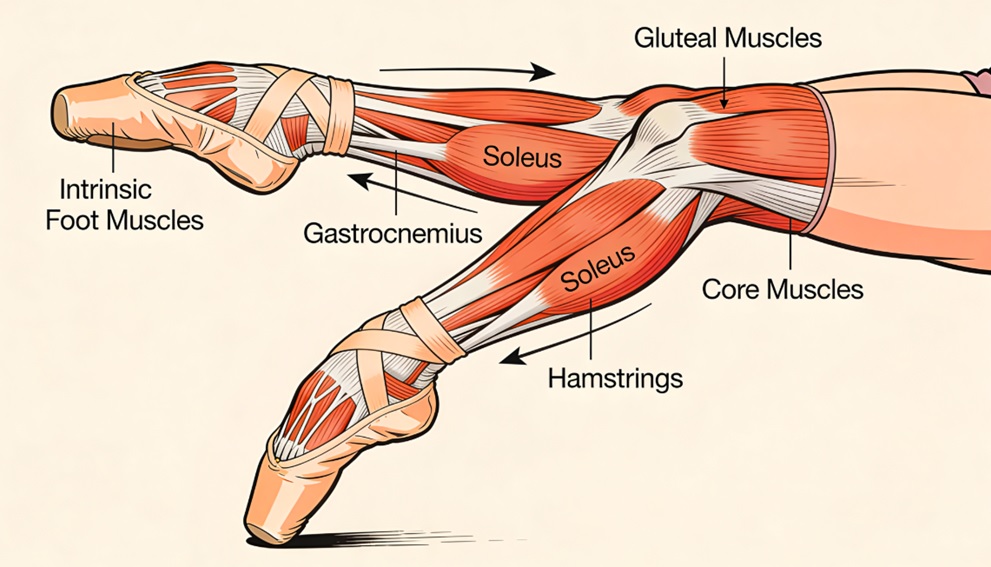
Understanding anatomy helps dancers train more intelligently. Ballet pointe technique may look refined and artistic, but it depends on precise biomechanical coordination. The foot does not work alone. Pointe is supported by a chain of muscles extending from the intrinsic foot muscles through the calves, legs, hips, and core.
Intrinsic Foot Muscles
These small muscles inside the foot help maintain the arch, organize the toes, and stabilize the dancer over the platform. They are especially important for control, proprioception, and avoiding clawing or collapsing inside the shoe.
Calves and Ankles
The gastrocnemius and soleus generate lift and help control the lowering phase. At the ankle, multiple structures help maintain stability and prevent rolling. In practical pointe training, this is why repeated calf raises, controlled relevés, and eccentric lowering exercises are so useful.
Hips, Glutes, and Turnout Support
The gluteal muscles and deep rotators support turnout and pelvic stability. When these muscles are weak, dancers often try to create turnout from the knees or feet, which weakens the entire line. Strong hip support makes ballet pointe work look cleaner and feel safer.
Core and Postural Muscles
The abdominals, spinal stabilizers, and upper-back muscles help organize the torso so the lower body can work underneath it. When a dancer balances or turns en pointe, the core does not simply “tighten.” It coordinates the body so the pelvis, spine, and rib cage stay efficient and responsive.
Proper Alignment, Balance, and Movement in Pointe Work
This is the technical heart of the article. When people search for ballet pointe technique, they usually want to understand what correct execution actually looks like. Alignment, balance, and movement are what separate decorative information from usable technical guidance.
Placement and Alignment
Correct placement begins with a long, organized spine and a neutral pelvis. The dancer should feel lifted upward, not compressed downward into the shoe. The knee should track cleanly over the foot, and the ankle should be fully supported in extension. The shoulders must stay calm, and the neck should remain free so the upper body does not tense in response to balance challenges.
Movement Into En Pointe
Moving into pointe should look smooth and inevitable. The dancer passes through demi-pointe, continues through the ankle, and arrives over the shoe without jerking or hopping. A clean rise reveals strong articulation, while a rough rise often signals weakness, poor timing, or fear of getting fully over the box.
Maintaining Balance Without Gripping
Good balance on pointe is active but not rigid. Dancers often make the mistake of gripping the toes, locking the knees, or hardening the shoulders in an attempt to “hold on.” True balance comes from coordinated muscular support and proper vertical alignment. The best balances feel lifted, responsive, and breathable rather than tense and stuck.
Transitions and Traveling Steps
In real pointe work ballet, technique is tested in motion. Traveling steps such as bourrées, directional changes, and turns require the dancer to preserve turnout, organization, and timing while the base of support shifts rapidly. That is why training must move beyond static barre work. Strong pointe dancers can transition without losing their line.
Common Pointe Technique Mistakes and How to Fix Them
Most technical problems in pointe are not random. They usually come from weakness, poor habits, or trying to progress faster than the body is ready for. Identifying the mistake is only half the job. The other half is understanding why it happens and how to correct it.
Sickling
Sickling happens when the foot curves inward and breaks the line of the ankle. It reduces support, affects aesthetics, and can increase strain on the ankle structures. To fix it, dancers need stronger lateral ankle support, better turnout mechanics, and slower, more mindful rises that reinforce correct tracking.
Clawing the Toes
When dancers grip with the toes inside the shoe, it is often a sign that they are trying to create stability from the wrong place. Clawing can come from poor fit, fear of getting fully over the platform, or weakness in the intrinsic foot muscles. The correction is not to grip harder, but to improve placement, strengthen the foot, and reduce unnecessary tension.
Leaning Back
Leaning back is one of the most common issues in ballet on pointe. Dancers often do it because they are hesitant to place weight fully over the shoe. Unfortunately, this makes pointe even harder. The solution is better core organization, more confidence in getting over the box, and repeated practice with controlled rises at the barre.
Weak Descents
Some dancers can get up onto pointe but collapse on the way down. This usually reflects insufficient calf control, rushed timing, or lack of attention to the lowering phase. Strong descents should be trained deliberately, because they improve both safety and overall technical polish.
Poor Shoe Fit
Sometimes the issue is not only technique. A badly fitted shoe can make even good mechanics look unstable. If the box is wrong, the platform too narrow, or the shank unsuited to the dancer’s foot, problems such as clawing, slipping, or poor balance may persist until the fit is corrected.
Best Exercises to Improve Ballet Pointe Technique
Strong pointe work is built through targeted practice. The best exercises do not just make the feet stronger; they teach the body how to articulate, align, and control movement more precisely. This is where improvement happens for dancers asking how to build better pointe technique.
Theraband Foot Articulation
Theraband work helps dancers strengthen the foot and ankle through the full range of motion. Done correctly, it can improve articulation, support cleaner rises, and reduce sickling. The key is moving slowly and keeping the toes long rather than clawed.
Controlled Relevés at the Barre
Relevés remain one of the most useful tools for improving ballet pointe work. They teach the dancer how to rise vertically, organize the ankle, and lower with control. Fewer high-quality repetitions are more effective than many rushed ones.
Échappés and Basic Transition Drills
Échappés help train weight transfer, turnout maintenance, and dynamic coordination. They are particularly useful for dancers who can stand on pointe but lose organization when moving between positions.
Doming and Intrinsic Foot Strength
Exercises like doming strengthen the arch and improve awareness inside the foot. These small details matter because the foot must stay active and responsive inside the shoe, not passive or collapsed.
Single-Leg Balance and Eccentric Calf Work
Single-leg exercises develop stability that transfers directly into balancing, turns, and sustained pointe work. Eccentric lowering drills are especially useful for improving descents and reducing overuse stress in the calves and Achilles tendon.
Choosing and Fitting Pointe Shoes the Right Way
Pointe shoes do not create technique, but they can support or sabotage it. Good fitting matters because the shoe must work with the dancer’s anatomy and current strength level. A shoe that is too soft, too hard, too wide, or too tapered can interfere with balance and line, even when the dancer is otherwise prepared.
Why Shoe Fit Matters for Technique
When a pointe shoe fits well, the dancer can get over the platform more naturally, feel supported through the arch, and maintain better alignment. When it fits poorly, the dancer may compensate by gripping, sinking, or twisting. That is why discussions of ballet pointe technique should always include footwear.
Professional Fitting Is Essential
A professional fitter looks at toe shape, arch mobility, instep height, metatarsal width, and the dancer’s technical level. This process is especially important for first-time pointe dancers, since beginners often cannot yet identify what a proper fit should feel like.
Toe Pads, Ribbons, and Elastics
Accessories should support comfort and security without masking poor fit. Toe pads can reduce friction, while ribbons and elastics help stabilize the shoe on the foot. However, none of these should be used to force a bad shoe to behave like a good one.
How Often Pointe Shoes Need Replacing
Pointe shoes wear down according to how often a dancer trains, how strong the feet are, and what repertoire or class load is involved. Once the shank softens too much or the box loses support, technique can deteriorate quickly. Replacing dead shoes on time is part of safe pointe practice.
Injury Risks in Pointe Work and How to Prevent Them
Pointe is demanding by nature, so injury prevention must be part of the technique conversation. Dancers, parents, and teachers often focus on whether a student can start pointe, but the equally important question is how to keep that student healthy once training begins.
Common Pointe-Related Injuries
Some of the most common issues include blisters, bruised toenails, tendon irritation, Achilles soreness, and stress-related pain in the metatarsals. These problems do not always come from pointe itself. They often come from too much load, poor mechanics, inadequate recovery, or shoes that are no longer supportive.
Warm-Up and Preparation
A proper warm-up activates the feet, calves, hips, and core before full loading begins. Dancers who rush into pointe without preparing the body often feel stiffer, less responsive, and more vulnerable to technical breakdown. Warm-up should include gentle activation, dynamic mobility, and progressive foot articulation.
Recovery and Rest Matter
Improvement does not happen only in class. Tissues need recovery time to adapt to repeated load. Rest, sleep, hydration, and sensible scheduling all matter. Overtraining can make pointe work ballet feel progressively worse, even in motivated dancers, because fatigue often shows up first as loss of alignment and control.
Cross-Training Helps Long-Term Progress
Pilates, mobility training, resistance work, and other forms of conditioning can support better turnout control, pelvic stability, and endurance. Cross-training should not replace technique class, but it can strengthen the structures that pointe relies on.
Pointe Work for Children, Teens, and Adult Beginners
Not every pointe journey looks the same. A pre-teen ballet student, a serious teen dancer, and an adult beginner may all approach pointe with very different goals, strengths, and limitations. That is why good instruction adjusts expectations to the dancer rather than forcing everyone into the same timeline.
Children and Early Teen Dancers
Younger dancers usually approach pointe as part of structured classical training. For them, the emphasis should be on readiness, gradual progression, and technical habits that will support future work. The excitement of getting pointe shoes should never outweigh the need for safe preparation.
Teen Dancers Building Stronger Technique
For teenagers already training regularly, pointe often becomes more complex and demanding. This is where dancers move beyond simply standing en pointe and begin refining artistry, turns, transitions, and stamina. Consistency matters greatly at this stage, because poor mechanics repeated under more advanced choreography can quickly become entrenched.
Adult Beginners and Returning Dancers
Adult dancers often wonder whether ballet on pointe is realistic for them. In many cases, yes—but only with honest expectations, patient progression, and experienced instruction. Adults may bring discipline and body awareness, but they may also need more time to build ankle mobility, calf endurance, and consistent turnout support.
For adults, success should not be defined by speed. It should be defined by clean progression, safe training, and sustainable improvement.
The History of Pointe Work in Ballet
Although this article is primarily focused on technique, a short historical section helps explain why pointe matters artistically. Pointe work became closely associated with ethereal and otherworldly roles in the Romantic era, when dancers such as Marie Taglioni helped shape the visual identity of the ballerina onstage. Over time, what began as an illusion developed into a sophisticated technical discipline supported by stronger training methods and more structured shoe design.
The evolution of pointe parallels the broader evolution of classical dance traditions. If you enjoy the historical side of dance, you can also explore related topics such as the history of jazz dance and the history of ballroom dancing, which show how different dance styles developed their own technical and artistic identities over time.
More articles about Dance Types
Explore more guides and related content about Dance Types.
See more about Dance TypesFinal Thoughts on Mastering Ballet Pointe Technique
Mastering ballet pointe technique is not about forcing the body into a pretty position. It is about building the strength, alignment, mobility, and discipline required to move en pointe with control and confidence. The best pointe work looks effortless because the technique underneath it is highly trained.
Whether the goal is to prepare for first pointe shoes, improve weak areas, or better understand pointe ballet as a parent or teacher, the same principles apply: strong fundamentals, patient progression, correct shoe fitting, and consistent attention to quality. In the long run, graceful dancing on pointe is not created by rushing. It is created by doing the basics exceptionally well, again and again.

Discover more about the world of dance: