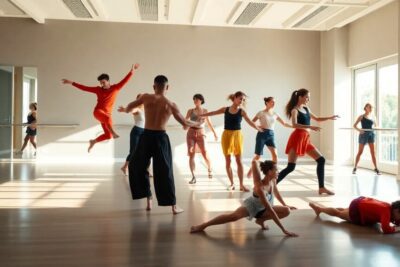
Types of Dance: A Guide to Popular Dance Styles
Dance has developed into countless forms across cultures and historical periods, ranging from highly codified theatrical traditions to social, street, folk, and ceremonial practices. The major types of dance include ballet, ballroom, contemporary, jazz, hip-hop, Latin dance, folk traditions, and many other regional and modern forms.
This guide explores the main types of dance and explains how different dance styles can be grouped into broader categories. Because dance traditions often overlap, the same form may be described as social, competitive, theatrical, cultural, or street dance depending on the context. The sections below provide a practical way to understand these relationships while highlighting the characteristics that distinguish major forms.

Table of Contents:
Top Dance Genres
Some dance forms have become internationally recognized through theaters, dance schools, competitions, films, social events, and popular music. For readers looking for a quick introduction, these are among the best-known dance forms:
- Ballet – a classical theatrical tradition built around codified technique, control, alignment, and expressive movement.
- Ballroom – a broad family of partner dances that includes styles such as waltz, tango, foxtrot, and quickstep.
- Contemporary – an evolving performance form that draws from modern dance, ballet, improvisation, and other movement practices.
- Hip-Hop – an urban dance culture associated with freestyle movement and forms such as breaking, alongside other street traditions.
- Jazz – a rhythm-driven performance tradition with deep roots in African-American culture and a strong influence on stage and commercial dance.
- Tap Dance – a percussive form in which metal taps attached to the shoes create rhythmic patterns through footwork.
- Folk Dance – traditional community-based dances connected to regional customs, celebrations, music, and cultural identity.
- Latin Dance – a broad label that includes social and competitive forms associated with Latin American and Caribbean traditions, such as salsa, rumba, and samba.
- Modern Dance – a theatrical tradition that developed partly as an alternative to the conventions of classical ballet.
- Swing – a family of energetic partner dances connected to swing-era jazz, including Lindy Hop and later related forms.
These categories provide a useful starting point, but they are not rigid boundaries. Many dances have changed over time or developed social, theatrical, and competitive versions that are classified differently depending on the setting.
List of Dance Styles by Category
Grouping dance into broad families makes it easier to understand how traditions are related. The categories below are based on factors such as performance setting, cultural background, movement vocabulary, musical tradition, and whether the dance is primarily social, theatrical, competitive, or community-based.
- Ballroom and partner dance – codified and social partner traditions including waltz, tango, foxtrot, quickstep, and related competitive forms.
- Jazz and African-American dance – rhythm-centered traditions such as jazz, tap, swing, Charleston, and related forms that have had a major influence on American dance.
- Latin, world, folk, and traditional dance – social and cultural traditions shaped by communities in Latin America, Europe, Africa, Asia, the Middle East, and other regions.
- Ballet, modern, and contemporary dance – theatrical traditions commonly associated with concert stages, professional companies, and formal dance training.
- Street and club dance – forms shaped by nightlife, popular music, social spaces, freestyle practice, and urban communities.
- Hip-hop and funk styles – distinct urban traditions including breaking, popping, locking, and other forms that developed within or alongside hip-hop and funk culture.
Popular Types of Ballroom Dance
Ballroom dancing developed from European social dance traditions and eventually became both a recreational and competitive activity. Today, the term can be used broadly for partner dancing, although organized competitions distinguish between specific ballroom, Latin, and rhythm categories.
Some of the principal ballroom styles include:
- Waltz – known for smooth traveling movement, turns, and its characteristic triple meter. The waltz became one of the defining European ballroom dances of the 19th century.
- Viennese Waltz – a faster form of waltz characterized by continuous rotational movement and a more rapid tempo than the slower ballroom waltz.
- Tango – ballroom tango is a codified competitive and social form derived from the broader tango tradition that developed in the Río de la Plata region.
- Foxtrot – a smooth partner dance associated with long, flowing steps and music in quadruple meter. It became an important ballroom style during the early 20th century.
- Quickstep – a lively ballroom dance characterized by fast traveling steps, turns, runs, and light rhythmic movement.
Dance schools and ballroom programs also commonly teach Latin and rhythm dances. In competition, however, these may be classified separately from the standard ballroom dances rather than treated as a single category.
- Cha-Cha-Cha – a lively partner dance associated with Cuban music and recognized for its distinctive rhythmic step pattern.
- Rumba – a term associated with several Cuban music and dance traditions; competitive ballroom rumba developed into a codified partner dance emphasizing controlled movement and rhythm.
- Samba – in ballroom competition, samba is a codified partner dance derived from Brazilian musical and dance influences and distinguished by rhythmic bounce action.
- Jive – a fast, energetic competitive dance influenced by American swing and jazz-related social dancing.
- Mambo – a Cuban-derived social partner dance that became internationally popular through Latin music and dance scenes during the mid-20th century.
- Bolero – a name used for more than one music and dance tradition; in American ballroom settings, bolero is performed as a slow and expressive partner dance.
Types of Jazz and African-American Dance
African-American communities have played a central role in the development of many influential American dance traditions. The history of jazz dance is closely connected to African-American music, rhythm, improvisation, social dancing, and theatrical performance. Over time, jazz-related forms also interacted with Broadway, film, popular entertainment, and dance education.
Important forms within this broad history include:
- Charleston – an energetic dance associated with the 1920s, recognized for swinging leg movements, rhythmic footwork, and its close relationship with jazz-age popular culture.
- Swing – a broad family of dances created around swing music. Lindy Hop became one of its most influential forms, while later variations developed for different social and competitive settings.
- East Coast Swing – a later social swing form that simplified elements of earlier swing dancing into a compact rhythmic structure suitable for dance instruction and social floors.
- Tap Dance – an American percussive dance tradition shaped through interaction between African-American rhythmic practices and European step-dance traditions. The dancer creates both movement and audible rhythm through the feet.
- Boogie-Woogie – a fast social partner dance associated with blues, boogie-woogie, rock-and-roll, and swing-related movement traditions.
Individual dance moves should not always be confused with complete dance forms. The moonwalk, for example, is an iconic gliding movement rather than a separate dance genre. Similar movements can appear within larger performance and street-dance vocabularies.
Types of Latin and World Dance
Latin and world dance is an extremely broad grouping that brings together traditions with very different histories. Some are social partner dances, while others are theatrical, communal, ceremonial, or closely tied to specific musical and cultural practices.
Well-known examples include:
- Salsa – a social partner dance shaped by Afro-Cuban and Caribbean musical traditions and further developed through Latino communities and dance scenes, particularly in places such as New York and the Caribbean.
- Flamenco – an artistic tradition centered in Andalusia in southern Spain that brings together dance, singing, guitar, rhythm, and expressive performance.
- Argentine Tango – a social dance rooted in the tango tradition that developed in Buenos Aires and Montevideo in the Río de la Plata region. It places strong emphasis on partner connection, improvisation, walking, and musical interpretation.
- Lambada – a Brazilian partner dance associated with flowing movement, close partnering, turns, and musical influences from northern Brazil and the wider Caribbean and Latin music scene.
- Polka – a lively couple dance that originated in Bohemia during the 19th century and spread rapidly throughout Europe and beyond.
- Capoeira – an Afro-Brazilian cultural practice that combines elements of combat, dance, music, play, and ritual. Participants traditionally interact inside a circle while musicians and other participants provide rhythm and song.
- Country and Western Dance – an umbrella term covering social traditions associated with country music, including line dancing and several forms of partner dancing.
- Folk Dance – a broad category encompassing dances connected to the customs, celebrations, music, and identity of particular communities or regions.
- Belly Dance – a broad Western term used for several dance traditions from the Middle East and North Africa, with Egyptian styles becoming especially influential in modern stage and international practice.
- Bollywood Dance – a performance-oriented form associated with Indian cinema that may combine classical and folk traditions from India with modern, popular, and international movement influences.

Ballet, Modern, and Contemporary Dance
Ballet, modern dance, and contemporary dance are major traditions within theatrical and concert performance. Although they influence one another, they developed from different artistic ideas and use distinct approaches to technique, movement, choreography, and expression.
The history of ballet can be traced to European court culture, after which ballet developed into a highly codified theatrical tradition. Modern dance later challenged many classical conventions, while contemporary dance continued to draw from multiple movement systems.
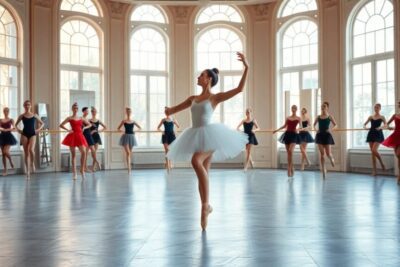
- Ballet – a codified theatrical form based on alignment, turnout, placement, controlled movement, structured vocabulary, and extensive technical training. Different schools and traditions have developed distinct approaches to ballet technique.
- Modern Dance – a broad theatrical tradition that developed during the late 19th and 20th centuries as choreographers explored alternatives to classical ballet. Modern techniques often emphasize weight, breath, the torso, grounded movement, and individual choreographic approaches.
- Contemporary Dance – an evolving form that may combine ideas from modern dance, ballet, improvisation, release-based practices, floorwork, and other movement traditions. Its vocabulary varies considerably among choreographers and companies.
- Concert Dance – not a single technique but a broad performance category for dance created primarily for an audience in theatrical or staged settings. Ballet, modern, contemporary, jazz, and tap can all function as concert dance.
The distinction between these forms is useful, but contemporary choreography frequently crosses traditional boundaries. A dancer may train in ballet while performing contemporary work, or combine several techniques within the same production.
Street and Club Dance Styles
Street and club dances often develop in social environments rather than through a single formal syllabus. Nightclubs, parties, music scenes, community gatherings, and freestyle exchanges can all become spaces where new movement vocabularies emerge and evolve.
Examples include:
- House Dance – a freestyle club form associated with house music and U.S. club culture. It is known for rhythmic footwork, fluid movement, improvisation, and a strong connection to the music.
- Punk-Related Dancing – punk scenes produced social movement practices such as pogo dancing and, in later contexts, forms of moshing. These are better understood as music-scene practices than as one codified dance technique.
- Rave Dance – a broad description for freestyle movement associated with electronic dance music and rave culture rather than a single standardized technique.
- Disco Dance – social dancing associated with the disco era and nightclub culture of the 1970s. Disco settings helped popularize partner and freestyle forms, including variations of the Hustle.
Because these forms grow within living music and social scenes, their boundaries can be less rigid than those of codified theatrical or competitive dances. Freestyle and personal interpretation are often central to how they are practiced.
Hip-Hop and Funk Dance Styles
Hip-hop and funk dance are often grouped together in popular discussions, but they do not all share the same origin. Breaking developed within early hip-hop culture in New York, while styles such as locking and popping emerged from funk-oriented dance communities on the U.S. West Coast and later became closely associated with the broader world of street dance.
Important forms and related styles include:
- Breaking – an athletic and improvisational street dance that developed in New York City during the emergence of hip-hop culture. Its vocabulary includes upright movement, floorwork, freezes, transitions, and power-based techniques. Explore more dance moves used across different styles.
- Locking – a funk style characterized by rhythmic movement, sudden stops or “locks,” expressive gestures, and a strong relationship with funk music.
- Popping – a funk-related style built around controlled muscle contractions and releases that create visible accents or “pops” in time with the music.
- Electric Boogaloo – a style associated with the broader boogaloo and popping traditions, using fluid body rolls, isolations, angles, and illusion-based movement.
- Jookin' – a Memphis street-dance tradition known for intricate footwork, gliding, balance, and movement closely connected to the city's music culture.
- Street Jazz – a contemporary fusion label commonly used for choreography that combines jazz technique and presentation with influences from hip-hop, funk, and commercial dance.
- Bounce-Related Dance – dance practices associated with New Orleans bounce music, known for energetic rhythmic movement and a strong connection between dancers, local music, and community culture.
These traditions continue to evolve through battles, clubs, choreography, social media, performance, and community practice. For that reason, terminology can differ between practitioners, regions, and generations.
How Many Types of Dance Are There?
There is no universally accepted number of dance styles. Dance is a living cultural practice, so new forms continue to appear while older traditions develop regional variations, competitive versions, theatrical adaptations, and new substyles.
The number also depends on how dance is classified. Ballet, ballroom, jazz, folk, modern, contemporary, hip-hop, street, Latin, and traditional dance can be treated as broad categories, but each category may contain numerous individual forms. Ballroom alone includes several standardized partner dances, while folk dance encompasses traditions from communities across the world.
For that reason, a useful way to understand the many types of dance is to begin with broad families and then explore the individual styles within them. This approach recognizes both the differences between dance traditions and the cultural connections that have allowed them to influence one another over time.

Discover more about the world of dance: