Salsa Dance: Definition, Meaning, Characteristics, Styles and Facts
Salsa dance is one of the most popular Latin partner dances in the world. Known for rhythmic footwork, turns, expressive body movement, improvisation, and partner connection, salsa is danced socially and competitively in clubs, studios, festivals, congresses, and cultural events around the globe.
Its character comes from the interaction of Afro-Caribbean musical and movement traditions, especially those connected with Cuba, Puerto Rican participation in the New York Latin scene, and the development of modern salsa culture in cities across the Americas. Over time, dancers created recognizable approaches such as New York On2, Los Angeles On1, Cuban Casino, Rueda de Casino, and Colombian/Cali style.
This guide explains what salsa dance is, its main characteristics, how its timing and basic steps work, the differences between major salsa styles, where people dance it, useful facts about the dance, and what beginners should know before getting started.
Table of Contents:
- What Is Salsa Dance?
- Origin and History of Salsa Dance
- Characteristics of Salsa Dance
- Salsa Music and Rhythm
- Basic Salsa Dance Steps and How Salsa Dancing Works
- Salsa Dance Styles and Types
- Where Salsa Dance Is Performed: Venues and Social Dancing
- Salsa Dance Facts
- Is Salsa Dance Mexican?
- Tips for Learning Salsa Dance
- Why Salsa Dance Is So Popular
What Is Salsa Dance?
Salsa dance is a social Latin partner dance performed primarily to salsa music. Most partner salsa is based on a repeating rhythmic cycle in which dancers transfer weight through a sequence of steps while incorporating turns, directional changes, body movement, styling, and improvisation.
A simple salsa dance definition is that it is a partner dance in which two people interpret Latin music through coordinated footwork, timing, and connection. One partner usually leads changes in direction and patterns while the other follows those signals. These roles describe functions within the dance and are not limited to a particular gender.
Salsa dancing combines structure with spontaneity. Beginners learn a basic rhythm and recognizable movements, but social dancing is not normally a fixed choreography. Partners respond to each other and to the music in real time, which means the same dancers can move differently each time they hear a song.
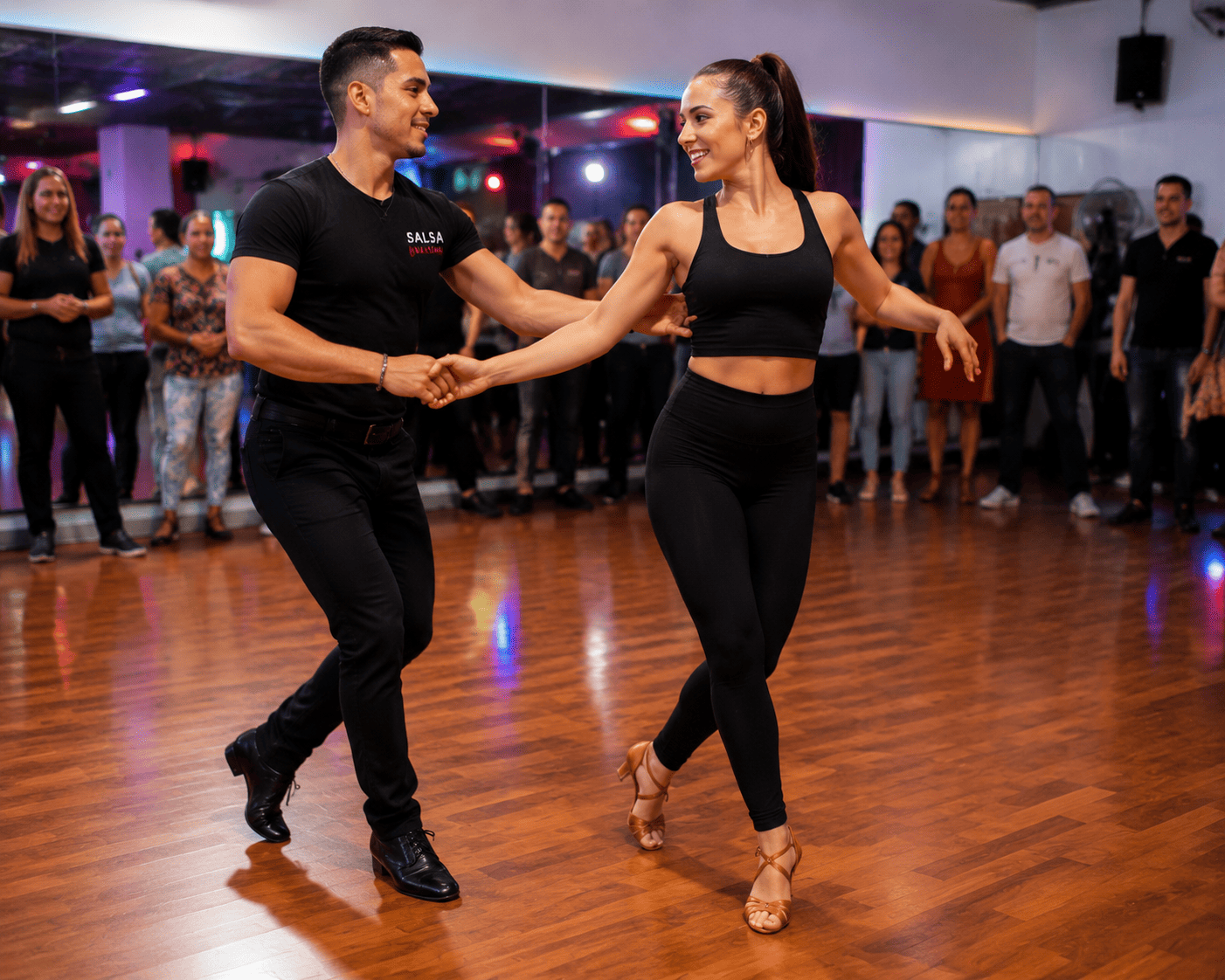
The meaning of salsa also extends beyond its steps. In many communities, the dance is associated with social connection, cultural identity, celebration, creativity, and shared musical experience. It can look playful, elegant, sensual, athletic, or dramatic depending on the style, music, setting, and dancers.
Origin and History of Salsa Dance
Salsa did not originate from one inventor or one isolated dance tradition. Its development is connected to Afro-Caribbean music and social dancing, with especially strong foundations in Cuban forms such as son, rumba, and mambo. Puerto Rican musicians, dancers, and communities also became central to the cultural environment in which modern salsa developed.
New York City became a major meeting point during the twentieth century. Cuban, Puerto Rican, other Caribbean, Latino, and African American musical cultures interacted through ballrooms, clubs, live performances, and social dancing. As salsa music gained a recognizable modern identity, dancers developed different approaches to timing, footwork, turns, and partner movement.
This is why salsa is better understood as a transnational dance than as the creation of a single country. For the complete chronology, cultural influences, pioneers, and development of the dance, see our guide to the history of salsa dance.
Characteristics of Salsa Dance
The main characteristics of salsa dance are rhythmic footwork, weight transfer, partner communication, turns, improvisation, body movement, and musical interpretation. These elements appear differently from one style to another, but together they give salsa its recognizable social-dance character.
Rhythm and weight transfer form the foundation. Salsa dancers generally take three weight-changing steps within four musical beats before repeating the pattern on the other side of the phrase. The unused beat is not simply a complete stop; body motion and rhythmic continuity can continue through it.
Partner connection allows two dancers to communicate without verbally planning each movement. The leader uses changes in direction, timing, frame, and connection to suggest a pattern, while the follower interprets those signals and maintains their own timing, balance, and movement. Effective leading should provide information rather than physically force the follower into a move.
Body movement develops naturally from changes of weight and can involve the hips, rib cage, shoulders, arms, and torso. The amount and style of movement varies greatly: Cuban Casino, New York salsa, LA style, and Cali salsa do not use the body in exactly the same way.
Turns and partner patterns give salsa much of its visual variety. Social dancers combine relatively simple movements in different sequences rather than relying only on long memorized routines.
Improvisation and musicality are equally important. Dancers can alter footwork, styling, pauses, energy, or movement quality in response to breaks, percussion, vocals, melodies, and changes in the arrangement. This makes salsa a structured dance without making it rigid.
Salsa Music and Rhythm
Salsa dance is closely connected to salsa music. The music typically combines layered percussion with piano, bass, brass, and vocals, creating several rhythmic references that dancers can use for timing and musical interpretation.
Salsa is commonly counted in an eight-count phrase: 1-2-3, 5-6-7, with dancers normally making three main weight transfers during each four-beat half of the phrase. Different styles place the break step on different beats, which is one reason two couples can dance to the same song with visibly different timing.
In On1 salsa, the directional break is associated with beat 1 or beat 5. In common New York On2 timing, the break occurs on beat 2 or beat 6. On2 should not be understood simply as “dancing to the clave”; dancers can respond to the conga, bass, piano, melody, vocals, phrasing, and other rhythmic layers as well.
The clave remains an important organizing principle in much salsa music, but dancers do not need to consciously follow every clave stroke in order to dance salsa correctly. For beginners, developing a reliable sense of the main beat and phrase is usually more useful before studying deeper musicality.
As dancers become more experienced, they learn to recognize musical breaks, changes in intensity, percussion passages, horn accents, vocal sections, and transitions. Musicality allows them to adapt their movement to what is happening in a particular song instead of performing the same patterns with the same energy every time.
Basic Salsa Dance Steps and How Salsa Dancing Works
The basic salsa dance step teaches timing and weight transfer before a dancer adds turns or complicated partner patterns. In many salsa styles, dancers make three weight changes over four beats, then repeat the movement during the second half of the eight-count phrase.
The basic is more important than it first appears. It develops balance, posture, coordination, rhythm, and control over the center of the body. A dancer with a consistent basic can usually learn partner work more efficiently because turns and combinations are built on the same underlying timing.
Common salsa movements include forward and back basics, side basics, right and left turns, cross-body leads, inside and outside turns, and solo footwork known as shines. Cuban Casino uses additional vocabulary such as enchufla and dile que no, reflecting differences between Cuban and linear salsa systems.
In partner dancing, the leader does not need to announce which movement comes next. Changes in connection and body direction communicate the intention of the movement. The follower responds while continuing to control their own steps, balance, and timing.
This makes social salsa similar to a conversation: good dancing depends less on performing the greatest number of complicated moves and more on maintaining rhythm, clear communication, comfortable connection, and awareness of the music.
Salsa Dance Styles and Types
Several recognizable salsa dance styles have developed in different cities and countries. They share overlapping musical and movement foundations but differ in timing, direction of movement, footwork, body action, partner vocabulary, and performance traditions.
The main types commonly encountered in salsa communities include New York On2, Los Angeles On1, Cuban Casino, Rueda de Casino, and Colombian/Cali style. Salsa Choke is also frequently discussed alongside salsa dancing, although it developed as a distinct Colombian urban musical and dance expression rather than simply as another timing system within traditional partner salsa.
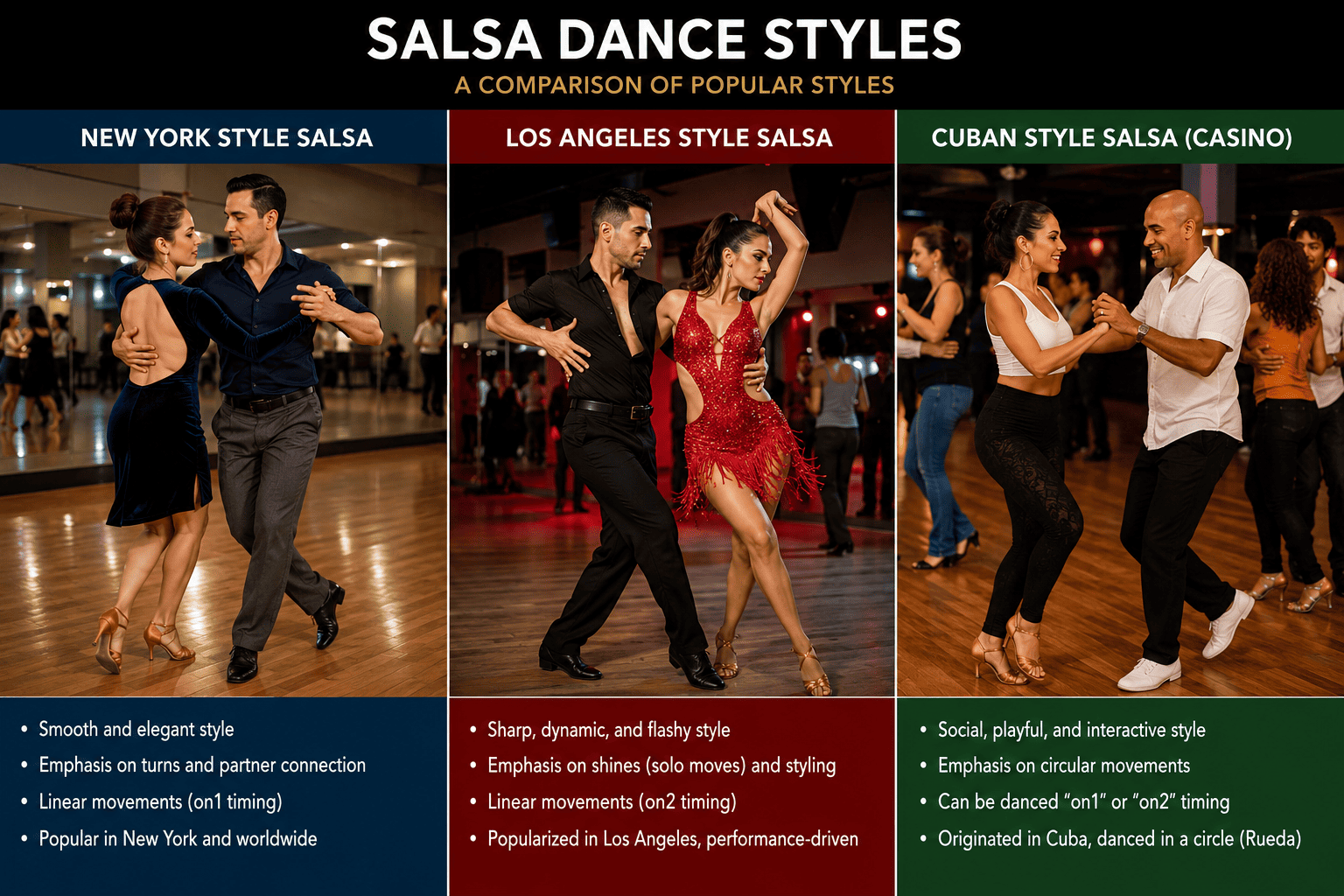
New York Style Salsa / Salsa On2
New York style salsa is closely associated with On2 timing and the mambo tradition. It is generally danced in a linear or slot-based format, meaning partners tend to exchange positions along an imaginary line rather than continuously circling around each other.
The style emphasizes controlled partner work, smooth transitions, turns, shines, and musical interpretation. Eddie Torres became especially influential in systematizing and teaching a widely recognized New York On2 method, helping transmit the style internationally.
Los Angeles Style Salsa / Salsa On1
Los Angeles style is commonly danced On1 and, like New York salsa, usually follows a linear or slot-based structure. Partners frequently change places through movements such as the cross-body lead while maintaining a clear directional orientation.
LA style became especially known for strong visual presentation, sharp turns, dramatic styling, dips, tricks, and performance-oriented combinations. These elements can be prominent in stage salsa, although social LA-style dancing does not require acrobatics or elaborate tricks.
Cuban Style Salsa / Casino
Cuban salsa is commonly known as Casino. Unlike the predominantly linear movement of New York and Los Angeles styles, partners often travel around one another using a more circular relationship.
Casino incorporates Cuban social-dance vocabulary, playful partner interaction, changes in direction, and movement influenced by the broader Cuban dance tradition. Its body action and partner mechanics can therefore look noticeably different from linear salsa even when both are danced to related music.
Rueda de Casino
Rueda de Casino transforms Casino vocabulary into a group dance. Several couples form a circle while a caller announces or signals movements that the group performs together.
Many calls involve partner changes, synchronized figures, or playful interactions between couples. Because dancers must recognize calls and respond at the correct moment, Rueda combines social connection with timing, memory, and group coordination.
Colombian / Cali Style Salsa
Colombian salsa, particularly the style associated with Cali, is famous for rapid and intricate footwork, rhythmic precision, and energetic lower-body movement. The style developed within Colombia's exceptionally strong salsa culture and can look very different from New York or Los Angeles slot-style dancing.
Cali-style dancers frequently emphasize fast steps and musical accents rather than relying primarily on elaborate turn patterns. Performance versions can be extremely athletic, but social forms also exist and do not necessarily use the speed or complexity seen in competitions.
Salsa Choke
Salsa Choke emerged in Colombia as an urban music and dance expression influenced by salsa and contemporary Afro-Colombian and urban culture. Its movement is typically more grounded and individual than traditional partner salsa, with repeated steps and body grooves that fit its distinctive musical style.
It is therefore useful to distinguish Salsa Choke from styles such as New York On2, LA On1, or Cuban Casino. Those forms represent different approaches within partner salsa, while Salsa Choke developed through its own Colombian urban context. Its popularity nevertheless demonstrates how the wider salsa tradition continues to inspire new forms of music and movement.
The most characteristic setting for salsa is the social dance, where people dance with different partners rather than performing a predetermined routine. Salsa socials can take place in studios, clubs, restaurants, community centers, festivals, outdoor spaces, and dedicated Latin dance venues.
Latin clubs and weekly salsa nights give dancers an opportunity to apply timing, leading, following, and musicality in a real social environment. Partner rotation is common, which helps dancers become comfortable adapting to people with different movement styles and levels of experience.
Salsa also has a strong performance culture. Competitions, congresses, showcases, and cultural festivals may feature choreographed routines with synchronized shines, lifts, tricks, costume design, and theatrical presentation. Performance salsa often emphasizes visual impact more strongly than social dancing, where comfort, improvisation, and partner communication are usually more important.
Today, active salsa communities can be found throughout the Americas, Europe, Asia, Africa, and other regions. New York, Los Angeles, Miami, San Juan, Havana, and Cali remain culturally important locations, but salsa has developed into a genuinely international social dance.
Salsa Dance Facts
These salsa dance facts highlight some of the features that make the dance historically and socially distinctive:
- No single person invented salsa dance. It developed gradually from earlier Caribbean music and movement traditions and later urban social-dance culture.
- Salsa is not originally Mexican. Mexico has an important salsa community, but the dance's principal historical connections are with the Caribbean and New York.
- Most salsa uses three main weight changes across four beats. Those steps repeat during the second half of an eight-count musical phrase.
- On1 and On2 are timing approaches, not completely different dances. They change where the break step occurs and influence the rhythmic feel of the movement.
- Partner roles are not inherently gender-specific. “Leader” and “follower” describe the functions dancers perform when communicating movement.
- Salsa dancers do not remain connected at all times. During shines, partners can separate and perform individual footwork before reconnecting.
- Rueda de Casino involves multiple couples and a caller. Partners may change repeatedly as the entire circle responds to announced movements.
- Social salsa and performance salsa have different priorities. Social dancing relies heavily on improvisation and partner communication, while stage routines may emphasize choreography and visual effects.
- Salsa has developed several regional movement systems. New York, Los Angeles, Cuba, and Cali all produced recognizable approaches rather than one universal way of dancing salsa.
- Salsa is now a global social dance. International congresses, schools, festivals, and local communities have spread it far beyond the Caribbean and the United States.
These facts also show why salsa cannot be described accurately as only a set of steps. Its identity comes from the interaction of music, culture, partner communication, regional traditions, and continuous adaptation.
Is Salsa Dance Mexican?
No. Salsa dance is not originally Mexican, although salsa is popular in Mexico and the country has developed important dance communities, musicians, instructors, clubs, and festivals.
The historical foundations of salsa are principally Afro-Caribbean, with especially important Cuban musical and movement influences, Puerto Rican participation, and later development within New York's Latin cultural scene. Salsa subsequently spread throughout Latin America, including Mexico.
This distinction between origin and popularity is important. A dance can become deeply established in a country without having originated there, and salsa's international growth has allowed many communities to contribute to the way it is practiced today.
Tips for Learning Salsa Dance
The best way to begin learning salsa dance is to become comfortable with timing and weight transfer before trying complicated turns. Practice the basic slowly until you can change weight without looking at your feet and remain relaxed while keeping the rhythm.
A beginner class can help establish posture, balance, frame, partner connection, and safe turning technique. Learning from an instructor also reduces the risk of developing habits such as pulling with the arms, taking unnecessarily large steps, or using force to lead a partner.
Listening to salsa music outside class is just as useful as practicing movements. Try identifying the main pulse, counting phrases, and noticing where choruses, percussion passages, breaks, or horn sections change the energy of a song. Musical familiarity makes timing increasingly intuitive.
Beginners should also practice with different partners. Social salsa requires adaptation, so dancing only with one person can make it harder to develop clear leading or responsive following.
Finally, attend salsa socials before you feel “advanced enough.” Start with movements you already control rather than testing every new combination. Social dancing develops skills that cannot be learned completely from choreography or videos, including floor awareness, partner adaptation, musical response, and confidence.
Why Salsa Dance Is So Popular
Salsa dance remains popular because it combines music, physical movement, social interaction, cultural expression, and improvisation. Beginners can participate after learning a relatively small amount of vocabulary, while experienced dancers can continue developing timing, musicality, body movement, partner technique, and personal style for years.
Its diversity is another reason for its longevity. A dancer may prefer the smooth linear movement of New York On2, the visual energy of LA On1, the circular interaction of Cuban Casino, the rapid footwork of Cali style, or the collective experience of Rueda de Casino.
Despite those differences, the essential appeal remains similar: people meet, listen to music, communicate through movement, and create something that is partly structured and partly spontaneous. That combination has helped salsa dancing grow from its Caribbean and New York foundations into one of the world's most enduring social dance traditions.
Contra Dance: Definition, History & How It Works
Square Dance: Meaning & History
Ice Dance: Meaning, History, Rules, Moves and Olympic Facts
Salsa Music: Origins, Rhythm, Instruments & History

Ghost Dance: Meaning, History, and Native Legacy
Argentine Tango: Meaning, History, Music, Milonga and Dance Style
Discover more about the world of dance: