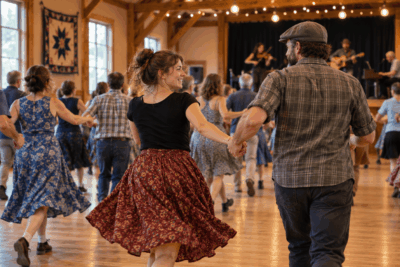
Line Dancing: History, Styles, and How to Get Started
Line dancing is a choreographed group dance in which people perform the same sequence of steps in lines or rows, usually without physical contact with a partner. Dancers move together through repeated counts, turns, and patterns while facing one or more directions, often called “walls.”
Although many people associate line dancing with country music, it is not limited to country songs. Line dances are performed to country, pop, disco, R&B, soul, Latin, hip-hop, rock, and other styles of music. From the Electric Slide and Cupid Shuffle to country favorites and community-based R&B routines, line dancing has developed into a broad social dance practice in the United States and around the world.
This guide explains what line dancing is, how it developed, where its influences came from, the main types and difficulty levels, basic steps, well-known routines, and practical tips for getting started.
Table of Contents:
- What Is Line Dancing?
- History of Line Dancing
- Where Did Line Dancing Originate?
- How Line Dancing Works
- Types of Line Dancing
- Common Line Dances
- Basic Line Dancing Steps for Beginners
- Why Line Dancing Is Popular
- Learning Line Dancing: Tips for Beginners
- Line Dance Events and Competitions
- Frequently Asked Questions About Line Dancing
- Conclusion
What Is Line Dancing?
Line dancing is a form of group dancing in which participants follow a choreographed sequence while arranged in rows or lines. Dancers generally begin facing the same direction and perform the same steps and turns at the same time. Most routines do not require partners, so people can join individually while still participating as part of a group.
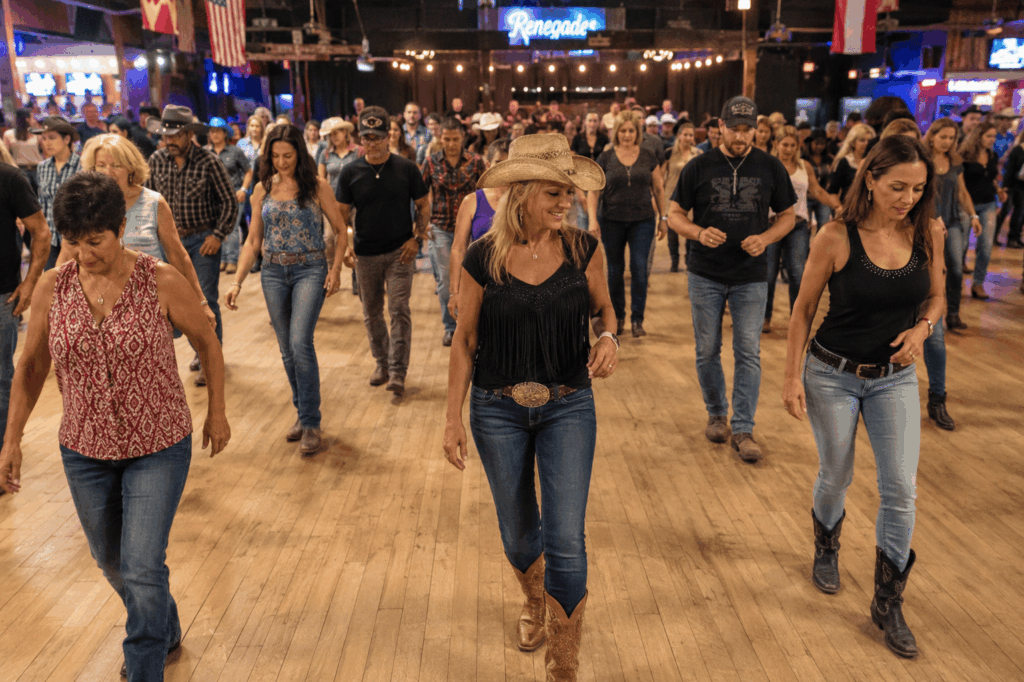
A routine is usually organized around a fixed number of musical counts, such as 16, 32, 48, or 64. When the sequence ends, dancers begin it again. Many dances also change direction between repetitions, creating one-wall, two-wall, or four-wall patterns.
What Is a Line Dance?
A line dance is one specific choreographed routine, with its own sequence of steps, timing, turns, musical interpretation, and difficulty level. Some dances are short and beginner-friendly, while others include syncopation, tags, restarts, faster turns, and more complex footwork.
What Are Line Dances Used For?
Line dances are performed for recreation, social connection, instruction, exercise, competition, and entertainment. They are common at country bars, dance halls, weddings, festivals, community centers, clubs, schools, studios, and family celebrations.
Because most routines do not require partners, the format works especially well at social events where individuals can join the dance floor without first finding someone to dance with.
History of Line Dancing
The history of line dancing does not begin with a single inventor or one clearly defined moment. Modern line dance developed gradually within a much broader history of group and social dancing. Older folk, contra, square, country-western, and other community dances used repeated figures and organized formations, while later popular-music culture helped shape the choreographed line dance format recognized today.
These traditions are best understood as influences and antecedents rather than as one simple, continuous lineage leading directly to modern line dancing.
Early Group and Folk Dance Influences
Organized group dancing existed long before the modern term line dance. Traditional folk dances in Europe and elsewhere frequently used lines, circles, chains, and other formations in which participants repeated shared movement patterns.
American contra dance and square dance also developed around organized formations, repeated figures, musical phrasing, and community participation. They are distinct dance traditions rather than early versions of modern line dancing, but they belong to the broader history of structured social group dance.
1950s–1970s: Modern Group Choreography Expands
By the late 1950s and early 1960s, dances such as the Madison helped make choreographed line formations more visible in American popular culture. Television, recorded music, clubs, and social dance spaces helped specific routines spread beyond the communities where they first became popular.
The 1970s brought another important period of development. Disco dancing encouraged synchronized social routines and choreographies that could be learned and repeated in groups. Not every disco group dance was a line dance, but the era helped normalize organized social dancing outside traditional partner holds.
1980s–1990s: The Country Line-Dance Boom
During the 1980s, country-western dance culture provided an increasingly important setting for line dancing in the United States. Honky-tonks, dance halls, country bars, instructors, and classes helped dancers learn named routines and share them with wider communities.
The association became especially visible during the early 1990s, when country line dancing experienced a major national boom. Popular country songs, music videos, dance instruction, and routines performed in western venues helped make the style part of mainstream American popular culture.
Line Dancing Beyond Country Music
At the same time, group choreography continued developing outside country-western settings. The Electric Slide and later dances such as the Cha-Cha Slide, Cupid Shuffle, and Wobble became familiar at weddings, parties, reunions, clubs, schools, and community events.
Today, line dancing is also an international practice. Choreographers, instructors, competitions, social events, and online communities continue to create and circulate new routines across different musical traditions.
Where Did Line Dancing Originate?
There is no single birthplace that completely explains the origin of line dancing. Modern line dancing became especially prominent within American social-dance culture, while drawing on older traditions of organized group dancing and later developing into an international dance practice.
Country-western culture became one of its strongest public associations in the United States, but line dancing did not simply originate as country dancing. Folk and community dance traditions, popular social dances, disco, R&B, soul, pop, and other musical cultures have all contributed to the broader development of the form.
Who Invented Line Dancing?
No single person invented line dancing. The broader dance form developed gradually through the work of many dancers, choreographers, teachers, and social communities. Individual routines can have identifiable creators, but line dancing itself cannot be credited to one inventor.
How Line Dancing Works
Line dancing combines a choreographed sequence with musical counts. Dancers stand in organized rows, learn the same pattern, and repeat it as the music continues. Once the sequence becomes familiar, dancers can concentrate more on rhythm, timing, musicality, direction, and styling.
Basic Formation
Dancers commonly stand side by side and front to back, creating rows across the floor. Everyone generally begins facing the same direction and performs the choreography together. The formation may include only a few participants or enough dancers to fill a large venue.
What Is a Wall in Line Dancing?
In line dancing, a wall refers to the direction dancers face in relation to the room as the choreography repeats. The number of walls describes the orientation at the beginning of successive repetitions, not whether dancers turn during the routine itself.
- One-wall dance: each full repetition begins facing the same wall.
- Two-wall dance: successive repetitions generally alternate between two opposite walls.
- Four-wall dance: repetitions move through all four sides of the room, commonly through quarter-turn changes.
A routine can still contain turns within any of these structures. What determines the wall count is the direction in which successive repetitions begin.
Counts, Tags, Restarts, and Repeated Patterns
Most line dances are organized by musical counts. Beginner routines often use relatively simple 16- or 32-count patterns, while more complex choreography may contain 48, 64, or more counts along with syncopation, tags, restarts, and changes in rhythm.
Repetition can make many beginner dances easier to remember, but advanced line dancing can demand considerable timing, balance, musical awareness, and memory.
Types of Line Dancing
There is no single universal list of the types of line dancing. Routines can be grouped by music and dance culture or by technical difficulty. Different instructors, communities, and competitive organizations may use somewhat different terminology.
Country Line Dancing
Country line dancing is one of the most widely recognized forms of line dancing in the United States. It is strongly associated with country music, western dance halls, honky-tonks, rodeos, festivals, and social dance events.
Country routines commonly use steps such as vines, heel digs, toe taps, shuffles, rocking actions, and turns. The country boom of the early 1990s helped introduce this style to a much larger national audience.
R&B and Soul Line Dancing
R&B and soul line dancing is an important social dance tradition in many African American communities in the United States. Sometimes described as R&B, soul, or urban line dancing, it includes community-based classes, social gatherings, choreographers, instructors, and shared repertoires danced to R&B, soul, funk, hip-hop, and related music.
These traditions demonstrate that American line dance culture extends well beyond country-western settings. Dances may emphasize groove, musical interpretation, social participation, and styling that reflect the music and communities in which the routines develop.
Pop and Party Line Dances
Pop and party line dances are especially common at weddings, school dances, clubs, reunions, and family celebrations. Many use recognizable songs and repeated choreography designed to encourage large groups to participate.
Examples include the Electric Slide, Cupid Shuffle, Cha-Cha Slide, Macarena, and Wobble.
Latin-, Street-, and Hip-Hop-Influenced Line Dances
Some choreographies draw on Latin, hip-hop, funk, street-dance, pop, or other movement influences. They may include syncopated footwork, body movement, slides, arm patterns, rhythmic accents, and styling that differs from traditional country routines.
Beginner, Improver, Intermediate, and Advanced Levels
Line dances are also classified by difficulty. Beginner routines typically use familiar steps, predictable timing, and relatively simple direction changes. Improver and intermediate dances may add faster turns, syncopation, tags, restarts, and more complex combinations.
Advanced choreography can require stronger musicality, balance, memory, timing, styling, and technical control. Difficulty labels vary between instructors and organizations, so the same dance may not always receive exactly the same classification.
Common Line Dances
Some routines have become social-dance classics because they are widely recognized and frequently performed at public events. Others became closely associated with particular songs or periods in popular dance culture.
Electric Slide
The Electric Slide is one of the best-known social line dances. It is closely associated with “Electric Boogie” by Marcia Griffiths and uses repeating side travel, backward movement, touches, and directional change. It remains common at weddings, parties, reunions, and community events.
Cupid Shuffle
The Cupid Shuffle uses instructions embedded in the song to guide dancers through movements to the right and left, kicks, and the “walk it out” section. The musical cues make the routine accessible in social settings where many participants may not already know the choreography.
Cha-Cha Slide
The Cha-Cha Slide is an instruction-based group dance in which the lyrics call out actions such as sliding, stomping, clapping, hopping, turning, and reversing. This call-and-response structure helps large groups participate together.
Macarena
The Macarena became one of the most recognizable group dances of the 1990s. It is often classified more broadly as a novelty or party dance, but its repeated group choreography and directional change mean it is frequently discussed alongside social line dances.
“Boot Scootin’ Boogie” and the Country Line-Dance Boom
“Boot Scootin’ Boogie” is a country song rather than the name of one single universal choreography. However, dances performed to the song became strongly associated with the early-1990s country line-dance boom and helped reinforce the cultural connection between line dancing, country music, and western dance halls.
Basic Line Dancing Steps for Beginners
Many beginner line dances use a relatively small vocabulary of common steps. Learning these movements makes it easier to recognize patterns in new routines and follow instruction without having to learn every action from scratch.
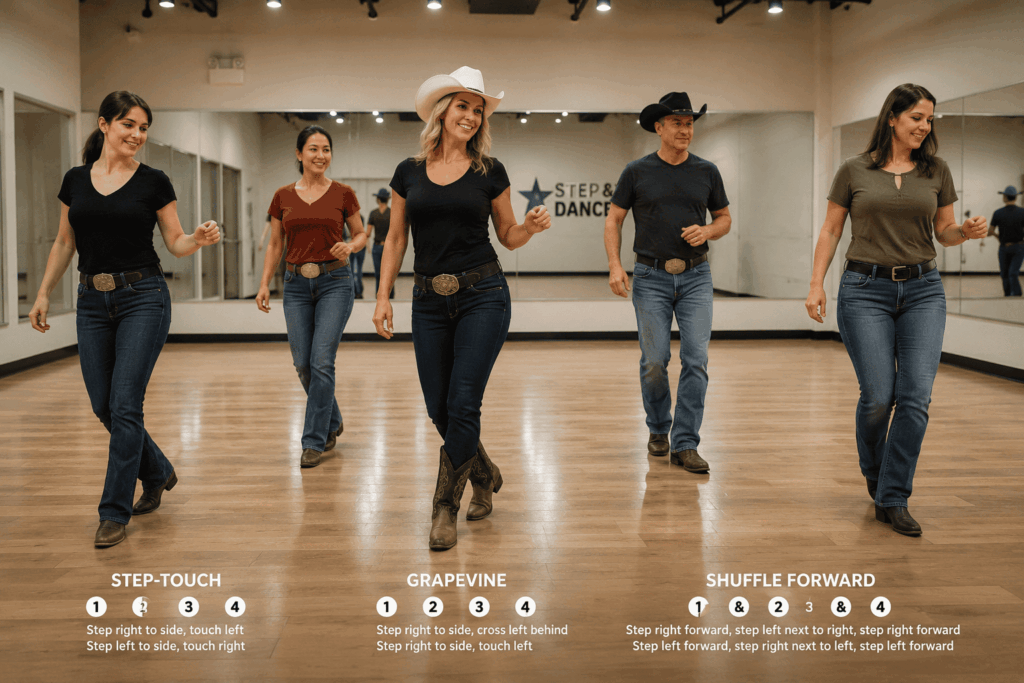
Step-Touch
The step-touch is one of the simplest movements. A dancer steps to one side with one foot and brings the other foot beside it for a touch. The pattern can then repeat in the opposite direction.
Grapevine
The grapevine, often shortened to vine, travels sideways. A common version steps to the side, crosses one foot behind, steps sideways again, and finishes with a touch, kick, or another movement depending on the choreography.
Shuffle Step
A shuffle is a quick triple-step action commonly counted with a subdivision such as “one-and-two.” Depending on the routine, it can travel forward, backward, sideways, or through a turning pathway.
Kick-Ball-Change
The kick-ball-change combines a small kick with two quick weight changes. It appears in several dance styles and is frequently used in faster or more rhythmically complex line dance combinations.
Quarter Turns
Quarter turns rotate the dancer approximately 90 degrees to the right or left. They are particularly important in four-wall choreography, where successive repetitions may begin facing different sides of the room.
Why Line Dancing Is Popular
Line dancing combines social participation with a relatively accessible starting point. Most routines do not require partners, so people can arrive alone and still participate as part of a group. Beginner dances often use recognizable counts and repeated patterns, while more difficult choreography gives experienced dancers room to develop musicality, memory, timing, technique, and personal styling.
Its musical flexibility also contributes to its popularity. Country remains one of its strongest traditions, but R&B, soul, pop, disco, Latin, hip-hop, rock, and other genres support their own routines and communities. The activity also provides physical movement while challenging rhythm, coordination, balance, directional awareness, and memory.
Learning Line Dancing: Tips for Beginners
Beginners usually progress more comfortably when they start with simple routines and concentrate on the basic sequence before worrying about styling. The first goal is to recognize the pattern, stay with the music, and learn how to recover when a mistake happens.
Start With Beginner-Friendly Dances
Routines such as the Electric Slide and other short dances with clear counts can help beginners understand timing, repetition, and direction changes before moving into more complex choreography.
Learn the Counts Before the Styling
Focus first on foot placement, weight changes, direction, and timing. Once the sequence feels familiar, styling can be added without interfering with the basic choreography.
Practice With Tutorials or Classes
Classes, workshops, social dance nights, and online tutorials can all be useful. Instructors can explain terminology and weight changes in real time, while videos make it possible to repeat difficult sections at home.
Learn How to Rejoin the Dance
Missing a step does not mean a dancer needs to stop completely. In social line dancing, it is often better to keep moving, watch the people nearby, find the count again, and rejoin the choreography at a familiar point.
Line Dance Events and Competitions
Line dancing ranges from casual social participation to structured training and competition. The setting determines whether the emphasis is primarily on recreation, learning choreography, improving technique, or performance.
Social Dance Nights
Social dance nights take place in country bars, clubs, dance halls, community centers, studios, and private events. They commonly combine established favorites with newer routines taught by instructors or experienced dancers.
Workshops and Classes
Beginner classes focus on terminology, basic steps, counts, direction, and confidence. More advanced workshops may introduce musical interpretation, styling, faster turns, syncopation, tags, restarts, and increasingly complex choreography.
Competitions and Performances
Competitive line dance can include divisions based on factors such as skill level, age, choreography, or musical style. Rules and classifications vary by organization, but competitions demonstrate that the form can function both as an accessible social activity and as a technically demanding performance discipline.
More articles about Dance List
Explore more guides and related content about Dance List.
See more about Dance ListFrequently Asked Questions About Line Dancing
How many different line dances are there?
There is no fixed total. Thousands of choreographies have been created, and new routines continue to appear for many different kinds of music. Some become international standards, while others remain popular only within particular communities or for a limited period.
Can one line dance be performed to different songs?
Yes. Some choreographies are strongly associated with one particular song, while others can be performed to different tracks with compatible tempo, rhythm, phrasing, and musical structure.
Conclusion
Line dancing is a flexible form of social choreography shaped by older group-dance traditions, American country-western culture, R&B and soul communities, disco, popular music, and modern international dance culture. From simple social routines to advanced competitive choreography, it continues to bring people together through repeated movement, shared music, and the experience of dancing as a group.
Contra Dance: Definition, History & How It Works
Square Dance: Meaning & History
Ice Dance: Meaning, History, Rules, Moves and Olympic Facts
Salsa Music: Origins, Rhythm, Instruments & History
Ghost Dance: Meaning, History, and Native Legacy
Argentine Tango: Meaning, History, Music, Milonga and Dance Style
Discover more about the world of dance: