Ghost Dance: Meaning, History, and Native Legacy
The Ghost Dance was a Native American religious movement of the late 19th century centered on spiritual renewal, reunion with the dead, and hope for a transformed world. Its best-known form spread rapidly in 1889–1890 through the teachings of the Northern Paiute prophet Wovoka and was adapted by different Native nations according to their own histories, beliefs, and circumstances.
Wovoka’s teachings emphasized peaceful conduct, but U.S. officials and settlers often interpreted the growing movement as a possible threat. That fear contributed to escalating federal and military pressure on Native communities and became closely connected with the Wounded Knee Massacre of 1890.
The Ghost Dance is therefore important not simply as a form of dance, but as an example of dance functioning as religious ceremony, community practice, and a response to profound historical crisis.
Table of Contents:
- Ghost Dance Definition and Meaning
- Ghost Dance History
- Wovoka: The Paiute Prophet Behind the Ghost Dance
- The Ghost Dance Movement
- Native American Ghost Dance and Its Spread Across Native Nations
- Ghost Dance and the Wounded Knee Massacre
- Suppression, Change, and Continuation of the Ghost Dance
- Legacy and Modern Status of the Ghost Dance
- Historical Documentation and Study of the Ghost Dance
- Frequently Asked Questions About the Ghost Dance
- Conclusion
Ghost Dance Definition and Meaning
The Ghost Dance was a spiritual and ceremonial movement practiced by Native American communities during the late 19th century. Participants gathered for circle dancing, sacred songs, prayer, and other religious practices connected with teachings about renewal and reunion with deceased relatives and ancestors.
In U.S. history, the movement is significant because it developed during a period of land loss, reservation confinement, assimilation policies, disrupted food systems, and government pressure on Native religions and cultures. Different Native nations adapted its message in different ways, so there was no single identical set of beliefs or ceremonial practices shared by every participant.
What Was the Ghost Dance?
The Ghost Dance was a religious revival that offered hope during a period of extreme upheaval. Wovoka taught that people should live peacefully and morally and participate in a sacred communal dance connected with the coming renewal of the world.
Teachings associated with the movement included reunion with the dead and the restoration of a more abundant life. As the religion traveled, communities interpreted those promises through their own experiences. Among some Plains peoples, for example, hopes for the return of the bison became especially important.
Why Is It Called the Ghost Dance?
The English name “Ghost Dance” became associated with the movement because reunion with deceased relatives and ancestors was central to many accounts of its teachings. Historical terminology and translations varied, so the word “ghost” should not be understood in the modern horror or entertainment sense.
For believers, relationships with the dead were connected with kinship, restoration, religious experience, and the hope that separation caused by death and colonial violence would not be permanent.
Ghost Dance Meaning in Native American History
In Native American history, the movement is important as a religious response to conquest, dispossession, cultural suppression, and social disruption. It gave participating communities a way to maintain religious identity and imagine renewal while federal policies were attempting to transform Native landholding, education, religion, and community life.
Ghost Dance History
The history of the Ghost Dance is more complex than a single movement beginning suddenly in 1890. An earlier Ghost Dance revival developed among Northern Paiute communities in the late 1860s and early 1870s around the prophet Wodziwob. Wovoka’s later teachings produced the much wider movement that spread through the West and Great Plains in 1889 and 1890.
The Library of Congress documents this longer history, helping distinguish the earlier Paiute revival from the movement most closely associated with Wovoka and the events surrounding Wounded Knee.
Historical Context in the United States
By the late 19th century, many Native nations had endured warfare, forced removal, confinement to reservations, land loss, broken treaty commitments, and federal efforts to restructure Native society. Allotment policies divided communally held lands, while boarding schools, missions, and government agents pressured Native people to abandon languages, religions, and cultural practices.
Conditions were especially severe in many Plains communities. The destruction of the great bison herds undermined food systems, economies, and cultural practices, while inadequate government rations and reservation poverty intensified hardship. The promise of religious renewal therefore emerged within a real material and political crisis.
Paiute Roots and Earlier Religious Revival
The movement associated with Wovoka did not emerge without precedent. Wodziwob and other Northern Paiute religious leaders had already connected prophecy, communal dancing, visions, and renewal during the previous generation.
Wovoka developed a distinct message emphasizing peaceful behavior, moral living, work, and ceremonial practice. Visitors from other Native nations traveled to Nevada to hear his teachings and later adapted what they learned to their own communities.
Circle Dancing in the Ghost Dance
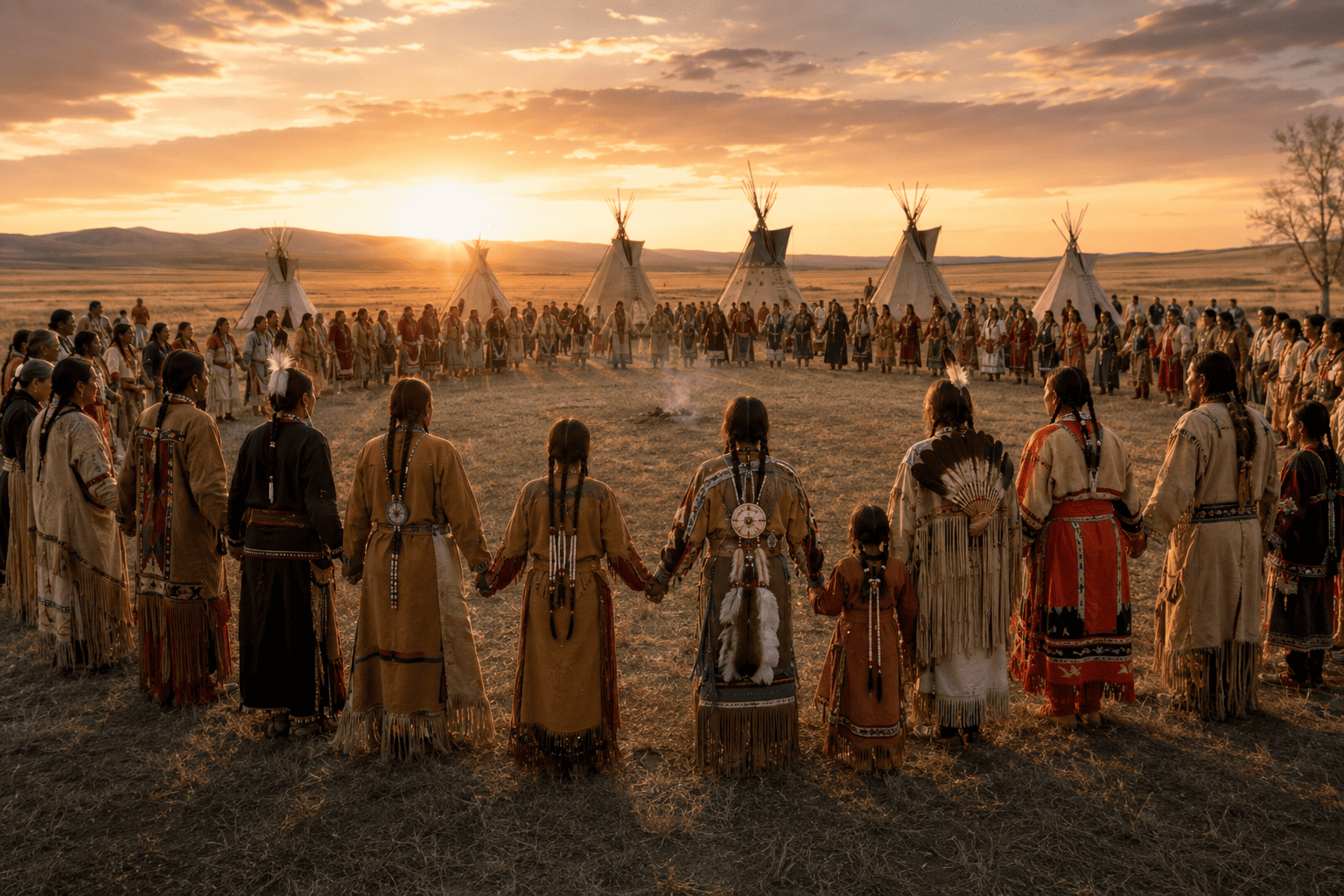
The Ghost Dance used a communal circle-dance form already familiar in different Native communities. Historical accounts describe participants moving together in a circle while singing religious songs, sometimes continuing for extended periods.
The meaning and performance of circular dancing varied among Native cultures, so the form should not be assigned one universal Indigenous symbolism. Its adaptability allowed participating communities to incorporate the ceremony into their own religious traditions.
Wovoka: The Paiute Prophet Behind the Ghost Dance
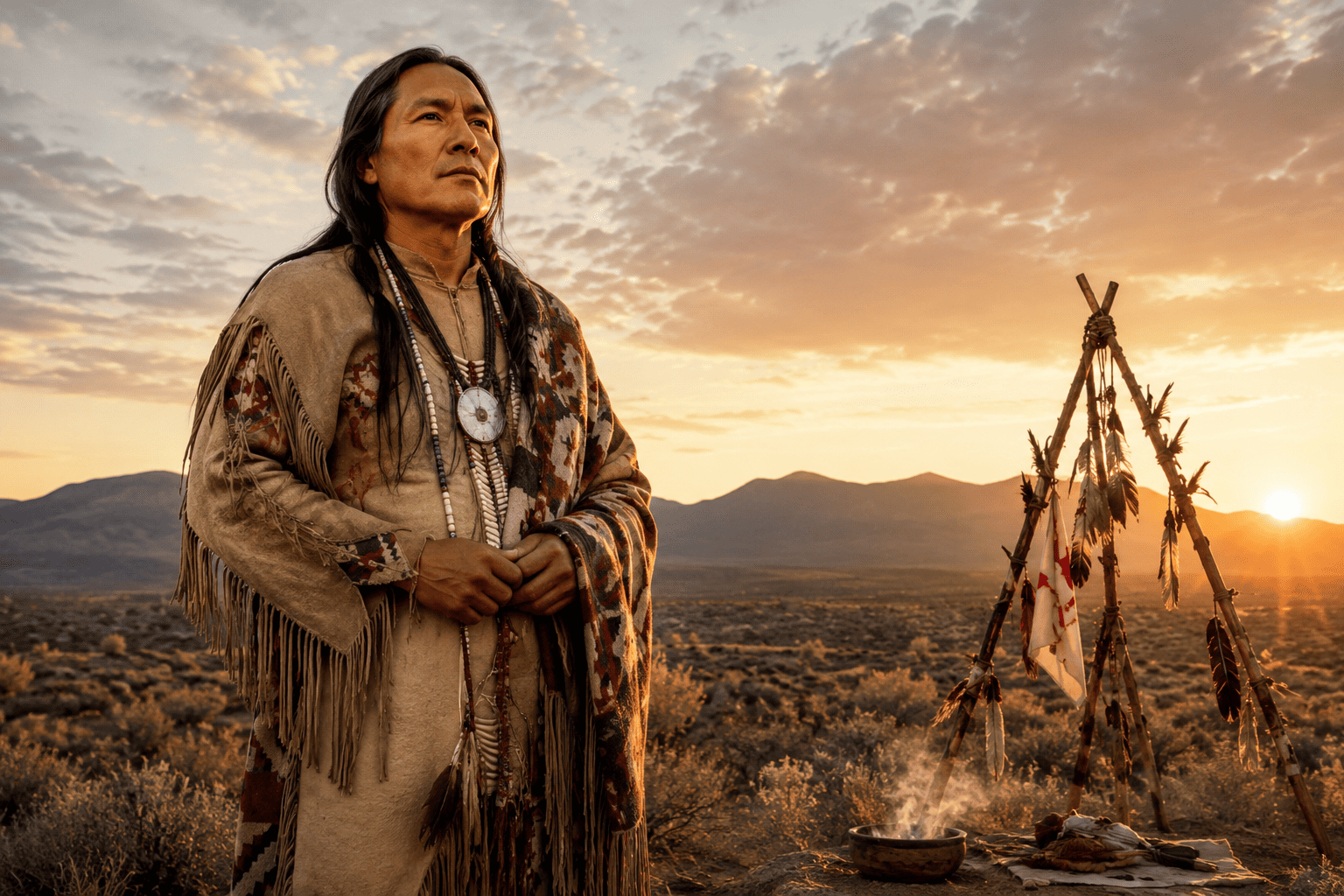
Wovoka, also known as Jack Wilson, was the Northern Paiute spiritual leader at the center of the Ghost Dance revival of 1889–1890. He lived in Nevada and grew up during a period of major political and economic change for Native peoples in the American West.
Wovoka had contact with both Northern Paiute religious traditions and Christianity. His teachings emerged from this particular cultural and historical setting rather than representing a simple continuation of either tradition alone.
Wovoka’s Vision
Wovoka described a powerful religious experience associated with the solar eclipse of January 1, 1889. Accounts of his message describe a renewed world in which the dead returned, Native people were restored, suffering ended, and people lived peacefully.
He taught followers to behave morally, avoid violence, work, and perform the ceremonial dance. Representatives from other Native nations traveled to Nevada to meet him and carried versions of his message home.
The Peaceful Message of the Ghost Dance
Wovoka’s teachings emphasized peaceful relations rather than armed war against the United States. This distinction is important because later government and newspaper accounts frequently portrayed the growing religion as evidence of impending rebellion.
The movement was not practiced identically everywhere, however. Native nations interpreted Wovoka’s prophecy in light of their own religious traditions, losses, political conditions, and expectations.
The Ghost Dance Movement
The Ghost Dance movement spread across cultural and linguistic boundaries because Native communities could interpret its message within their own experiences. Participants did not form a single political organization, nor did every community practice an identical religion.
What Was the Purpose of the Ghost Dance Movement?
The central purpose was religious renewal. Followers sought connection with deceased relatives and ancestors and hoped for a transformed world in which suffering and disruption would end. In some communities, expectations also included restored food sources, land, and older ways of life.
The movement also strengthened community ties and allowed Native people to practice a shared sacred tradition while U.S. assimilation policies were placing Indigenous religions and identities under intense pressure.
The Ghost Dance Ceremony
In many communities, ceremonies involved participants moving together in a circle while singing sacred songs. Dances could continue for long periods, and some participants reported visions or trance-like religious experiences involving relatives, ancestors, or the promised renewed world.
Details differed among Native nations and should not be treated as one fixed ritual. The Ghost Dance should also not be confused with the Sun Dance ceremony, which is a distinct ceremonial tradition with its own histories and meanings.
Ghost Shirts, Songs, and Sacred Symbols
Songs were central to Ghost Dance practice and carried religious teachings, visions, and hopes for renewal. Communities developed their own song repertories as the religion spread.
Among some Lakota followers, special garments later called Ghost Shirts became particularly important. Some adherents believed these garments offered supernatural protection, including protection from bullets. That belief was associated especially with Lakota adaptations and should not be presented as a universal Ghost Dance teaching or as part of Wovoka’s original message.
Who Were the Ghost Dancers?
Ghost Dancers were Native men, women, and children who participated in the religious ceremonies. Followers came from a number of Native nations and communities, including Northern Paiute, Lakota, Cheyenne, Arapaho, Shoshone, Kiowa, and others.
They were not members of a single army or political organization. Participation was religious and communal, although the movement inevitably carried wider social and political significance because it developed under conditions of federal control, dispossession, and forced assimilation.
Native American Ghost Dance and Its Spread Across Native Nations
The Native American Ghost Dance spread rapidly in 1889 and 1890 as representatives from other Native nations traveled to Nevada to learn about Wovoka’s teachings. They returned home with accounts of his prophecy, songs, ceremonial practices, and instructions.
The religion became intertribal without becoming culturally uniform. Each participating nation interpreted it through existing beliefs, political circumstances, and community needs.
Lakota, Cheyenne, Arapaho, Shoshone, and Other Native Nations
The movement reached Lakota, Cheyenne, Arapaho, Shoshone, Kiowa, and other Native communities. The Lakota became especially prominent in later historical accounts because the federal response to Lakota participation was closely connected with the crisis that ended at Wounded Knee.
Lakota interpretations reflected their own circumstances, including reservation hardship, land loss, deceased relatives, and the devastating disappearance of the bison herds. These adaptations should not automatically be projected onto every Native nation that practiced the religion.
How Wovoka’s Message Spread
Wovoka’s message traveled through visiting delegations, oral communication, ceremonial songs, personal networks, and written messages. Native representatives observed the religion in Nevada and returned to teach versions of it in their own communities.
The Library of Congress notes that letters were also circulated by movement leaders explaining the vision and ceremony. The religion therefore spread through both oral and written Indigenous communication networks.
Why U.S. Authorities Feared the Ghost Dance
Many U.S. officials interpreted large religious gatherings and rapidly spreading prophecies as evidence that Native communities might unite in resistance to federal authority. Sensational newspaper reporting and local settler fears intensified that perception.
The resulting response included surveillance, demands that ceremonies stop, attempts to arrest Native leaders, and eventually military intervention. The gap between the movement’s religious meaning and the threat imagined by federal authorities became particularly consequential among the Lakota.
Ghost Dance and the Wounded Knee Massacre
The Ghost Dance became permanently linked in U.S. historical memory with the Wounded Knee Massacre of December 29, 1890. The movement did not by itself cause the massacre, but government fear of Lakota Ghost Dance participation formed an important part of the escalating crisis.
What Led to the Wounded Knee Massacre?
The events leading to Wounded Knee involved multiple factors: reservation hardship, distrust between Lakota communities and federal authorities, fear surrounding the Ghost Dance, increasing military presence, and government efforts to arrest leaders believed to be associated with unrest.
Sitting Bull was killed on December 15, 1890, during an attempt by Indian police to arrest him at Standing Rock. His death intensified fear and instability. Some of his followers later joined Spotted Elk, a Miniconjou Lakota leader also known in historical U.S. sources as Big Foot.
Spotted Elk and his group were traveling toward Pine Ridge when U.S. troops intercepted them and escorted them to a camp near Wounded Knee Creek.
What Happened at Wounded Knee?
On December 29, 1890, soldiers of the U.S. Seventh Cavalry surrounded Spotted Elk’s Lakota camp and attempted to disarm the people there. During the tense disarmament, a shot was fired and U.S. troops opened fire.
Lakota men, women, and children were killed. Estimates vary, with commonly cited historical figures ranging roughly from 150 to 300 Lakota deaths; about 250 is also frequently cited. Wounded Knee is widely remembered as a massacre rather than simply a conventional military battle.
How the Ghost Dance Was Misunderstood
Government officials often viewed ceremonies, prophecies, large gatherings, and Ghost Shirts primarily through the possibility of armed rebellion. This interpretation obscured the religious dimensions of the movement and the diversity of beliefs held by participants.
Wounded Knee consequently became a powerful example of what can happen when religious practice, political fear, military force, and colonial authority converge.
Suppression, Change, and Continuation of the Ghost Dance
Wounded Knee severely disrupted the Ghost Dance among some communities and increased fear of federal punishment, but the religion did not simply disappear after 1890. Practices, songs, and teachings persisted in different places and forms during the following decades.
The Library of Congress documents Ghost Dance activity after Wounded Knee, while later scholarship has challenged the older idea that the movement ended abruptly in 1890.
Why the Movement Changed After Wounded Knee
Federal pressure, military intervention, reservation rules, missionary activity, and fear following Wounded Knee changed the conditions under which ceremonies could be practiced. Participation declined sharply in some communities, while elsewhere elements of the religion continued or were adapted.
This uneven history is more accurate than describing the movement as having one single ending. Different Native nations experienced different levels of repression and maintained religious traditions in different ways.
How U.S. Policy Suppressed Native Ceremonies
Federal policy during the late 19th and early 20th centuries frequently treated Native religions and ceremonies as obstacles to assimilation. Government agents and missionaries discouraged or prohibited traditional practices while promoting Christianity, English-language schooling, individual landownership, and Euro-American social norms.
The pressure placed on Ghost Dance followers was therefore part of a broader effort to transform Native political, religious, and cultural life.
Legacy and Modern Status of the Ghost Dance
The legacy of the Ghost Dance includes religious renewal, intertribal exchange, government repression, historical memory, and the persistence of Native identity under colonial pressure. It should not be reduced either to the Wounded Knee tragedy or to a simple story of a failed movement.
Is the Ghost Dance Still Practiced Today?
The Ghost Dance is not publicly documented today as a mass intertribal movement comparable to that of 1890, although ceremonies, songs, and related practices persisted in some communities well into the 20th century.
Present-day Indigenous religious practice is diverse, and it would be inaccurate to describe other Native ceremonies automatically as continuations of the Ghost Dance. The movement’s historical and spiritual significance also varies among the Native nations connected with it.
The Ghost Dance as Indigenous Resistance
Historians often interpret the movement as a form of spiritual or cultural resistance because it asserted the continued importance of Native religion, kinship, identity, and community despite federal efforts at assimilation.
Resistance in this context should not be understood only in military terms. Religious practice itself could affirm Indigenous continuity and reject assumptions that Native cultures were destined to disappear.
Native-Centered Historical Perspectives
There is no single Native interpretation of the Ghost Dance. Different nations have distinct relationships with the movement, and Native-centered historical approaches emphasize Indigenous testimony rather than relying only on government, military, newspaper, or early ethnographic accounts.
Lakota-centered histories, for example, can place greater attention on the religious experiences and voices of participants rather than treating the movement merely as a prelude to Wounded Knee. This helps distinguish Native understandings from the fears projected onto the movement by outside observers.
Historical Documentation and Study of the Ghost Dance
The Ghost Dance became one of the most extensively documented Native religious movements of the late 19th century. Government records, newspapers, ethnographic accounts, oral histories, songs, photographs, and later Native-centered scholarship preserve different perspectives on its development and meaning.
James Mooney and Ghost Dance Songs
Ethnologist James Mooney conducted extensive research among Ghost Dance participants in the 1890s and later published a major historical account of the religion. His work preserved descriptions, testimonies, and songs, although it should be read as the work of a non-Native scholar writing within the assumptions of his era.
The Library of Congress preserves early recordings connected with Mooney’s research, providing direct historical evidence of the importance of song within Ghost Dance religious practice.
More recent scholarship has challenged older portrayals of the movement as inherently militant, irrational, or simply an attempt to escape into a vanished past. Greater attention to Native testimony, regional adaptations, and post-1890 continuity has produced a more complex interpretation.
More articles about Dance List
Explore more guides and related content about Dance List.
See more about Dance ListFrequently Asked Questions About the Ghost Dance
What was the Ghost Dance?
The Ghost Dance was a Native American religious movement associated especially with Wovoka’s teachings in 1889–1890. It used ceremonial circle dancing and songs and offered followers hope for spiritual renewal and reunion with deceased relatives and ancestors.
What was the purpose of the Ghost Dance?
Its central purpose was religious renewal. Followers hoped for an end to suffering and restored relationships with ancestors, community, and a transformed world. Specific expectations varied among participating Native nations.
Who was Wovoka?
Wovoka, also known as Jack Wilson, was a Northern Paiute prophet whose teachings inspired the widespread Ghost Dance revival of 1889–1890. He taught peaceful behavior, moral living, and ceremonial dancing in preparation for spiritual renewal.
How was the Ghost Dance connected to Wounded Knee?
U.S. officials feared Lakota participation in the movement and treated it as a possible sign of rebellion. Those fears contributed to escalating military intervention in 1890 and formed part of the chain of events that ended with the Wounded Knee Massacre.
Conclusion
The Ghost Dance was a complex Native religious movement shaped by prophecy, community adaptation, colonial pressure, and hope for renewal. Wovoka’s teachings helped inspire an intertribal revival in 1889–1890, while different Native nations interpreted the religion according to their own circumstances. Its association with Wounded Knee remains central to U.S. history, but its longer story also includes religious persistence, cultural adaptation, Indigenous testimony, and a legacy that continued well beyond 1890.
Contra Dance: Definition, History & How It Works
Square Dance: Meaning & History
Ice Dance: Meaning, History, Rules, Moves and Olympic Facts
Salsa Music: Origins, Rhythm, Instruments & History

Argentine Tango: Meaning, History, Music, Milonga and Dance Style

Bandoneon: Meaning, History, Tango Instrument, Range and Players
Discover more about the world of dance: