History of Ballroom Dancing: From Origins to Today
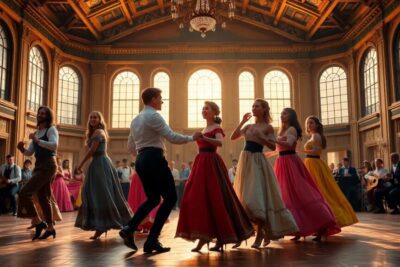
The history of ballroom dancing is the story of how formal European social-dance traditions gradually evolved into a global culture of social, competitive, and performance dance. Across several centuries, court dances, public assemblies, changing musical styles, professional teaching systems, and international competitions all contributed to what is now recognized as ballroom dancing.
This guide traces the documented roots of ballroom in Renaissance Europe, its expansion during the 18th and 19th centuries, the major changes of the early 20th century, the development of competitive systems, and the international dance traditions that shaped modern ballroom.
Table of Contents:
- What Is Ballroom Dancing?
- Origins of Ballroom Dancing
- Where Did Ballroom Dancing Originate?
- Early Modern Period: 15th–16th Centuries
- Ballroom Dancing in the 18th and 19th Century
- Early 20th-Century Developments
- The Emergence of Competitive Ballroom Dancing
- Standard, Latin, Smooth, and Rhythm Ballroom Styles
- Key Styles in Ballroom Dancing and Their Historical Roots
- Ballroom Dancing Around the World
- Cultural and Social Impact of Ballroom Dancing
- Ballroom Dance History Timeline
What Is Ballroom Dancing?
Ballroom dancing refers to a broad family of partner dances performed socially, competitively, and sometimes theatrically. It is not one single dance style. Instead, ballroom includes dances with different histories, rhythms, techniques, and cultural origins that were later organized into formal systems for teaching and competition.
Readers who want a wider overview of how dance forms are classified can explore our guide to types of dance.
Origins of Ballroom Dancing
The origins of ballroom dancing are connected to European court and social-dance traditions documented during the late Middle Ages and Renaissance. In the 15th and 16th centuries, dancing played an important role in aristocratic education, ceremony, entertainment, and social display.
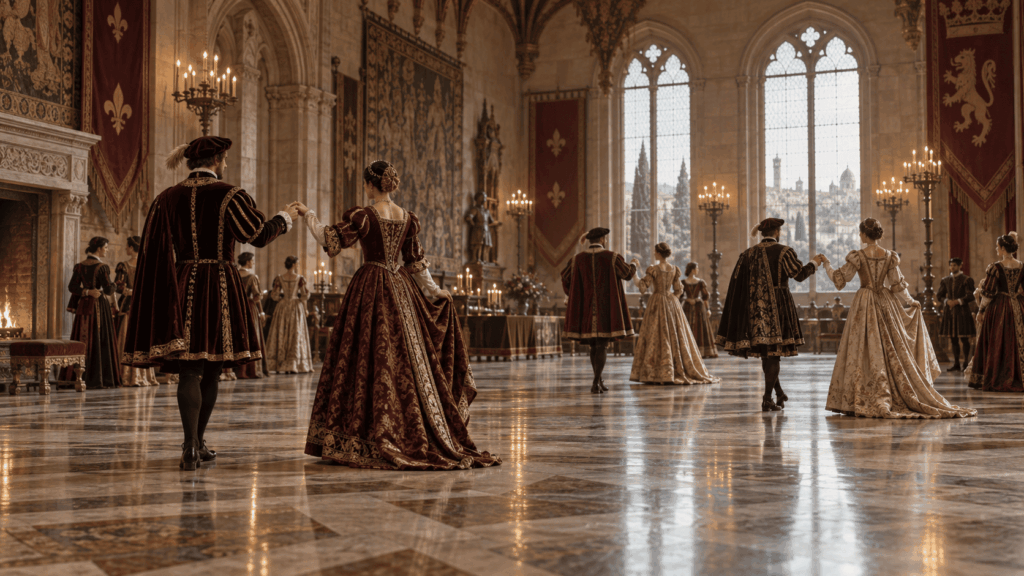
Italian and French dance masters recorded choreography, etiquette, musical structure, and movement practices in manuals that provide some of the clearest surviving evidence of early European social dancing. These traditions were not yet “ballroom dancing” in the modern competitive sense, but they helped establish conventions of formal partner interaction, musicality, posture, and social presentation that influenced later ballroom culture.
Where Did Ballroom Dancing Originate?
Ballroom dancing does not have one single birthplace in the same way that some individual dances do. Its documented historical roots are found primarily in European court and social traditions, with Renaissance Italy and France playing especially important roles in preserving and codifying dance practice.
Ballroom culture later developed through traditions in England, Austria, Germany, France, Italy, and other parts of Europe. During the 19th and 20th centuries, influences from the United States, Latin America, and the Caribbean became equally important to the repertoire now associated with modern ballroom.
Early Modern Period: 15th–16th Centuries
The Earliest Records in Europe
Some of the most important surviving records of European social dancing come from Renaissance dance masters. Domenico da Piacenza, working in 15th-century Italy, was among the early writers to document courtly dance practice, while the later work of Thoinot Arbeau provides detailed evidence of 16th-century French social dancing.
These sources describe a varied dance culture rather than one uniform ballroom style. Processional dances, couple dances, circles, and group formations all appeared within the social life of European courts and communities.
The Renaissance and Court Dancing
During the Renaissance, dance became closely associated with etiquette, education, and aristocratic refinement. Forms such as the pavane and galliard required control, musical awareness, and knowledge of social conventions. Professional dance masters trained members of the nobility, helping turn formal dancing into an important courtly skill.
This environment also intersected with theatrical court traditions that contributed to the later history of ballet, although social ballroom and theatrical ballet ultimately followed different paths.
Early Forms of Structured Partner Dancing
Partner dancing was already present during the Renaissance, but it coexisted with group, line, circle, and processional formations. It would therefore be misleading to describe the period as a simple transition from communal dancing to modern couple dancing.
What developed over time were increasingly formal conventions for coordinating partners, responding to music, observing etiquette, and moving within shared social spaces. Later ballroom traditions built on these practices while introducing new holds, steps, rhythms, and systems of lead and follow.
Ballroom Dancing in the 18th and 19th Century
The 18th and 19th centuries transformed European social dancing. Courtly traditions remained influential, but public assemblies, commercial ballrooms, changing social classes, and new dance fashions brought formal partner dancing to wider audiences.
The Rise of Waltzes, Mazurkas, and Polkas
During the late 18th and 19th centuries, dances such as the waltz, mazurka, and polka became increasingly prominent. Their movement qualities differed from many earlier court dances and helped reshape expectations about how couples could move through a ballroom.
The waltz was especially influential. Developing from Central European turning-dance traditions and becoming closely associated with Vienna, it popularized continuous rotation and close partnered movement. Its development is explored in greater detail in our guide to the history of the waltz.
The Expansion of Public Ballroom Culture
Ballroom increasingly expanded beyond royal and aristocratic settings as public assemblies, subscription balls, commercial dance halls, and other social venues became more common. Middle-class participation grew, and formal dancing became closely linked with courtship, sociability, entertainment, and public display.
Etiquette, Fashion, and Music
Ballroom culture was shaped not only by choreography but also by etiquette, fashion, and music. Invitations, social rules, dress expectations, and appropriate conduct all influenced the experience of attending a ball. Footwear also changed alongside dance practices, a subject explored further in our guide to types of dance shoes.
Music was equally important. Composers and dance orchestras adapted to changing tastes, while figures such as Johann Strauss II helped make the Viennese waltz an internationally recognized symbol of 19th-century ballroom culture.
Early 20th-Century Developments
The early 20th century marked a major turning point in ballroom dance history. Urban dance halls, popular entertainment, recorded music, professional instruction, and transatlantic cultural exchange accelerated the development and international circulation of social dances.
The Tango traveled from the Río de la Plata region of Argentina and Uruguay to Europe and other international centers, where distinctive ballroom versions later developed. At roughly the same time, American social dancing and popular music were becoming increasingly influential.
One of the clearest examples was the Foxtrot, which emerged in the United States during the 1910s. Its smooth walking movement and relationship with popular music helped it become a major ballroom dance, and it was later standardized within both international and American competitive systems.
The Emergence of Competitive Ballroom Dancing
The 20th century also transformed ballroom from a primarily social practice into a structured competitive discipline. Professional organizations increasingly developed teaching methods, technical standards, examinations, competition rules, and judging systems.
The Founding of the ISTD and the Codification of Ballroom
The Imperial Society of Teachers of Dancing (ISTD) was founded in London in 1904. In 1924, it established its Ballroom Branch, which became highly influential in the technical development and standardization of dances such as Waltz, Foxtrot, Tango, and Quickstep.
Through syllabi, teacher training, examinations, and agreed technical principles, organizations such as the ISTD helped make ballroom instruction more consistent and laid important foundations for later competitive systems.
From Social Dance to Competition Floor
As competitions became more organized, dancers were increasingly evaluated on qualities such as timing, posture, footwork, movement, musical interpretation, and presentation. Ballroom developed into an international competitive practice alongside its continuing role as a social activity.
Standard, Latin, Smooth, and Rhythm Ballroom Styles
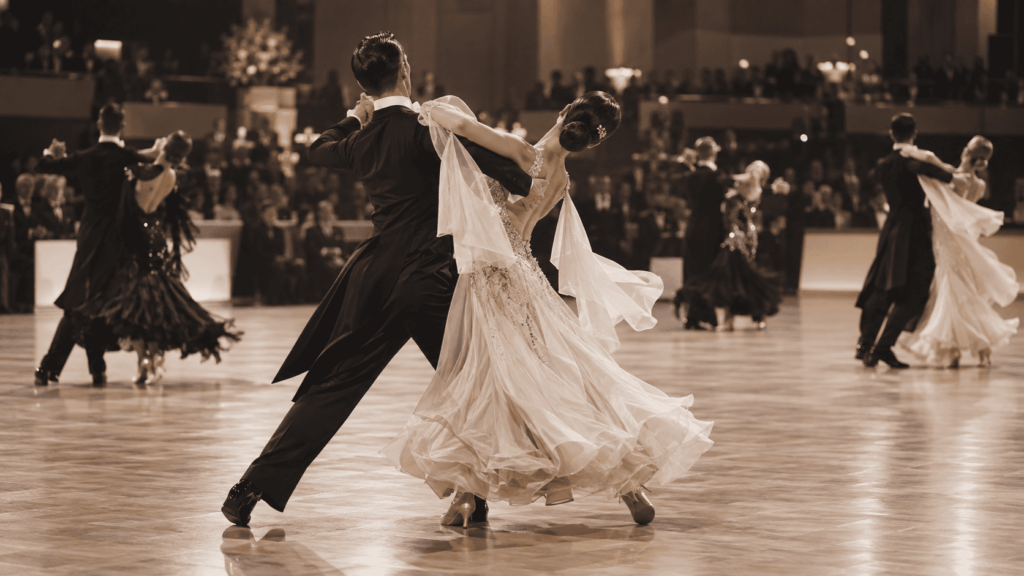
Modern competitive ballroom is organized differently depending on the system being used. International competition distinguishes Standard and Latin, while the American system uses Smooth and Rhythm. These categories overlap in some dances but are not interchangeable.
International Standard
The five International Standard dances are:
- Waltz
- Tango
- Viennese Waltz
- Slow Foxtrot
- Quickstep
International Latin
The five International Latin dances are:
- Samba
- Cha-Cha-Cha
- Rumba
- Paso Doble
- Jive
American Smooth
American Smooth developed within the U.S. ballroom system and allows greater freedom between closed and open positions than International Standard. Its principal competitive dances are Waltz, Tango, Foxtrot, and Viennese Waltz.
American Rhythm
American Rhythm is the corresponding U.S. category for rhythm-oriented ballroom dances. Its principal competitive dances include Cha Cha, Rumba, East Coast Swing, Bolero, and Mambo.
These systems represent different competitive traditions rather than one universal ballroom standard. Dance organizations codify timing, technique, syllabus figures, and judging practices within their respective systems.
Key Styles in Ballroom Dancing and Their Historical Roots
The modern ballroom repertoire brings together dances that originated in very different cultural environments before being adapted for social teaching, performance, or competition.
Waltz
The Waltz took recognizable form in Central Europe during the late 18th century and became especially associated with Austria and Vienna. Its rotating couple movement became one of the defining developments of European ballroom culture.
Tango
The Tango developed in the Río de la Plata region, particularly Buenos Aires and Montevideo, before becoming internationally fashionable in the early 20th century. Ballroom organizations later adapted it into structured competitive forms that differ considerably from Argentine Tango and remain connected with distinctive tango music.
Foxtrot
The Foxtrot emerged in the United States during the 1910s and became one of the defining ballroom dances of the early 20th century. Its rise reflected the growing influence of American popular music and social-dance culture on international ballroom.
Quickstep, Rumba, Cha-Cha-Cha, Samba, Paso Doble, and Jive
Quickstep developed during the 1920s from faster Foxtrot forms together with influences from Charleston and other Jazz Age dances, before being standardized within British ballroom.
Ballroom Rumba should not be confused with traditional Afro-Cuban rumba, which is a distinct Cuban music-and-dance tradition. The ballroom form developed through international adaptations influenced heavily by Cuban son and bolero-son before being codified differently in American and international ballroom systems.
Cha-Cha-Cha developed in Cuba during the early 1950s and was later incorporated into competitive ballroom. Samba has Brazilian roots but was substantially adapted for international ballroom technique and competition. These dances therefore entered ballroom through different historical processes rather than through one shared path.
Paso Doble developed through European theatrical interpretations associated with Spanish bullfighting imagery, while Jive grew from American swing-era dance traditions. Their inclusion illustrates how modern ballroom combined dances and influences from several regions into formal competitive systems.
Ballroom Dancing Around the World
Although ballroom has important European historical roots, modern ballroom is international. Britain became especially influential in technical standardization and competition, while the United States developed Smooth and Rhythm systems alongside strong social and entertainment traditions. International competitions, national federations, studios, and professional training networks later expanded ballroom across Europe, Asia, the Americas, and other regions.
Ballroom has continually adapted to changing social expectations while retaining its emphasis on partnership, musicality, and presentation. In the modern era, television programs such as Strictly Come Dancing and Dancing with the Stars introduced competitive ballroom to large mainstream audiences and renewed public interest in lessons and performance.
Contemporary ballroom communities have also become increasingly diverse, with greater visibility for same-sex partnerships, adaptive dance, and alternative approaches to traditional role conventions.
Ballroom Dance History Timeline
This ballroom dance history timeline summarizes major stages in the development of European social dancing and modern competitive ballroom.
| Year / Period | Event |
|---|---|
| 1400s–1500s | European dance masters document and codify court and social dances during the Renaissance. |
| 1600s–1700s | Formal court dances, including the minuet, become influential in European aristocratic social life. |
| Late 1700s | The waltz takes recognizable form in Central Europe and becomes increasingly associated with Austria and Vienna. |
| 1800s | Waltz, polka, mazurka, and other social dances spread through public and private ballrooms across Europe and beyond. |
| 1910s | Foxtrot develops in the United States while Tango becomes internationally fashionable. |
| 1920s | Competitive ballroom grows, while Quickstep develops from faster Foxtrot forms, Charleston, and other Jazz Age influences. |
| 1924 | The ISTD establishes its Ballroom Branch, contributing to the codification of ballroom technique. |
| 1930s–1950s | Ballroom versions of Rumba, Samba, Mambo, Cha-Cha-Cha, and other Latin American or Caribbean dances enter teaching and competitive systems at different times. |
| 1960s–1980s | Ballroom competition and dance education expand internationally through organizations, studios, and federations. |
| 1990s–Present | DanceSport, international competitions, television, and global teaching networks broaden ballroom's public reach. |
More articles about Dance History
Explore more guides and related content about Dance History.
The history of ballroom dancing spans centuries of social and cultural change. Renaissance court traditions provided important documented foundations, 18th- and 19th-century social dances transformed how couples moved through the ballroom, and 20th-century organizations codified the technical and competitive systems used today. Modern ballroom now combines European, American, Latin American, Caribbean, and other cultural influences within an international social and competitive tradition.



Discover more about the world of dance: