Tango Dance: Meaning, Characteristics, Styles, Steps and Facts
Tango dance is one of the most expressive partner dances in the world. Known for its close embrace, elegant walking, dramatic pauses, intricate footwork, and emotional connection, tango is both a social dance and a cultural art form.
Although many people associate tango with Argentina, passionate music, and dramatic performances, the dance is much deeper than a romantic image. Tango combines movement, music, improvisation, partner communication, history, and personal expression. It can be danced socially in a milonga, performed on stage, studied in a class, or enjoyed as part of a broader cultural tradition.
This guide explains what tango dance is, its meaning, description, characteristics, main styles, basic steps, techniques, clothing, music, and key facts. It also gives a short overview of tango history while linking to deeper guides on related topics.
Table of Contents:
- What Is Tango Dance?
- Tango Dance Meaning and Description
- Characteristics of Tango Dance
- Main Tango Dance Styles and Types
- Argentine Tango vs Ballroom Tango
- Basic Tango Dance Steps and Techniques
- A Brief Tango Dance History and Origin
- Tango Music and Instruments
- Tango Clothing and Shoes
- Famous Tango Dancers and Important Tango Figures
- Tango Influence, Society and Gender
- Facts About Tango
- How to Learn Tango Dance
- Conclusion: Why Tango Dance Still Matters
What Is Tango Dance?
Tango dance is a partner dance based on walking, embrace, rhythm, improvisation, and connection. It is usually danced by two people, with one partner leading and the other following through subtle body signals instead of spoken instructions.
If someone asks what is tango dance, the simplest answer is this: tango is a partner dance where two people move together in response to tango music, using walking steps, turns, pauses, pivots, and close communication through the body.
What is tango dancing in practice? It is not just memorizing steps. Tango dancing is a silent conversation. The leader proposes movement, the follower responds, and both dancers adjust to the music, the space, and each other. This is why tango is often described as a dialogue without words.
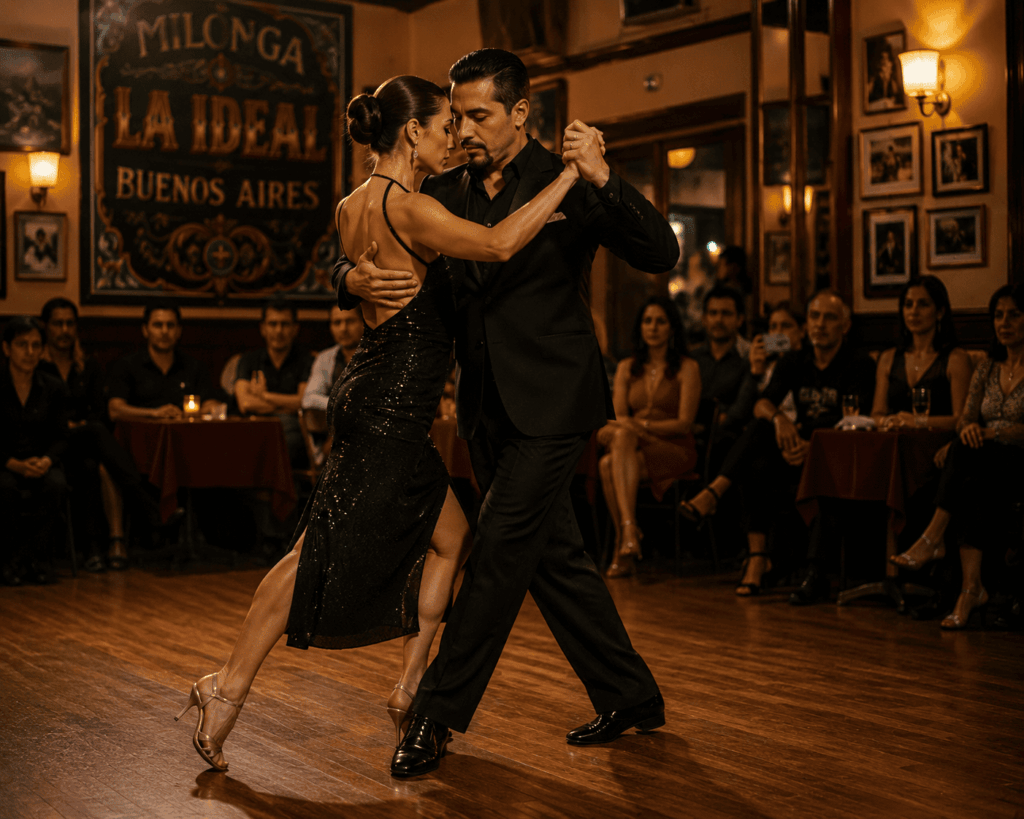
Unlike many choreographed dance forms, social tango is often improvised. Dancers may know common movements, but each dance changes depending on the partner, the music, the floor, and the mood of the moment.
Tango Dance Meaning and Description
The tango dance meaning is closely connected to emotion, connection, elegance, longing, and human communication. Tango can express tenderness, nostalgia, tension, joy, melancholy, or passion, depending on the music and the way the dancers move together.
A clear tango dance description should include its most recognizable elements: a close or flexible embrace, grounded walking, precise footwork, dramatic pauses, turns, pivots, musicality, and strong partner connection.
When people ask what is tango, they may be asking about the dance, the music, or the culture. Tango is all three. It is a dance form, a musical genre, and a cultural tradition with roots in Argentina and Uruguay.
At its core, the tango is about presence. Dancers must listen to the music, feel their partner, respect the space, and respond in the moment. This balance of structure and freedom is what gives tango its emotional depth.
Characteristics of Tango Dance
The characteristics of tango make it easy to recognize. Tango is known for its close partner connection, grounded movement, elegant walking, expressive pauses, improvisation, and musical interpretation.
One of the most important tango characteristics is the embrace. In Argentine tango, the embrace may be close, open, or flexible depending on the style, music, and dancers. The embrace allows partners to communicate through posture, chest connection, arms, and subtle weight changes.
Another defining characteristic is walking. Tango may look complex, but much of the dance is built on the quality of the walk. A skilled dancer can make a simple step feel expressive through timing, balance, intention, and musicality.
Tango also uses stillness. Dancers do not need to move on every beat. A pause can create drama, intimacy, suspense, or emotional emphasis. This use of silence and suspension is one reason tango feels different from many other partner dances.
Other common characteristics include pivots, ochos, turns, ganchos, sacadas, barridas, close body awareness, and improvisation. Together, these elements create a dance that is technical, emotional, and deeply social.
Main Tango Dance Styles and Types
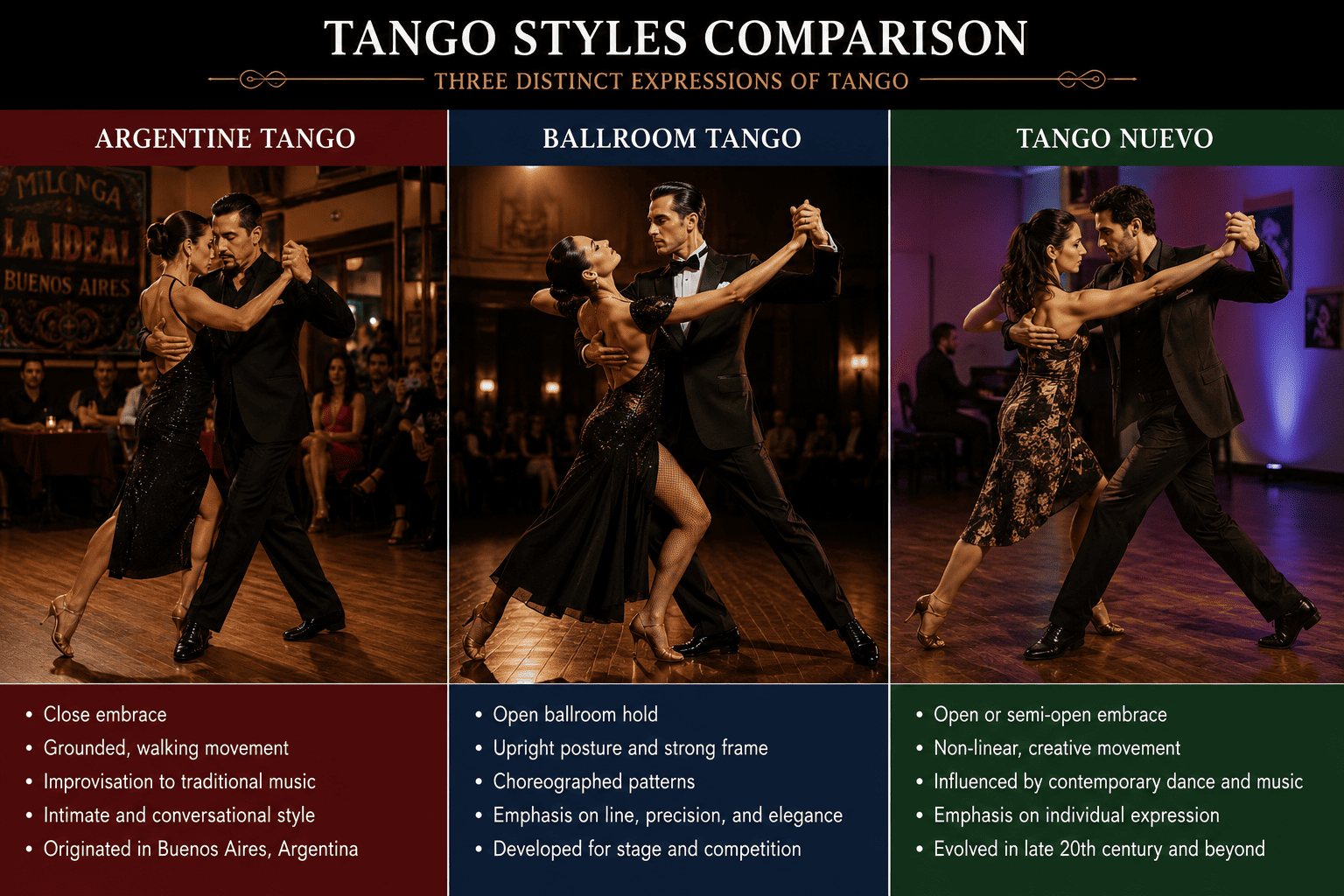
Tango is not one single style. Over time, different tango dance styles developed for social dancing, stage performance, competitions, and regional traditions. The main styles include Argentine tango, tango de salon, tango canyengue, tango nuevo, ballroom tango, and several national variations.
Argentine Tango
Argentine tango is the traditional social form most closely associated with Buenos Aires and Montevideo. It emphasizes improvisation, musicality, connection, and the embrace. Dancers interpret the music in the moment instead of following a fixed routine.
Because Argentine tango has its own philosophy, etiquette, embrace, and social culture, it deserves a deeper explanation. You can explore it further in this complete guide to Argentine Tango.
Tango de Salon
Tango de salon, or salon tango, is designed for social dancing in milongas. It values elegance, smooth walking, respect for the line of dance, and comfortable navigation around the floor. The movements are refined but practical for shared dance spaces.
Tango Canyengue
Tango canyengue is an older tango style associated with the early 20th century. It often has a playful, rhythmic, grounded quality and a compact posture. It reflects an earlier social atmosphere of tango before later stylistic refinements.
Tango Nuevo
Tango nuevo is a modern approach that explores new possibilities in movement, structure, and musical interpretation. It often uses more open embraces, larger movements, and creative combinations while still drawing from traditional tango foundations.
Ballroom Tango
Ballroom tango is a standardized and competitive form. It is danced with a strong frame, sharp head actions, dramatic movement, and choreographed patterns. It differs significantly from Argentine tango in posture, technique, and purpose.
Finnish Tango and Other National Styles
Tango also developed national variations outside Argentina and Uruguay. Finnish tango, for example, became a major cultural form in Finland and often has a more melancholic musical character. Other countries have also adapted tango to local music, dance culture, and social traditions.
Argentine Tango vs Ballroom Tango
Argentine tango and ballroom tango share the word “tango,” but they are very different dance forms. Argentine tango is usually social, improvised, and based on connection. Ballroom tango is more formal, standardized, and performance-oriented.
| Aspect | Argentine Tango | Ballroom Tango |
|---|---|---|
| Purpose | Social dance and improvisation | Performance and competition |
| Embrace | Close, open, or flexible | Structured ballroom frame |
| Movement | Grounded, subtle, improvised | Sharp, dramatic, choreographed |
| Music | Traditional tango orchestras and social dance music | Ballroom tango music with a stronger competitive rhythm |
| Floor use | Designed for shared social dance floors | Often designed for performance or competition space |
| Feeling | Intimate, musical, conversational | Theatrical, precise, visual |
Both forms require skill, but they train different habits. A ballroom tango dancer may need to adapt to Argentine tango’s improvisation and close partner connection, while an Argentine tango dancer may need to adjust to ballroom tango’s fixed frame and choreography.
Basic Tango Dance Steps and Techniques
Tango dance technique begins with posture, balance, walking, and connection. Beginners often expect dramatic moves immediately, but tango starts with the ability to move clearly and comfortably with another person.
The most basic tango movement is the walk. From there, dancers learn weight changes, side steps, forward steps, back steps, pivots, turns, and pauses. These simple elements become expressive when combined with music and partner connection.
Common tango movements include ochos, which are figure-eight pivoting steps; ganchos, which are hook-like leg movements; sacadas, where one dancer appears to displace the other’s step; and giros, which are turns around a partner.
The embrace is also a technique. In tango, leading is not about pushing or pulling. It is about offering clear intention through the body, timing, and weight changes. Following is not passive either; it requires sensitivity, balance, interpretation, and active listening.
Musicality gives every step meaning. A dancer who understands the music can pause, accelerate, soften, or emphasize movements in a way that feels natural. This is what turns tango steps into tango dancing.
A Brief Tango Dance History and Origin
The tango dance origin is usually traced to the late 19th century in the Río de la Plata region, especially Buenos Aires in Argentina and Montevideo in Uruguay. These port cities brought together European immigrants, African cultural traditions, local music, working-class communities, and urban nightlife.
The history of tango dance began in social spaces where people from different backgrounds met, worked, played music, and danced. African rhythms, European melodies, criollo traditions, milonga, habanera, and other influences helped shape early tango.
Early tango was sometimes viewed as scandalous because of its close embrace and sensual movement. Over time, however, it moved from working-class neighborhoods into theaters, salons, and international stages. By the early 20th century, tango had reached Europe, especially Paris, where it became fashionable.
This article only gives a brief overview to avoid repeating the full historical topic. For a deeper timeline, origin story, and global expansion, read the complete guide to the history of tango.
Tango Music and Instruments
Tango dance is inseparable from tango music. The music guides the speed, mood, pauses, and emotional quality of the dance. Traditional tango music often includes bandoneon, violin, piano, double bass, and sometimes vocals.
The bandoneon is especially important because its sound is closely associated with tango. Its expressive tone can feel nostalgic, dramatic, or intense, making it ideal for the emotional character of tango music.
Famous tango music figures include Carlos Gardel, who helped popularize sung tango, and Astor Piazzolla, who transformed tango music through tango nuevo by blending tango with classical and jazz influences.
For dancers, learning the music is as important as learning steps. To explore tango songs, composers, orchestras, Golden Age tango, Tango Nuevo, and Neotango in more depth, visit this guide to Tango Music.
Tango Clothing and Shoes
Tango clothing combines elegance with function. Because tango requires walking, pivoting, turning, and close partner connection, dancers need clothes that allow movement without getting in the way.
Women often wear dresses, skirts, or fitted outfits that allow leg movement. Slits, stretch fabrics, and asymmetrical designs are common because they support movements such as ochos, ganchos, and turns. Men often wear dress shirts, trousers, vests, or elegant but comfortable clothing.
Shoes are especially important. Tango shoes usually have smooth leather or suede soles that allow controlled pivots. Women’s tango shoes often have secure straps and heels, while men’s tango shoes usually have a supportive sole and slight heel.
This section is only a short overview. For a full guide to tango dresses, shoes, fabrics, accessories, and dress code, see this article on Tango Dresses.
Famous Tango Dancers and Important Tango Figures
Tango has been shaped by dancers, musicians, singers, composers, and choreographers. Some figures influenced the dance directly through performance, while others shaped the music and culture that dancers respond to.
Juan Carlos Copes
Juan Carlos Copes was one of the most influential tango dancers and choreographers of the 20th century. He helped bring tango to international stages and showed how the dance could be both theatrical and connected to its social roots.
María Nieves
María Nieves is one of the great icons of tango dance. Known for her expressive style and partnership with Juan Carlos Copes, she helped define stage tango for international audiences.
Mora Godoy
Mora Godoy is a contemporary tango dancer and choreographer known for bringing tango to modern stages. Her work combines tradition, theatricality, and contemporary presentation.
Carlos Gardel
Carlos Gardel was not a tango dancer, but he is one of the most important figures in tango music. His voice and songs helped make tango internationally famous and emotionally recognizable.
Astor Piazzolla
Astor Piazzolla was a composer and bandoneonist who transformed tango music through tango nuevo. His influence changed the way many dancers and listeners understood the expressive possibilities of tango.
Tango Influence, Society and Gender
Tango has always reflected society. It grew from working-class and immigrant communities, later moved into elite salons, and eventually became a symbol of Argentine identity and global culture.
In society, tango has been seen in many ways: scandalous, elegant, romantic, national, artistic, and social. Its close embrace challenged some social norms, while its emotional depth made it a strong form of expression for people navigating urban life, migration, loneliness, and desire.
Gender has also played an important role in tango. Traditional tango often used leader and follower roles associated with men and women, but modern tango communities increasingly explore more flexible roles. Today, many dancers learn both leading and following, and queer tango communities have expanded how tango can express identity, partnership, and connection.
Tango’s influence appears in film, theater, fashion, music, literature, and social dance communities. Its ability to adapt while preserving its emotional core is part of what keeps it alive.
Facts About Tango
These facts about tango help explain why the dance is so important and recognizable:
- Tango dance originated in the Río de la Plata region. Buenos Aires and Montevideo were central to its development.
- Tango is both a dance and a musical genre. The dance and music developed together, but each can also be studied separately.
- Argentine tango and ballroom tango are different. Argentine tango is more improvised and social, while ballroom tango is more structured and competitive.
- The embrace is central to tango. It allows dancers to communicate without words.
- Tango uses improvisation. Social tango is often created in the moment rather than memorized as a fixed routine.
- The bandoneon is a key tango instrument. Its sound is strongly associated with traditional tango music.
- Tango became globally famous in the early 20th century. Paris played an important role in spreading tango to international audiences.
- Tango continues to evolve. Modern dancers explore tango nuevo, stage tango, queer tango, and other contemporary forms.
These tango facts show that tango is not only a dance of passion. It is also a cultural tradition shaped by history, migration, music, social change, and personal expression.
How to Learn Tango Dance
Learning tango dance begins with walking, posture, balance, and connection. Beginners often expect to learn dramatic moves right away, but tango starts with the ability to move clearly and comfortably with another person.
A beginner tango class usually teaches basic walking, weight changes, embrace, leading and following, simple turns, and musical timing. Many classes rotate partners, so students can learn how connection changes from one person to another.
Practicing at home can help, especially with posture, balance, pivots, and listening to tango music. However, tango is a partner dance, so social practice is essential. Attending a milonga, or tango social dance, helps beginners understand floorcraft, etiquette, music structure, and the community side of tango.
The best mindset for learning tango is patience. Tango is not about collecting steps as quickly as possible. It is about developing sensitivity, musicality, balance, and connection over time.
More articles about Dance List
Explore more guides and related content about Dance List.
See more about Dance ListConclusion: Why Tango Dance Still Matters
Tango dance still matters because it brings together movement, music, emotion, technique, and human connection. It began in the social culture of Buenos Aires and Montevideo, but it grew into a global dance practiced by people around the world.
Understanding tango dance means understanding more than steps. It means understanding its meaning, characteristics, styles, music, clothing, social codes, and cultural influence. Tango is intimate, disciplined, improvised, and expressive all at once.
Whether danced in a traditional milonga, performed on stage, studied in a class, or discovered through music, tango continues to invite people into a shared moment. That is why tango remains one of the most powerful and enduring partner dances in the world.
Contra Dance: Definition, History & How It Works
Square Dance: Meaning & History
Ice Dance: Meaning, History, Rules, Moves and Olympic Facts
Salsa Music: Origins, Rhythm, Instruments & History
Ghost Dance: Meaning, History, and Native Legacy
Argentine Tango: Meaning, History, Music, Milonga and Dance Style
Discover more about the world of dance: