Sun Dance Ceremony: Meaning, History and Traditions
The Sun Dance ceremony is one of the most significant sacred ceremonies practiced by several Indigenous peoples of the North American Plains. It is a ceremony of prayer, renewal, sacrifice, healing, community responsibility and spiritual connection.
Although the Sun Dance is sometimes described simply as a “dance,” that word does not fully capture its meaning. For the Native nations that practice it, the Sun Dance is not entertainment or performance. It is a sacred ceremonial tradition connected to deep spiritual teachings, community survival, gratitude, endurance and renewal.
The ceremony has different forms depending on the nation, community and spiritual tradition. It is especially associated with Plains peoples, including Lakota, Dakota, Nakota, Cheyenne, Arapaho, Blackfoot, Plains Cree, Ponca and Kiowa communities, among others. Because each tradition has its own protocols, the Sun Dance should be understood with respect and without assuming that all Native communities practice it in the same way.
Table of Contents:
- What Is the Sun Dance Ceremony?
- Sun Dance Meaning and Spiritual Purpose
- History of the Sun Dance Ceremony
- Tribes and Traditions Connected to the Sun Dance
- Main Elements of the Sun Dance Ceremony
- Symbolism of the Sun Dance
- Sun Dance Ceremony in Canada and the United States
- Suppression, Prohibition and Cultural Resilience
- Contemporary Practices and Cultural Respect
- Photography, Filming and Respectful Boundaries
- FAQ About the Sun Dance Ceremony
What Is the Sun Dance Ceremony?
The Sun Dance ceremony is a sacred Indigenous ceremony practiced by some Native American and First Nations communities, especially among peoples of the Great Plains. It is usually connected with prayer, sacrifice, healing, renewal and the reaffirmation of spiritual relationships.
In many traditions, the ceremony brings the community together for several days. Participants may pray, fast, sing, dance and make offerings for the wellbeing of their families, their people and the world. The Sun Dance is often held during the summer, when the sun is powerful and symbolically connected with life, warmth and renewal.
The Sun Dance is not a single uniform ceremony shared in exactly the same way by every Native nation. Its meaning, structure and protocols vary. Some communities emphasize renewal and thanksgiving. Others connect it with vows, healing, visions, spiritual discipline or the fulfillment of promises made through prayer.
For this reason, the most accurate way to understand the Sun Dance is as a living sacred tradition, not as a historical curiosity. It continues to hold spiritual and cultural importance for communities that maintain it today.
Sun Dance Meaning and Spiritual Purpose
The meaning of the Sun Dance is deeply spiritual. At its center is the idea that human beings are connected to the Creator, the natural world, the community and future generations.
The ceremony is often associated with renewal. Participants may pray for healing, strength, guidance, protection, rain, abundance or the wellbeing of loved ones. In some traditions, dancers make personal sacrifices not for individual attention, but as an offering made on behalf of others.
This is why the Sun Dance is often understood as both personal and communal. A dancer may enter the ceremony with a personal vow or prayer, but the ceremony itself belongs to the larger community. Family members, elders, singers, helpers and supporters all have roles in maintaining the sacred space.
The sun is important because it represents life-giving power. It brings warmth, light and growth. In the ceremony, the relationship with the sun is not merely symbolic; it is part of a broader spiritual worldview in which the natural world is alive with meaning and responsibility.
History of the Sun Dance Ceremony
The history of the Sun Dance ceremony is closely connected to the Indigenous peoples of the Great Plains. Historical accounts describe it as an important annual ceremony for many Plains communities, especially in connection with renewal, prayer and communal gathering.
The ceremony became widely known across the Plains after the 18th and 19th centuries, although different communities preserve their own origin teachings and sacred histories. The Encyclopedia of Oklahoma History and Culture notes that the Sun Dance spread across the Great Plains sometime after 1800 and became a major annual ceremony among several Plains peoples.
For nomadic Plains communities, the Sun Dance was also a time when groups could gather, renew relationships, share responsibilities and reaffirm spiritual beliefs. It was not only a religious event, but also a community-centered moment that reinforced identity, memory and belonging.
European colonization deeply disrupted Indigenous ceremonial life. In both the United States and Canada, government policies attempted to suppress Native spiritual practices, including the Sun Dance. Despite this suppression, many communities preserved their traditions, sometimes in secret and sometimes through adaptation.
Today, the continued practice of the Sun Dance is a sign of cultural survival and spiritual resilience.
Tribes and Traditions Connected to the Sun Dance
The Sun Dance is most often associated with Plains Indigenous peoples, but it should not be treated as identical across all nations. Each community has its own language, teachings, songs, ceremonial leaders and protocols.
Among the Lakota, the Sun Dance is known as Wiwáŋyaŋg Wačípi, often translated as “dance looking at the sun” or “gazing-at-the-sun dance.” The Aktá Lakota Museum identifies it as one of the sacred Lakota rites, connected to prayer, sacrifice and spiritual renewal.
Other Plains peoples, including Cheyenne, Arapaho, Blackfoot, Plains Cree, Ponca and Kiowa communities, also have Sun Dance traditions or related ceremonial practices. However, the names, meanings and details may differ.
This distinction matters because many online articles generalize Native American spirituality as if all tribes share the same beliefs. A stronger and more respectful article should make clear that “Native American Sun Dance ceremony” is a broad phrase, while actual ceremonial knowledge belongs to specific Native nations and communities.
Main Elements of the Sun Dance Ceremony
The elements of the Sun Dance ceremony vary by tradition, but several themes are commonly mentioned in public descriptions: prayer, singing, dancing, fasting, community support, a sacred central space and ceremonial leadership.
A central arbor or lodge is often constructed for the ceremony. In some traditions, a sacred tree or pole stands at the center, representing a connection between the earth, the people, the sky and the spiritual world. The circular form of the ceremonial space can also represent the sacred hoop, the cycles of life and the unity of the community.
Singing and drumming are also central. They are not background music; they carry prayer, rhythm, memory and spiritual power. Dancers move in relation to the songs, the sun, the sacred center and the intentions of the ceremony.
Fasting may be part of the ceremony in some traditions. It is understood as a form of discipline, purification and prayerful focus. Some traditions also include acts of physical sacrifice, but these should not be described in a sensational or voyeuristic way. In Indigenous contexts, sacrifice is not about spectacle; it is connected to devotion, humility, vows and responsibility.
Because the Sun Dance is sacred, not all details are meant for public explanation. A respectful article should explain the general meaning without revealing or dramatizing ceremonial protocols that communities may consider private.
Symbolism of the Sun Dance
The symbolism of the Sun Dance is rich and layered. The ceremony often expresses relationships between the sun, the earth, the people, the Creator, the ancestors and future generations.
The sun represents life, warmth, growth and spiritual power. Without the sun, crops, animals and people cannot survive. Honoring the sun is also a way of recognizing dependence on the natural world.
The sacred tree or central pole, where used, can symbolize the connection between earth and sky. It may stand at the heart of the ceremonial space as a spiritual axis, bringing together the physical and spiritual dimensions of life.
The circle is also important. Many Sun Dance spaces are circular, reflecting cycles of time, seasons, community and renewal. The circle reminds participants that life is relational and that no person exists alone.
The dance itself represents prayer in motion. Movement becomes a form of offering. Instead of separating body and spirit, the ceremony brings them together through endurance, rhythm and intention.
The community is another key symbol. The Sun Dance is not only about the dancers. It includes families, elders, singers, helpers, supporters and those who come to pray. The ceremony reflects the idea that healing and renewal are shared responsibilities.
Sun Dance Ceremony in Canada and the United States
The Sun Dance ceremony has been practiced by Indigenous communities in both the United States and Canada. In Canada, it is associated with several First Nations of the Plains, including Blackfoot, Cree, Saulteaux and others. In the United States, it has been connected with Plains nations such as Lakota, Cheyenne, Arapaho, Kiowa, Ponca and others.
The competition result that includes “Canada” reflects an important SEO opportunity. Many users searching for the Sun Dance want to understand not only the ceremony itself, but also where it has been practiced and how colonial governments responded to it.
In both countries, Indigenous ceremonies were targeted by assimilation policies. These policies attempted to replace Native spiritual practices with Euro-Christian systems and to control Indigenous cultural life. The Sun Dance survived despite these efforts because communities continued to value it as sacred and essential.
Today, some Sun Dance ceremonies continue annually within Native communities. However, they are not public festivals in the ordinary sense. Access depends on the community, the ceremonial leaders and the protocols of that tradition.
Suppression, Prohibition and Cultural Resilience
One of the most important parts of Sun Dance history is the period of suppression. Colonial governments in the United States and Canada attempted to restrict or ban Indigenous ceremonies as part of broader assimilation policies.
These policies were based on the false belief that Native spiritual traditions were obstacles to “civilization.” As a result, ceremonies such as the Sun Dance were misunderstood, criminalized or forced underground.
Despite these pressures, Indigenous communities preserved their ceremonial life. Some continued to practice secretly. Others adapted in order to survive. Elders, families and spiritual leaders played a crucial role in passing down knowledge across generations.
The survival of the Sun Dance is therefore not only a religious story. It is also a story of cultural resistance. The ceremony’s continuation shows the strength of Native communities in protecting identity, spirituality and ancestral responsibility.
For modern readers, this history is essential. The Sun Dance should not be described as an exotic ritual from the past. It is a living tradition shaped by survival, resilience and ongoing Indigenous sovereignty.
Contemporary Practices and Cultural Respect
Contemporary Sun Dance practices vary by community. Some ceremonies remain private and are open only to community members or invited guests. Others may allow certain visitors under strict protocols. In all cases, respect is essential.
A respectful approach means understanding that the Sun Dance is not a performance for outsiders. It is a sacred ceremony. Visitors, researchers, journalists or curious observers should not assume they have the right to attend, record, photograph or describe everything they see.
Modern discussions of the Sun Dance also raise concerns about cultural appropriation. Some Indigenous leaders have criticized non-Native individuals or groups who imitate Native ceremonies without permission, training or cultural responsibility. This is especially sensitive because many Native ceremonies were historically banned, punished or misrepresented.
For that reason, anyone learning about the Sun Dance should prioritize Native voices, tribal sources, cultural centers and educational materials created or approved by Indigenous communities.
Photography, Filming and Respectful Boundaries
Photography and filming are especially sensitive issues in relation to the Sun Dance ceremony. In many communities, cameras, recordings or public sharing may be restricted or forbidden.
This is not simply a matter of privacy. For many Indigenous people, ceremony is sacred, and recording it can disrupt the spiritual integrity of the event. Some teachings hold that sacred moments should be experienced with humility and presence, not captured for public consumption.
The fact that one competitor includes a section on “Filming” shows that this is an important topic for SEO and user intent. Readers may wonder why there are few authentic videos or images of the Sun Dance. The answer is that many communities protect the ceremony from being photographed, commercialized or taken out of context.
A respectful article should make this clear: lack of footage does not mean lack of importance. It often means the ceremony is being protected according to cultural protocol.
More articles about Dance List
Explore more guides and related content about Dance List.
See more about Dance ListFAQ About the Sun Dance Ceremony
What is the Sun Dance ceremony?
The Sun Dance ceremony is a sacred ceremony practiced by some Indigenous peoples of the North American Plains. It is connected with prayer, renewal, sacrifice, healing and community responsibility.
What does the Sun Dance mean?
The Sun Dance often represents renewal, gratitude, spiritual sacrifice and connection with the Creator, the sun, the earth and the community. Its meaning varies by nation and tradition.
Is the Sun Dance a Native American ceremony?
Yes, the Sun Dance is associated with several Native American and First Nations peoples, especially Plains communities. However, it is not practiced in the same way by all Indigenous nations.
Who practices the Sun Dance ceremony?
The Sun Dance has been practiced by various Plains Indigenous peoples, including Lakota, Dakota, Nakota, Cheyenne, Arapaho, Blackfoot, Plains Cree, Ponca and Kiowa communities, among others. Traditions vary by nation.
What is the Lakota Sun Dance called?
In Lakota, the Sun Dance is often called Wiwáŋyaŋg Wačípi, commonly translated as “dance looking at the sun” or “gazing-at-the-sun dance.”
Why is the Sun Dance sacred?
The Sun Dance is sacred because it involves prayer, vows, spiritual discipline, community healing and relationships with the Creator and the natural world. It is not a performance or entertainment.
Was the Sun Dance banned?
Yes. During periods of colonial assimilation, Indigenous ceremonies such as the Sun Dance were restricted or suppressed in the United States and Canada. Many communities preserved the ceremony despite these policies.
Is the Sun Dance still practiced today?
Yes. The Sun Dance continues to be practiced in some Native communities today, according to their own traditions and protocols.
Can outsiders attend a Sun Dance ceremony?
That depends entirely on the community and ceremonial leaders. Some ceremonies are private, while others may allow invited guests. Visitors should never assume they can attend, photograph or record.
Why are there few videos of the Sun Dance ceremony?
Many communities restrict photography and filming because the ceremony is sacred. The absence of public footage often reflects cultural respect and protection, not lack of practice.
Is the Sun Dance the same in every tribe?
No. The Sun Dance varies across Native nations and communities. Each tradition has its own teachings, songs, protocols and ceremonial meanings.
Contra Dance: Definition, History & How It Works
Square Dance: Meaning & History
Ice Dance: Meaning, History, Rules, Moves and Olympic Facts
Salsa Music: Origins, Rhythm, Instruments & History
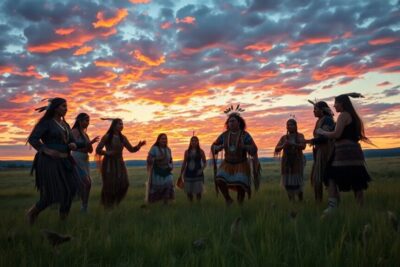
Ghost Dance: Meaning, History, and Native Legacy
Argentine Tango: Meaning, History, Music, Milonga and Dance Style
Discover more about the world of dance: